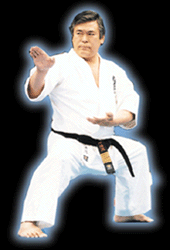
Shihan Seiji Isobe:
COMMITTED TO
POWER,
CHAMPIONS &
TRADITIONS
Blitz: Please tell us about your history in Karate
SI: I originally started training in Shotokan, this was in the early 1960's. I was
very happy at first but started having doubts about the practicality of the style. I
wanted to complete what I had started so I vowed to stay until I earned my Shodan. In the
old days there was no colored belt system, it went white, brown and black. They didn't
have a grading system, it would just be decided whether you should be a brown belt or
black belt. One day our instructor trained with Kyokushin karatekas and he returned with
his face looking like it had been put through a mincer (in those days Kyokushin still had
face punches). This increased our doubts in the style but one incident really sticks in my
mind. In Japan we would go cherry blossom viewing and it was so nice there that the
instructor started to do a kata. The crowd thought he was being a show off and turned on
our instructor - "Hey, look at this guy," and then they all bashed him. We were
brown belts and he was the Shihandai, he said that the Karate didn't work and we then
began to have doubts as well.
I was waiting for the day when he would say you're a black belt. One day the instructor
said, "you're good enough to put on a black belt" I then left straight away.
Blitz: How did you continue training?
SI: I continued my own training for several months together with a friend of mine.
By this time there was a large group of 50 that had formed looking for a true Budo karate.
As a group we decided to contact Mas Oyama and we wrote him a letter expressing our
interest.
Blitz - What was his response?
SI: We got a reply back from our letter to Sosai to send an instructor, but we
would need to pay for his travel, food and accommodation for about 10 days. The
accommodation was very expensive back in 1967. So we decided that a few of us could go to
the Honbu for the same price of having an instructor come to us. I am quite sure that 1967
was the year as Sosai wanted to go to Hokado to fight the bear.
Three of us went to Tokyo, Takehashi, another man and myself, we went to the Tokyo Honbu
and met Sosai. We were only there for three days and we wanted the chance to train, but
instead we just watched for three days and then returned home. When we went home we tried
to recall what we had watched for these days and train in the same way.
Blitz - When did you eventually get to train at Honbu?
SI: In 1968 we went again to Tokyo and eventually we established our branch. We
made an arrangement to open a Kyokushin branch and this was the first time we were able to
train at Honbu. While training I broke my finger really badly, I had a compound fracture.
We didn't have low kicks in Shotokan. When I blocked the next kick I had to close my fist
again, but my finger was sticking out and I couldn't watch to see that my finger was o.k,
when I opened my fist and looked at the finger instead of sticking out it was bent in
another direction. I could now see the sinew and bone so I grabbed the finger and put it
back in myself. They put the bone back in and stitched it up at the hospital across the
road from Honbu. I immediately returned to training. We put a splint on it and wrapped it
up and that is how I trained for the next three days at Honbu. I traveled back and forth
from Fukui to Tokyo many times that year.
Blitz: I believe that you were also Sosai's driver?
SI: I fought in the 1st, 2nd and 3rd All Japan Tournaments. I was an Uchi Deshi at
Honbu for 3 months when I fought in the 2nd All Japan in 1970. The guy who used to do the
driving there shot through during the middle of the night. While we were training one
morning, Sosai said " has anyone here got a drivers license?" and three of us
put our hands up, Kanemaru, someone else and me. He asked Kanemaru what license he had and
Kanemaru answered that he could drive a dump truck, he asked the second guy and he replied
that he had a license but had never driven before. So then he asked me and I answered that
I had driven a lot but only in the country, I wasn't sure about driving in Tokyo. He said
"no problem, done!"
It was a German car, left hand drive and I was driving around in Tokyo. The first time I
drove I had to go around this sharp left hand corner and everyone used to do a 3-point
turn because the road was so narrow. I luckily and scooted around in one shot and Sosai
said,
"Hey you're a really good driver, you can do my driving for me."
Blitz: It's a long way from driving Sosai to teaching in Brazil !
SI: I was his driver for a year and eight months, I had planned on getting my 2nd
Dan and going back to Fukui. Sosai said to Shihan Secorda, that instead of going back to
Fukui he would like me to go overseas. He sent one instructor to New York and one to
Taiwan
For 6 months, I was supposed to exchange with this instructor and go to Taiwan, this did
not end up eventuating.
I was then meant to go to Australia but just as I was preparing to leave my plans were
changed once more and I was sent to Brazil. Sosai called me and said " have you ever
heard of Brazil?" I hardly knew anything about the place except that it was in the
Southern Hemisphere, I had heard of Rio and Sao Paolo. Sosai said you will go to Brazil
for one year to teach and I said OSU as this was all I could say. That was 30 years ago
and I am still there. Brazil is now my home.
Blitz: When you arrived in Sao Paolo, how many Kyokushin students were there?
SI: There were already 100 students training.
Blitz: And now you have 100 branchs??
SI: Now we have branches in 6 countries. There are over 100 branches and 5000
students under my control in South America.
Blitz: Whilst in Brazil you developed not only the organisation but also a style of
Kyokushin basics that is now referred to as "Brazilian Kyokushin". Please tell
us how this developed.
SI: Most people in Japan know about Karate-do and they have this way of thinking
that it is different. You tell them they have to do it a million times over and over, just
keep going through the basics, if there are 20 people in the class you go through every
movement 20 times, over and over. With Japanese students you can get away with doing this
because Japanese don't question the importance of it, they understand that it has to be
done. So you don't worry in Japan about having to do something different and new.
You've got the white, blue, yellow, green, brown and black belts all doing the same thing
and they are not learning anything new. There is no need to grade if everyone is doing the
same thing. When I was first in Japan training, I started to think of things that
different colour belts would do to grade. I then put different combinations together to
form what you have now called "Brazilian Kyokushin". It is only basics that are
combined differently to what you are traditionally used to.
Blitz: How did you help Kyokushin to grow in Brazil?
SI: In Brazil all the many styles had instructors there, as Brazil has the largest
population of Japanese outside Japan. No one had ever heard of Kyokushin, so that is why I
went. When I first arrived I used to smash rocks and ice with my bare hands. When other
styles students watched me they would go to their instructors and say " we saw this
guy and he can smash rocks and ice with his bare hands." The instructors of these
students would say not to believe what they saw as they believed I had smashed the rocks
with a hammer and then glued it together, and that the ice crushing was an old trick from
Japan to allow the ice to melt a bit before smashing it. I was then asked to break some
ice on 60 minutes that was shown as a live television show in South America. I wanted to
do a big break so asked them to prepare 7 blocks of ice that I would smash with one shuto.
One the way to the studio I was informed that three of the blocks had broken so I declared
that I would smash them with my head. When I arrived at the studio I was shocked to see
that the blocks were twice the usual size. Still I would not go back on my word and
decided that either my neck or the ice would break. With cameras rolling I leaped forward
and broke the ice. My ears were ringing and I was dizzy but the ice was smashed. I was
pleased but when Sosai saw the tape he told me never to do that again. I was glad.
Blitz: I am sure a lot of people would like to hear about Francesco Fihlo and his
training.
SI: Leading up to his 100 man kumite, everyone heard stories about Filho's 50 man
kumite that he did each week for six months as preperation for the 100 man kumite. A lot
of media came to Brazil from Japan and wanted to know how I train strong champions. The
one thing that Brazilians have that the Japanese don't is power. They are not technically
as good as the Japanese, technique is only partially physical the rest is spiritual. No
one has fighting spirit like the Japanese, so they really need to work on their power.
When Filho was 20 he knocked out Andy Hug in the world tournament. Filho also has that
fighting spirit which is usually only reserved for the Japanese, he was 92Kgs, 190cm tall.
In Judo they say if you do not have a big bum you can't project the power that is needed.
Filho had a big bum and I knew he had the potential for power, so we worked on tube
training (special rubber restraints to develop power and strength), and a big sandbag. The
bag weighed 80Kgs and when Filho hit it, it looked like a toy so we had to get him a 120Kg
bag and that's how he developed his power.
Prior to the next world tournament that came up, the Japanese All Japan Champion, Tamura
came to Brazil but he could hardly touch the bag, it was then that I realized that the
training I was doing with the students was working well. We had the mini world tournament
and 14 nations came to fight, Filho won and again I realized that our training was working
really well and I hoped he would be able to win the 1995 World Championship.
Blitz: But you must have been excited when Filho won his first K1 fight.
SI: It was a very serious time for me. I asked Kancho Matsui to allow Filho to
participate in the K1 as I thought that he would do Kyokushin proud. I was shocked when I
found out that Andy Hug was to be his first opponent. With so much experience in the ring
I was not so sure that Chico (Filho's nickname) could defeat him in his first K1 event. I
was so nervous before the fight and felt so accountable that if Filho lost I would leave
Kyokushin forever out of shame for my student losing. This was Kyokushins first entrant
into the K1 and as it was my suggestion only I could be accountable. I was so excited when
Filho won as this was a victory for Kyokushin. I remember being in the corner and having
to keep looking left and right of the corner post to keep up with the movements inside the
ring. One time I moved right and only saw Chico standing and wondered where did Andy go???
He was on the floor unconscious - and I could now remain in Kyokushin and be proud that me
student had done well.
Blitz: A new direction for Kyokushin has begun here in Melbourne with the One Match
Challenge, will this type of competition become a bigger part of Kyokushin?
SI: The "One Match" competition is important, as often there is a long
time between big tournaments and these new type of events give fighters the chance to
become stronger. The One Match tournament allows fighters the opportunity to fight someone
they want to fight in advance of the larger tournaments, as not everyone will necessarily
be selected to fight in the large tournaments. I believe that as time goes by the
One-Match tournaments will become more and more popular.
Blitz: In your opinion is there a secret to Karate?
SI: There is no secret in Karate, you just need to train and train and train and
disregard your self. Some people train hard with the incentive being to make money and or
develop a reputation. These types of people want everything, nice clothes, nice
belongings, houses and cars and this is when life becomes complicated and difficult. You
have to keep sight of what Karate is about.
When I left Sosai at the Haneda (old International airport in Japan) his parting words to
me were, " I want you to go with the attitude that you are dying, because if you live
this way you will understand the meaning of OSU."
Blitz: Thank you Shihan Isobe for sharing all of this with us and we will look forward
to seeing you back in Australia.
Subscribe to
Blitz Martial Arts Magazine
NOW!

This page is from BLITZ Martial Arts Magazine, visit there site. |