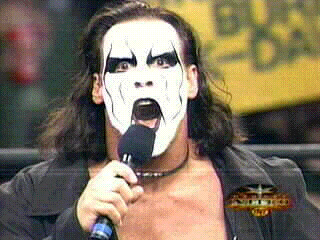
A: Uh, yeah, yeah. Been there, done that. Been there, done that. And, maybe some people believe because it worked so good before, maybe it'll work again. But uh (laughing), I'm out there doing it. I can feel-- I can feel it.
Q: Have you ever wanted to book the company?
A: No, I would never want that pressure, but I wouldn't mind being a part of a group of people, a committee or whatever you want to call it. I wouldn't mind that.
Q: Have you ever watched ECW?
A: No, I don't think I've ever seem 'em one time.
Q: So, do you know anything about their product?
A: Not a lot. I mean I think that they're pretty much hardcore blood and guts, and guys that are going there and killing themselves every night.
Q: After what happened at Columbine (High School), did you hear anything about the trenchcoats (you wear to the ring). Did WCW decide not to have you do that for a while, at least?
A: No, I decided not to do it. I did not want to do it any more because of that. So, I asked Eric Bischoff and he agreed. (He said) "I think we can hold off on that." Then again, I had other people give me some really good, sound advice, too. It's
like, you know, the group KISS. They paint their faces, and they did in the 70s, and here they are doing it again. They're more popular than ever. But people identify with them. KISS is KISS. If the guys at Columbine painted their faces like the guys from KISS, KISS wouldn't stop painting their faces like that. I mean,
KISS is KISS to me. And Sting is Sting. Sting had the trenchcoat, and Sting had the painted face and all that, so I think people know who I am. But, then again, you always have to think about the other side and the people that might be offended by it, and say "what kind of message are you sending?" So, that's where
I am.
Q: I know you do a lot of charity work. I heard a story about a girl in New Port Richey (Fla) with lupus that you called and sent some things not too long ago. How difficult is it to do things like that knowing that she didn't have a whole lot of
time left?
A: It's a real heartbreaker situation, but I'm so thankful that, first of all, I have the opportunity. I'm completely honored that somebody would want to talk to me like that. And then, I'm thankful that I'm able to be me and be upbeat and be positive
and just be straight up about things and not beat around the bush and be sad. So, I'm thankful that I had the opportunity to put a smile on this little girl's face. I've had this opportunity so many times over so many years now. I've done this many, many times. She was very special, though. I never did get to see her face. They say they're going to send me pictures, and I really do want to see her. But, I did it on a Thursday. The following Monday, I was going to say "hello" to her on TV if I had the opportunity. And, you know, many times you don't, and she died
that morning. But the contact person from Fulfill A Wish Foundation had put a text message on a pager of one of the people in our PR department, and she showed me the message, that she died with a smile on her face. So, it makes it all so worth it. I've never said "no" to one of those, nor will I ever. And there was no way for me to get all the way out to Florida (from home in California), so we were lucky enough to set the whole thing up via satellite through CNN, and it worked.
Q: Is that one of the more rewarding aspects of your profession?
A: You bet. No question about it.
Q: When you first started, you were in PowerTeam USA. It was you, Jim Hellwig, (Mark) Miller and someone else. Who was that? And do you keep up with those guys?
A: The other guy's name was Garland Donohoe. I haven't talked to 'em for years. I hear Mark Miller's name come up occasionally, and I think he had tried over the years somehow or another to get involved (in wrestling). But Garland, I don't think he ever did anything. I don't know what ever happened with Garland.
Q: Do you still speak to Jim Hellwig on occasion? I know he was in with you guys last year for a little bit.
A: Yeah, we can go two, three years at a clip without ever talking to each other. Usually, when we do (talk), it's either bumping into each other or, for example, he had tried to come in one time a few years ago and contacted me, asked me a lot of questions. And then, this last time around, it was pretty much the same thing?
Q: I read somewhere you played a little college basketball?
A: Yeah, it was just a junior college in California - the College of the Canyons.
Q: Did you play other sports in high school?
A: No, I only played basketball. I should have played football. That's what I was best at.
Q: Do you still play basketball now?
A: (laughs) Ahh, yeah. We had a little three-on-three up in Baltimore two or three weeks ago. In college I was a 6-foot-2 power forward. I had pretty good jumping ability for a white man.
Q: Could you dunk?
A: Ahh, yeah, I can dunk.
Q: Your athleticism and energy have always been some of the strongest parts of your ring presence and work. Did you know early on that you were different than some of the other guys?
A: I remember when I went through wrestling camp here in southern California. Early on, I did this move and Red Bastien, who was instructing, said "do that again." So, I did. He told me I had a lot of natural ability and great moves. He said I could go a long way with that. And I kind of had to have that. I broke in with
Hellwig and he was 285 pounds and as big as a bus. I was 255 and looked like a little guy next to him. So, I had to rely on my athleticism.
Q: Have you ever taken steroids?
A: Yes, I have in the past. In the mid-to-late 80s, I was in competitive bodybuilding. I did it on and off in minimal amounts my first two years in wrestling.
Q: Why did you stop?
A: I saw the long-term effects they were having on friends of mine during bodybuilding, and watched their bodies get completely wrecked. There were lots of health issues, specifically thyroid problems. It got to the point where it was complete insanity, and I didn't see it being worth it. Also, after I quit, I couldn't
stand it when I would go to Japan, still very big, and reporters would asked me if I used steroids. At the time, the answer from me was "no" because I didn't. Still, they would notice how big I was, and I kind of got the feeling they questioned how honest I was being. I didn't want health problems, and I didn't want to have to answer those types of questions all the time, so that's what made me stay away.
Q: Does wrestling have a steroid problem?
A: I don't know. You tell me. We get randomly tested a couple of times a year, and it has been that way for five years. I was just tested last week, in fact. I think WCW does what it can to combat use.
Q: What is your workout schedule like?
A: I'm in the gym four days-a-week and do cardio work three or four days, as well. I got really out of shape a few years ago, and that wasn't a good thing.
Q: I want to play a little name association. I'll give a name, and you tell me your first thought.
A: OK.
Q: Hollywood Hogan
A: Made wrestling a household name.
Q: Steve Austin
A: Great guy who had all the technical ability in the world and has found his niche.
Q: Goldberg
A: Phenomenon.
Q: Lex Luger
A: Greatest physique in wrestling.
Q: Eric Bischoff
A: New, young innovative wrestling mind and businessman.
Q: Vince McMahon
A: Sold his soul.
Q: Rick Rude
A: One of the best at being hated. He did the heel's job to perfection.
Q: I know accidents happen in the ring, but I also heard he never really forgave you for his neck being injured in a match against you. Is that true?
A: No, it's not. When he came back to WCW (from the WWF), he walked right up to me and shook my hand. We were friends until the day he died.
Q: Mick Foley
A: Cactus-- He deserves to be where he is. He has a very talented wrestling mind, and he's a very hard worker. He's also a really funny guy.
Q: Sting with blonde spiked hair
A: Had an uncanny ability to hold the interest of fans.
Q: Will we ever see him again?
A: Never say never.
Q: The current Sting
A: The most fun I've ever had with a character is this Sting. (long pause) That's tough. I really don't know what else to say. That's real tough.
Q: How much time do you have left on your contract?
A: Two-and-a-half years.
Q: How much longer do you anticipate wrestling?
A: At this point, I can't see myself doing it longer than the terms of my current contract. Other names like Hogan, Savage, Piper, Flair, those guys have been able to stick around for a long time and continue to be impact players. I just don't
know if I have it in me to go that long, though. We'll see, but right now, I'd say I'll be done with active wrestling in two-and-a-half years.
Q: Some say that some of the older guys may have stuck around too long. Do you ever worry there might be a point where people say that about Sting?
A: I don't want to get in that situation, but I'm sure there are some people that say that already. I hope not, but I'm sure they do. There's too much time spent driving down the road for people in the business not to talk about things like that. I guess, in a way, it's human nature to observe and critique people. You'd like to please everybody all the time. Unfortunately, you just can't.
Q: I understand you are a born again Christian. How has that changed your life?
A: I think I set a better example now. I still make mistakes. For example, I did something pretty stupid on Nitro a few weeks back. I thought the cameras were off and I said that "I've got two words for ya--" thing. I was thoroughly embarrassed, and I shouldn't be saying stuff like that. First off, it's kind of a
ridiculous thing to say anyway, and second, it is something from the other guys, and not us. So, I still make mistakes like that.
But I set a better example for my kids now. Some persecute religion, and some are anti-Jesus Christ, but I'm a lot more at peace with myself now. I was so wide-open with my life before. I'm a better father and a much better husband now. It makes wrestling more of a challenge because I won't do certain things I used to do. For example, if I was wrestling Flair and he knocked me down and then gyrated above me, I would have to gyrate in front of him after I got him down a few minutes later. Now, I've found myself and my spirituality, and I won't compromise that. I know some people will want to see that other stuff, but I hope some people will appreciate what I'll do now. It would be nice if we could all think about doing what's right. And the same goes in wrestling. Let's make lots of parity. Let's be creative with our storylines and characters and rise above the crap that is so much a part of wrestling nowadays.
Q: That's about all of the questions I have. Thank you so much for all of your time and openness.
A: No problem. (Laughs) Man, am I gonna get a lot of heat for this interview.
Q: I really do appreciate your candor. Good luck with everything.
A: Thank you. Take care.