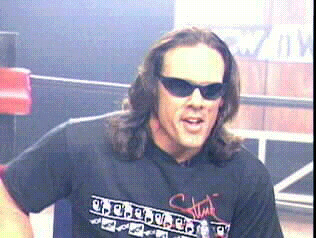
Q: Could you talk a little bit about your biggest career highlights?
A: Without any doubt, one of them would have to be the very first time I won the world title from Ric Flair in "The Great American Bash", 1990. That was after they reconstructed my knee. I had hurt it in February of that year at a "Clash of Champions" - it was Corpus Christi, Texas. And I came back five months later to
wrestle Flair for the world title in Baltimore at "The Great American Bash" and won. That was a great thing.
Q: That was your patella you tore, right?
A: Right, patella tendon.
Q: How many times have you won the world title since then?
A: I think it's around the eight number. There was one...
Q: I know there was the hour-and-a-half one recently.
A: (Laughs) Yeah, the hour-and-a-half one. There was also one in Germany that not many people here know about.
Q: When you were out the year or 15 months, and then came back for the match with (Hollywood) Hogan, how does that rate on your career highlight list?
A: Well yeah, to continue on that, it's beyond, I mean definitely that would be up there probably at the highest. That was big because I think the anticipation with all the fans, and even with -- I think -- a lot of the wrestlers, it was sky-high. And
so, that was huge. And everything that built up to it, the storyline that built up to it was fantastic.
Q: At all during your career when your contract has wound down, have you ever considered leaving WCW?
A: Yeah, I've talked to (World Wrestling Federation owner) Vince (McMahon). I've talked to him before, and even recently, I talked to him just before I signed this last one. I was going to meet with him, but I have a -- on a handshake -- I'm a handshake kind of guy, and on a handshake, I was going to stay here because I
shook hands with (WCW President) Eric (Bischoff). We made a deal verbally, and so I'm an honest guy (laugh). But, the other thing is, (the WWF has) turned into an adult-entertainment channel with a little bit of wrestling sprinkled in. And I just didn't want to go up there. I didn't want to do that. I've got two kids, and I would never let them watch one second of that program.
Q: If you had left, would you have been able to take the "Sting" name and likeness with you?
A: I own it.
Q: Oh, you do own it? OK.
A: It's a registered trademark that I registered in my name. I actually own name Sting. The rock singer does not own it.
Q: That's interesting.
A: Yeah, a lot of people don't know that, but it's the truth. And, yeah I could have gone up there as Sting.
Q: Are there things about the WWF that you do like?
A: I like that there is another place for some of the guys to go. I would never want to see one wrestling organization only. You know, we're not union. We're independent contractors, supposedly (laugh). So yeah, if one promoter had the monopoly on everybody, and not being union at the same time, that'd be a double-negative. It wouldn't work. It wouldn't be beneficial for any of us.
Q: Bret Hart and Jesse Ventura have talked lately about the need to unionize wrestling. Do you agree with that?
A: (pause) You know, to be honest, yes I do. I do agree with that. I mean, it's hard for us to go out and get insurance -- life insurance, medical insurance. It's tough. And even trying to buy a home. A couple of homes that I've bought in the past, I had to put down "independent contractor." They wanted to know how much money I made. I put down my salary, and (they said) "no, I'm sorry, you're an independent contractor. You're too much of a risk." (I said) "Now, wait a second now, I'm on salary. I'm guaranteed a certain amount of money every single year for the next two, three years or whatever the contract is." And I had to get special documents written up from the legal department up there at WCW -- in order to buy my house -- which would satisfy the bank. (They say) "OK, you call him an `independent contractor', but he's guaranteed X-amount of dollars. So, all right we'll go ahead and do this."
Q: Would there be other reasons that a union would be necessary? What I'm leading into is, like with what happened with Owen (Hart). That's what sparked Bret to talk about a union being necessary. And you've been put in the rafter in that kind of situation. Is that something --
A: No. I was put in there, but it was my decision to do that. I was always given the option, "Look, if you don't feel comfortable doing this, don't do it." So, I can't say that it wasn't scary. It's scary every single time I do it, and it's a risk every
time I do it. But every time you step into the ring, it's a risk.
Q: When you heard about Owen and how he died, how did you feel?
A: Very, very sympathetic toward Owen and the whole family, of course, because I know what it's like to be up there when you have 10-to-20,000 fans screaming at a fevered pitch. Music, lasers, lights, and you need to go down on your cue and all. Man, there's a lot of chaos all at one time, and you can't even hear yourself think sometimes. So, it can be pretty rough.
Q: Where were you when you heard about it?
A: I was flying, err -- on my way to LAX and I was flying to, I forget where. We were doing a pay-per-view or a Monday Nitro. Oh, it was a Monday Nitro. That's what it was, and I was scheduled to come out of the ceiling. And I knew -- I saw the guys that set me up to do that. They were on my flight. And, I had just -- somebody called me. My wife called me and told me. She said, "Somebody died, and I think it was Owen Hart. And you're not gonna believe this, but he died coming out of the ceiling on a cable." (I said) "You've got to be kidding me." So, what ended up happening is I ended up landing wherever it was we were doing the show (Greenville, SC), and it was confirmed. I had it confirmed definitely Owen had died. And I saw the guys that do my set-up and I said, "Guys, you won't be setting up anything for me tonight. I will not be doing that. (There are) two different reasons: No. 1: it would be completely disrespectful. No. 2: I was too shaken to do something like that.
Q: I can understand that. Did you speak to Bret on Monday (when Hart addressed the crowd at Nitro for the first time since the accident)?
A: Yes, I did.
Q: How was he doing?
A: He is not doing very good. I think that it may have helped him to get encouragement and acknowledgement over it from some of the guys, some of his friends. And to know he's had a lot of support, which he had mentioned, from fans all over the world, and to be there with a group of guys that, first of all, had total
respect for Owen, knew he was a great guy, knew he was a family guy, and of all people, why -- why Owen? And just there to support Bret. I think that probably helped him. But, of course, he's saddened heavily by it. I hope he can move on some time. Sometimes, people are affected by these things for the rest of their lives, and I hope that he can get some sort of closure or satisfaction in whatever way he feels he needs it.
Q: Did you know Owen?
A: Yeah, I knew him, but I never had a chance to really work in the same wrestling organization with him. I think he was here at WCW for a brief period in the early 90s, maybe?
Q: Yeah, he was going to be put with either (Chris) Benoit or (Brian) Pillman, I believe. I think they were going to be called "Wings".
A: Yeah, something like that. And so, I really never got to know him, but I've heard so many stories about him. You know, Owen had a great personality, and he loved to rib. He was a great ribber, and ribbing is a big thing in wrestling (laughs). And Owen was one of the best. So, anyway, I can't think of one person
that did not like Owen Hart. I never heard a bad thing said about him.
Q: Do you imagine you could be called to testify when this goes to trial?
A: Yeah, I mean, the words that you have coming out of my mouth right now are the first words that I've said to anybody publicly about this. So, and yeah, I know that I could come testify about it. I absolutely do not want to do it, but I know what it's like to be deposed against your will and testify. And it's no fun.
Q: Do you imagine ever coming out of the rafters again?
A: Never say never. Never say never. People are going to do that in different professions, and it's just what the entertainment business is a lot of times. These special maneuvers, and all the bells and whistles that go with it, and yeah, there is a chance that this could happen again.
Q: How big a loss will Chris Jericho be for WCW? What kind of potential do you think he's got?
A: I think that Chris Jericho has a lot of potential. I mean, he can be a big star up there, and I do consider it a loss. I don't know who's at fault. I couldn't point my finger at Chris or whoever he did his negotiating with. I can't point a finger at
anybody because I don't know if Chris was being unrealistic or if our company was being unrealistic, but I do know that I believe it'll be a loss because we've got to start -- I almost feel like we're almost a dying breed in some ways. I mean, some of the younger guys need to be developed, and we need to start creating
new big names - not just stars. I'm talking about superstars. Bill Goldberg: I can't tell you how many years that I did this and I thought, `when is somebody gonna come along and just have great, great impact?' And, you know all the years I've been here at WCW -- it's been 10 years or more, 12 years, whatever it's been -- and nobody really ever came along. And a lot of guys came and they tried to come up with these great gimmicks, and they even got pushed by the promoters, and it never worked. And then Goldberg came along, and Goldberg was a phenomenon. He was the first guy to come along and really have superstar impact on the world. And some people might think that they're a superstar, but superstar status is completely different than a big star. A superstar is: you put him on a wrestling card and you're gonna sell out the arena. Of course, it takes two to tango. You've got to have an opponent that people want to see, you know, get murdered (laugh).
Q: Do you think WCW gave you vs. Goldberg away a little too quickly?
A: I thoroughly believe that. Yes. Yes I do.
Q: I think it's something, like you and Hogan, something that should have been built up to a big pay-per-view like Starrcade or something. Is that kind of the way you feel about it, too?
A: Definitely, and I pushed as hard as I can possibly push for that -- to no avail.
Q: You mentioned the dying breed as far as the superstars in wrestling, but you're kind of a dying breed also in another way in that you've been with the same company for a long time. I can't think of another guy that's done that without at least jumping once. All the free agent moves, is that bad or good for wrestling?
A: What do you mean, exactly?
Q: The fact that people move around as much as they do. It used to be that people would stay with one company for a long time, and that's where they were known. Like Ric Flair, for the most part was known as NWA and WCW. He had a short run with Titan, but he is mostly known as being with you guys. You are completely identified with WCW. Are you pretty much a dying breed in that
regard?
A: Definitely. I'm the only guy. There's nobody else. Name one.
Q: I can't.
A: There's not one that hasn't been either here or there. The Ultimate Warrior and Bret Hart were about the last two big, big names, and they've been both places now.
Q: Also another dying breed is the guy that never turns. Is there a point down the road you could see Sting being a heel?
A: Sure. Oh yeah. I believe if the wheel isn't broken, why try to fix it. If things are going good the way they are, then I would like to continue the way things are going right now. It depends on who you are, and what your motives are, you can look at it two different ways. You can say, `Wow, he's never done it, so if he does do it, it's gonna be big. Let's do it.' And then again, you could say, `He's never done it. He's the only guy that hasn't ever done it, and it's not broken, let's keep it going. This is strong. This is really good.'
Q: With you and Goldberg down the road, if they were to do a program, could that work with two babyfaces -- because of who the two of you are?
A: I believe if you have two names that are big enough and there's enough of an interest and they
believe in both babyfaces enough, that yes, it could definitely, definitely work. And the fact that it's already been done takes away a little bit. It's kind of like smoking for 20 years, how many years did it take off your lifespan? If we'd have never done
it, I think that the buyrate might have been a little bigger or the ratings to lead up to it might have been a little bigger. I mean, it's a tough thing. But anyway.
Q: As far as the ratings go right now, you guys are struggling a bit. I know the ratings aren't bad compared to where they started a few years back, but compared to the WWF, they're down. What can be done to fix things or change things around?
A: Well, that's sort of a long explanation from me, but I believe a couple things are going to begin to happen. And one of them being that I don't think that they can sustain those high ratings forever, and I believe that their ratings are going to start
to come down. I don't know whether or not advertisers will eventually pull out. If they would have pulled out, they would have done it by now. I don't know that part of the business that well, but if I had to guess, it sure seems like they would. But
it just seems strange to see T&A, sexual innuendos and just trash-talk, most of it not blurred or bleeped, and the commercial content is for SuperSoakers. So, who are they gearing to? Who is their audience? A lot of kids. A lot of families. A lot of
parents let their kids watch this stuff, which is mind-boggling to me. It's kind of like Jerry Springer. Two, three years ago, if you're sitting at home or in your hotel room and you start flipping through the channels and you see Jerry Springer and one of their shows, you go `oh my gosh, these people are crazy.'
And you find yourself watching for two, three, four, five minutes and you go `what am I doing watching this stuff?' And then you might flip it. Or then again, you might say, `I'm watching this whole thing. This is (pause) incredible.' But now, two, three years later, it's the same exact thing every single episode of
Jerry Springer. And I find myself, personally, if I'm flipping through the channels and I see Jerry Springer, it doesn't matter what they've got on there, I don't even take time to find out what it is because it all looks the same. You've got people on
there fighting, and a lot of it is staged, probably, and some of it's not. But it's just so bogus that I flip through and I say to myself `Isn't the rest of the country doing the same thing? Aren't they all kind of sick of this?'
And when we first started Monday Nitro, Lex Luger was scheduled to be on Monday Night Raw and he showed up on Nitro, the very first Nitro. Well, that's like a dream-come-true for so many wrestling fans across the country to see those guys vs. us guys. And, well here we had one of them that showed up on our TV. There's a lot of realism there. And a few months later, we had Scott Hall come in -- some realism. And then he said he was going to bring his big buddy in, and (Kevin) Nash came in. That was pretty good. And now, we're really going now. Then Hogan switches heel. Then we create the n.W.o. and this whole thing. I mean, there was so much realism there. People wanted to see Hogan switch, and it worked. And so, I looked at us at the time, and we had a lot of realism with our storylines. And you looked up there at those guys, and they had all this crazy -- I mean -- just completely way over the top storylines going on. I remember Pillman. No, I think it was (Steve) Austin after Pillman with a gun or something at one time, and you just go `Man, these guys are -- I mean this is -- it's too much over the top. You're insulting all the fans. No wonder they're watching us.'
At least we had some realism and some, as Eric Bischoff called it at the time, `spontaneous combustion.' And when your creative juices are flowing, when you've got a group of people bouncing great ideas off each other, man, it's like a dream to work like that. That whole period of time when I was coming out of the rafters, and the big build-up with Hogan and all that, we had a group of people coming up with unbelievable ideas. Hall and Nash. Eric had great ideas. Hogan had great ideas. Sting had great ideas. We all bounced great ideas off each other. And then sometime down the line, whether it be egos or personal problems, which some of us have had, and I've had mine, too. I'm not pointing the finger at anybody because I was right there with all the rest of the guys. We, all of a sudden, started to get too, in my opinion, over the top and insulting to the people. And they had a lot more realism in their show.
So, we kind of flip-flopped somehow or another. Their spontaneous combustion was off the scale, and ours, in my opinion, has just turned to h$%^. It's the same old kind of thing. When we advertise a main event on our show, on Monday Nitro, and you look at your watch and it's 10 minutes before the end. Well, if I'm a fan at home watching, I'm going `well, they've got 10 minutes here, what's going on?' And then there's an interruption in the match, and then you don't deliver. There's no payoff for people watching. You've advertised this main event the whole program, and there's no payoff. There's no winner, and there's no loser. There's a run-in. There's something else.
So, I just think that we need to start giving fans what they want, and we need to be creative with our storylines. We need to start developing younger guys, and making some new stars that turn into superstars. That's just part of it. Obviously, I can go on and on and on and on about this, but those are some things, big things there that I think would really, really make a difference. I wish also, last but not least, I wish that we would get the right group of people together again and start working on this whole thing together. And then focus and concentrate on our TVs, which I think would really help our pay-per-views, also, and also drive our house shows. The people that matter up at WCW totally disagree with this philosophy. I know all the promoters disagree with the philosophy, but they want to continue with those house shows. And you've got a bunch of guys that are running like crazy. It's hard to perform at your optimum on these shows that are hurting severely at this point. And it's hard because you've got all those people saying `well, all those guys are doing it up in the WWF.' They come in with all the bells and whistles on all their house shows -- lasers, smoke, even Vince McMahon shows up. But, hey, that's not going to last forever. They've got a lot of problems up there with guys getting injured and needing time off, and same here. So, I know that pace cannot continue.
The interview is just so long, that you guys will need to go to the next page to continue. So pls click on next...