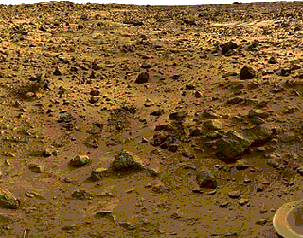


On 6th August 1996, researchers at NASA claimed that they
have discovered microbial fossils in a meteorite that arrived on Earth
from Mars. They say, that this finding supports the fact that we are not
alone in the Universe. The implication of the new find is that life reached
Earth, probably at the same time as it did our neighbouring planet Mars.
Both these planets were more or less simultaneously seeded from outside,
namely through comets.
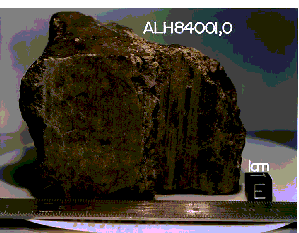
According to the researchers the meteorite dubbed ALH84001 was found in 1984 in Allan Hills ice field, Antarctica and it weigh 1.9 Kg and is about 4.5 billion years old, the period when the planet Mars formed. The rock is believed to have originated underneath the Martian surface and to have been extensively fractured by impacts from meteorites which occurred in the early solar system. Between 3.6 billion and 4 billion years ago, a time when it is generally thought that the planet was warmer and wetter, water is believed to have penetrated fractures in the subsurface rock, possibly forming an underground water system.
Because the water was saturated with carbon dioxide from
the Martian atmosphere, carbonate minerals were deposited in the fractures.
The team's findings indicate living organisms may also have assisted in
the formation of carbonate, and some remains of the microscopic organisms
may have become fossilized, in a fashion similar to the formation of fossils
in limestone on Earth. Then, 15 million years ago, a huge comet or asteroid
struck Mars, ejecting a piece of the rock from its subsurface location
with enough force to escape the planet. For millions of years the chunk
of rock floated through space. It encountered Earth's atmosphere 13,000
years ago and fell in Antarctica as a meteorite.
The evidence for microorganic life came through the use
of a laser mass spectrometer - the most sensitive instrument of its type
in the world - to look for the presence of the common family of organic
molecules called PAHs (Polycyclic Aromatic Hydrocarbons). When microorganisms
die, the complex organic molecules that they contain frequently degrade
into PAHs. PAHs are often associated with ancient sedimentary rocks, coals
and petroleum on Earth and can be common air pollutants. Not only did the
scientists find PAHs in easily detectable amounts in ALH84001, but they
found that these molecules were concentrated in the vicinity of the carbonate
globules. This finding appears consistent with the proposition that they
are a fossilisation process. The unique composition of the meteorite's
PAHs leads to the fact that they are primitive microorganisms. Other minerals
commonly associated with biological activity on Earth were found in the
carbonate as well.
The formation of the carbonate or fossils by living organisms
while the meteorite was in Antarctica was deemed unlikely for several reasons.
The team analyzed representative samples of other meteorites from Antarctica
and found no evidence of fossil - liked structures, organic molecules or
possible biologically produced compounds and minerals similar to those
in the ALH84001 meteorite. The composition and location of PAHs organic
molecules found in the meteorite also appeared to confirm that the possible
evidence of life was ExtraTerrestrial. No PAHs were found in the meteorite's
exterior crust, but the concentration of PAHs increased in the meteorite's
interior to levels higher than ever found in Antarctica. Higher concentrations
of PAHs would have likely been found on the exterior of the meteorite,
decreasing towards the interior, if the organic molecules are the result
of contamination of the meteorite on Earth.
However, there are many scientists of different disciplines
that opposes the possibility of Martian microbes. According to a team of
chemists, hydrothermal synthesis could take inorganic carbon and water
and make aromatic organics that the NASA team claims to have found in the
meteorite.
The final thread of evidence has drawn the sharpest attacks.
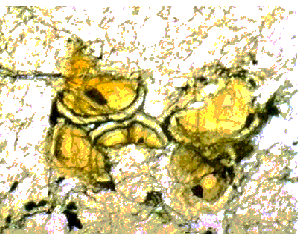
Examining bits of ALH 84001 under an electron microscope, the NASA team
found elongated and egg-shaped structures within the carbonate; the researchers
interpreted these as fossilised nanoorganisms. Many scientists are unconvinced
that such organisms ever existed on Earth, let alone elsewhere. There is
also a real danger of an observer effect at work.
According to some exobiologists, at the scale of just
tens of nanometers, minerals can grow into shapes that are virtually impossible
to distinguish from nanofossils.
Some critics also find the small size of the "fossils"
hard to square with the other evidence, saying that, the size of the structures
found are too small to be living units. Moreover, the putative Martian
bacteria are hardly larger than the mineral crystals they are supposed
to have produced.
If not life, then what can account for this odd collection
of features? One possibility is a hydrothermal process. Imagine hot fluids
flowing through the crust. The crystallization of magnetite, iron sulfides
and carbonate with a change in the chemistry over time. If anywhere in
the sub-surface of Mars there are PAHs, then they would be carried by this
fluid and deposited where the fluids crystallise. Then, the nanostructures
are an unusual surface texture resulting from the way in which the carbonate
crystallise.
Then there is the specter of contamination. According
to some oceanographers, PAHs have been found in glacial ice, albeit at
very low concentrations. Taking into account the analysis of the Murchison
meteorite, thought to come from the asteroid belt; hundreds of organic
compounds have been identified in it, including amino acids and compounds
closer to the things organisms actually use. It has carbonate minerals
in it, too-and real solid evidence of water-but nobody claimed that there
is life in the asteroid belt.
Both the physicist Prof. Chandra Wickramasinghe and the cosmologist Sir Fred Hoyle argued way back in 1970's that the biological replication of organic particles occurred most likely in the warm watery interiors of comets rather than on the Earth itself.
The inner planets, Earth and Mars in particular, that
came under fierce cometary attacks for a full half a billion years after
they were formed, eventually became conducive for life about 4 billion
years ago. Consequently the life that came with comets was able to survive.
(The solar system is believed to be formed about 4.6 billion years ago
and the microbial life that has found in the meteorite dates back to 3.6
billion years.)
Cometary dust , and indeed whole comets, may leave the
solar system from time to time and eventually reach distant sun - like
stars. The recent discoveries of planets around nearby stars adds credence
to the idea that many billions of inhabited planets must exist in our galaxy
alone. Of the 100 billion or so sun - like stars in our galaxy it would
be reasonable to expect, say, 1% with planetary systems like our own. According
to Prof. Wickramasinghe, the universe would then be teeming with microbial
life, at the very least.
Opposed to the theory that life evolved from microbes, through multi - celled life form - plants and animals - only on the Earth (one of the pioneers in this theory being the famous biochemist the late Prof. Cyril Ponnamperuma) Prof. Wickramasinghe and Sir Hoyle incline towards a parallel evolutionary process, starting from same cosmic building blocks to occur on every habitable planet in the Universe. If this is true then intelligent life may not be as much of a disbelief as it may otherwise seem. All in all the present debate on life on Mars can be viewed not as a surprise but as a new frontier.n
A panel discussion was held to present the facts of the above finding on 12th August '96 at the ICT Auditorium.
The panel consisted of:
Dr N. Goonasekera, Dept. of Chemistry
Dr K. Hirimburegama, Dept. of Botany
Dr C. Jayaratne, Dept. of Physics
Dr A. Jayasekara, Dept. of Botany
Dr N. Pallewatta, Dept. of Zoology
Dr K. Premadasa, Dept of Mathematics
Conducted by:
Prof. V.K. Samaranayake.
