






Comments?


Contents
What Would You Do?
Case studies of medical ethics in action
By Warren Shih
- Revealing the information would produce considerable public good.
- Revealing the information would prevent possible risk to someone, but we cannot identify with certainty who that might be.
- Revealing the information would prevent likely harm to specific and identifiable individuals.
 Health
professionals and decision-makers constantly deal with ethical problems.
They arise not only in well-publicized situations such as abortion, euthanasia,
and the use of human subjects in medical research, but also in many routine
decisions. How much should a physician tell a patient about his/her
disease (especially if the information could be traumatic)? When
should a patient decide on a particular treatment?
Health
professionals and decision-makers constantly deal with ethical problems.
They arise not only in well-publicized situations such as abortion, euthanasia,
and the use of human subjects in medical research, but also in many routine
decisions. How much should a physician tell a patient about his/her
disease (especially if the information could be traumatic)? When
should a patient decide on a particular treatment?
What other additional dilemmas might a physician face?
Consider the following case involving an A.I.D.S. (Acquired Immuno-deficiency Syndrome) patient.
A 27-year-old male patient, Fred, has been admitted to the intensive care unit for the fourth time in the last nine months. Lab work confirms that it is another case of pneumocystis carinii pneumonia, a common A.I.D.S-related infection. Each occurrence becomes more difficult to treat. Moreover, the patient has Kaposi’s sarcoma, a tumor of the blood vessel cells: The patient will very likely die within a few months.
Issue: Autonomy vs. Paternalism
The physician may disagree with Fred on how to treat the disease. For example, a complication such as cardio-pulmonary arrest might degrade the quality of life to a point where the physician is convinced that if she were the patient, she would refuse any additional treatment. Fred, however, may not be ready to end his struggle against the disease. Should the physician, with her greater knowledge of the disease and its symptoms, do what she thinks is best; or should she respect the patient’s autonomous choice, even if she perceives it to be wrong?
It is now accepted that physicians should respect the wishes of their patients in most situations. But this attitude is relatively new. The increasing number of “informed consents” being signed in hospitals is a consequence of this new outlook. A physician in the 1960s would have been perfectly justified in refusing to acquiesce in the wishes of a patient if it served the patient’s welfare.
The situation, however, becomes more complicated when the patient is unable to consent because of incompetence (possibly due to illness) or age (being a minor).
Issue: Patient Confidentiality
Because Fred is too sick and feeble to discuss treatment issues, the physician considers consulting Fred’s family. However, the physician learns that although his family is aware Fred had cancer, they are not aware that he had A.I.D.S. Should the doctor discuss the case with them at this critical time and risk breaking Fred’s confidence?
Confidentiality is clearly a serious issue. Patients are routinely
called upon to disclose private information, and are discouraged from seeking
medical help if they cannot trust physicians to keep such information private.
But not seeking medical help can lead to serious harm, both to the individual
and to society.
Deciding when to override confidentiality is difficult.
There are several situations when it may be justified (in order of increasing
justification)
Needless to say, interpreting when these situations apply still rests largely with the physician.
Issue: Interests of society vs. interest of the patient
 The
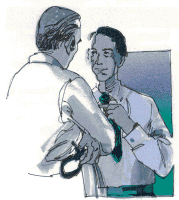
physician is aware from a previous admission that Fred never fully adjusted
to his illness. He had become angry. He blamed others for his
bad fortune. The physician suspects that Fred has remained sexually
active, perhaps exposing sexual partners to the A.I.D.S virus. Fred
had decided that since fate had been so cruel to him, he would take as
many other people with him as he could. Should the physician let
Fred die to protect others, or should she remain true to her traditional
obligation to serve the welfare of the patient? Does Fred’s irresponsible
behavior justify sacrificing his interests to protect others? And
if she does treat Fred, should she report his behaviour to authorities
-- or will that violate Fred’s confidentiality?
The
physician is aware from a previous admission that Fred never fully adjusted
to his illness. He had become angry. He blamed others for his
bad fortune. The physician suspects that Fred has remained sexually
active, perhaps exposing sexual partners to the A.I.D.S virus. Fred
had decided that since fate had been so cruel to him, he would take as
many other people with him as he could. Should the physician let
Fred die to protect others, or should she remain true to her traditional
obligation to serve the welfare of the patient? Does Fred’s irresponsible
behavior justify sacrificing his interests to protect others? And
if she does treat Fred, should she report his behaviour to authorities
-- or will that violate Fred’s confidentiality?
Physicians encounter many situations where they feel the pinch of competing loyalties; their duty to the public at large is not their only responsibility. The family physician may respect the privacy of a patient, but may also feel a duty to the relatives of that patient, who may also be patients of him/herself; they may also have a strong interest in knowing that information. For example, an adolescent may not want her parents to know that she is asking for birth-control pills; or a physician employed by a firm may wish to reveal information that could prevent financial losses for the company. There is no general solution to this problem. But as medicine becomes more complex and health-care institutions become more pervasive, these issues are sure to be more actively debated.
Issue: Allocating resources among patients
There is obviously more than one patient in the Intensive Care Unit (ICU). Treating Fred aggressively now would mean that he might return for future treatment. Other patients could be served by the unit. One is recovering from a mild heart attack, and should do quite well if given access to the unit. Which patient should be treated?
One approach is allocating scarce medical resources like ICU beds to those who would benefit most. Such patients are not necessarily those with the most life-threatening condition; for example, Fred has a very life-threatening condition, but will not do very well in the long run, even if treated. On the other hand, treating a mild heart attack properly may add many productive years to a person’s life, even if the heart attack is not immediately life-threatening.
Issue: Role of Voluntary Behaviour
The physician is convinced that Fred was exposed to A.I.D.S through risky social behaviour. He was an intravenous drug abuser, and was engaged in unsafe sex. Fred was aware of the dangers of such behaviour, and therefore brought about his own illness. Should Fred be treated with the same priority as, say, a patient with muscular dystrophy (a genetic disease clearly not the result of personal choice)?
It is obvious that physicians can face an array of extremely complicated ethical issues. We wrestle with these issues by reflecting on moral choices, and on the principles that underlie various rules of conduct. We must deal with basic questions of right and wrong, of ethical and unethical. Whether you pursue medicine or biomedical research, the issue of ethics will be encountered and must be attended to with the greatest care and judgment.
Reference: Veatch, Robert. Medical Ethics. Jones and Bartlett Publishers, Boston, MA.
To be made available soon.Flying Saucers?
ATTENTION: MARKS ATTACKIt may be a white disk hovering in the sky, but it's not a UFO. It's a flying robot called Cypher, and in its first full-scale test last Jasnuary, it went gliding down the streets of Fort Benning, Georgia, peering around corners, hovering in front of windoes, and perching on roofs. Cypher is a six-foot-wide, 250 pound doughnut, with a pair of propellers in its middle. The propellers spin in opposite directions to cancel each other's torgue -- otherwise the contraption would twist out of control -- but the blades are pitched so that both provide upward and forward thrust. The robot has a computer smart enough to follow commands like "fly down St. George Street" without having to be told to aboid each lamp post, and a Global Positioning System receiver keeps it from getting lost. The US Army is considering using Cypher chiefly as a military scout. It can track a person through woods, scan an area for underground bunkers, or transmit battle field images back to base. "The way we look at it is, Cypher is really a flying truck" says James Cycon, an aerospace engineer at Sikorsky Aircraft Corporation in Stratford, Connecticut, which developed the robot. "We can put different instruments on it for whatever we want to do with it."
-- extracted from Discovery Magazine, Jan 88, technology section by Fenella Saunders
Useful tips for 1st year science students, compiled by Selene Yuen
General tips that you can’t live without:[To Top]BIO150Ydo as many past tests as you can keep up with course work form your own study group have enough sleep before tests/exams CHM 137Yfor multiple choice questions, statements with words like “always”, “never” or “only” are usually incorrect read all 5 choices before deciding on an answer don’t waste your time on your textbook – concentrate on your lecture guides make sure you don’t suck flies from the wrong aspirator in your “Drosophila lab” MAT 135Ywrite out lab reports while they are still fresh in your mind
trust your instincts on multiple choice questions – what you put down the first time is usually right don’t trust your calculator – you may want to estimate the answers for numerical questions before scribbling down what you get from your calculator keep your textbook for future reference PHY 138Ybeware of positive and negative signs especially in multiple choice questions always ask yourself if your answers are reasonable make sure you check the endpoints in max/min problems don’t spend too much time on “recommended problems” – it is highly unlikely that they appear on tests CHM 240Ychoose easy labs (unless you love to challenge your mind and your marks)
choose labs which are unlikely to be tested – ask senior students do pre-lab outside of class time and perhaps get other TAs to help you prepare easy-to-read “cheat sheets”; highlight important formulas take it during the summer don’t even think of putting down the minor products when question asks for major products study hazardous materials carefully before lab quiz (e.g. is HCl corrosive and/or flammable?) in your lab, make sure all your equipment are functioning – chances are that you have no idea that your hotplate is not heating until after an hour!