 |
|
|
|
|
|
|
|
|
|
|
|
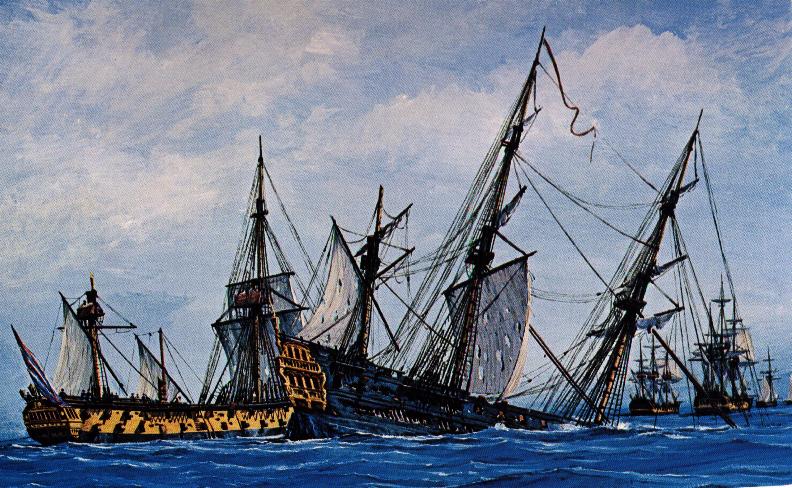
Last moments of the sinking of the Bon Homme Richard |
|
|
| The fiercest battle of all known history between two sailing ships had come to a slow end, and it took several minutes to get word passed to the crews of' both ships, the Bon Homme Richard and the Serapis, that the British ship had surrendered. As soon as some order was restored, Captain Jones received Captain Pearson on the shattered decks of the Richard for the formal surrender. A prize crew from the American ship under Lieutenant Dale was placed on and took command of the captured British ship. The lashings that had bound the ships together during the battle were cut so that the Serapis could move away from the danger of the burning Richard. |
|
| All attention was given to fighting the fire which the guns of the Serapis had started by shooting pointblank into the Richard's side. Some shots had conic from a distance of two feet. No one could get near the flames to extinguish them during the fighting, and they had spread. As a safety measure all powder in the magazine was removed to the quarterdeck. The Richard was also taking in water at an alarming rate. Seams that had opened during the pounding which the ship had taken from the British guns, and the shot holes from the guns of the frigate Alliance were letting in water faster than her pumps could work it out. A long night of fire fighting lay ahead of the crew that had fought the enemy since 7:30 P.M., and a long night of pumping lay ahead of the men who had been prisoners on the Richard's lowest deck during the battle. |
|
| Lieutenant Dale and his crew on the Serapis had been clearing the decks-a tremendous scene of carnage, wreck, and ruin. The fallen mast and sail and the tangled rigging made their task equal to that performed on the Richard. |
|
| During the battle, at not too great a distance, Captain Cottineau of the Pallas had fought, defeated, and captured the British sloop Countess of Scarborough, and now he brought his ship and the prize to Jones. |
|
| That the British Navy would be out in force looking for him was another worry of the American commander. With the lights on England's coast still in sight, many on shore had seen the glare of the battle. They would try to get word to the navy. It was of the greatest importance to get some type of' jury sail up on the Serapis so she could get under way, and daylight was welcome It was to be a hazy muggy clay with only light airs to till the jurv sails of the Serapis. Only her foremast was still intact, and she moved very slowly. The Richard still had all her masts, but she was low in the water. So as not to get too far ahead, the Pallas, Countess, and Cerf were under reefed sail, even the Alliance now joined the squadron again. The fire on the Richard was tinder control, but all that day and all that night he; pumps worked. The next day, September 25, was again one of hazv indifferent weather. |
|
| Captain Jones had admitted to no one but himself that there was no hope for the Richard until the carpenter had reported that water was gaining on them. Then the captain ordered all living things aboard, including the coop of chickens, to be put aboard the Serapis, now flying the Continental flag. Eastward toward Holland the squadron crawled through the sea, holding back to stay near the noble Bon Homme Rkhard. Bow first she gently settled below the lapping waves. At twelve o'clock high noon her masts dipped below tire water and she sank into the North Sea and into history. |
|
|
 |
|
|
|
Text and Image source from Navies of the Revolutionary War |
|
|
|
 |
|