 |
|
|
|
|
|
|
|
|
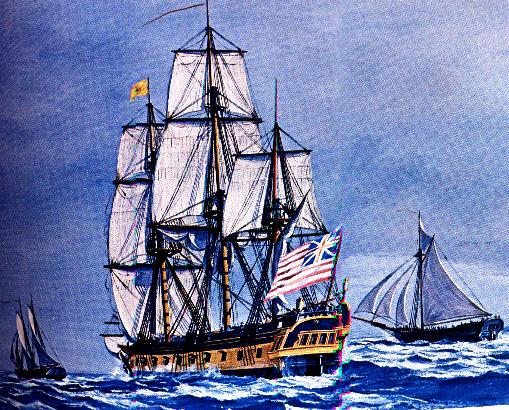
| John Paul Jones on the Alfred first raised the United States flag |
|
| "I hoisted with my own hands the Flag of Freedom the first time it was displayed, on the Alfred, on the Delaware...." John Paul Jones wrote on December 7, 1779, in a letter to the President of the Continental Congress, John Hancock. The event described took place when this naval hero was first appointed senior lieutenant on the Continental Navy flagship Alfred. He did not give the date of this occurrence. It has been established as December 3, 1775, from the report of a Loyalist informer to the Earl of Dartmouth, in a letter of December 20, 1775: "An admiral is appointed, a court established, and the 3cd instant, the Continental flag on board the Black Prince opposite Philadelphia was hoisted." (The Black Prince had been renamed the Alfred.) |
|
| This would have been the Grand Union flag, respected as the first flag of the United States-the one that flew over General Washington's headquarters at New York when the Declaration of Independence was read to the troops. For the first years of the American Revolution, the Grand Union was the nation's flag on land and sea. |
|
| How the flag came to be designed can only be surmised. At that time, the British naval flag in use on American waters was the "White"-a white field with the Union Jack employed as a canton. It would seem that the patriot founders of the United States, who wanted a flag of their own and at the same time clung to their mother country, added to the British naval flag a differentiating mark: the thirteen stripes. Some hold that this flag originated in the colonial navy |
|
| Naval flags of those days were enormous by later standards. It was the fashion to display very large ensigns at the sterns of war- |
|
| ships, and marine paintings of the time give evidence of this. There was a feeling left over from more than two centuries of naval warfare that a great banner betokened the might of the nation behind it. |
|
| No more honorable place could have been found to display this first flag than from the staff of the Continental Navy flagship Alfred, because all who made the young nation's affairs their own in 1775 looked on this ship and the fleet she headed as the representatives of freedom and liberty, and the defenders of their homes. Letters from the patriot citizens show their enthusiasm for their navy |
|
| The Alfred had been the successful Philadelphia-built packet, the Black Prince. Captain John Barry was her master on several trade cargo crossings. The Marine Committee purchased and converted her to a warship. She carried 24 guns, reduced from |
|
| 30. Her appearance is described in a British Intelligence Service dispatch of January 4, 1 776: "This day about one o'clock sailed the Alfred and the ship, Columbus, with two brigs. . . . Hopkins commands the Alfred. She has yellow sides, her head the figure of a man. |
|
| The career of this ship was admirable indeed. After her first cruises, her command was given to Lieutenant John Paul Jones. She stung the enemy more than once. On a six weeks' cruise she returned with six prizes, and many times she outsailed and escaped from large Royal Navy men-of-war. |
|
| In the painting, the other vessels shown with their flagship were the first in the United States Navy to be called Hornet (a sloop) and Wasp (a schooner). |
|
|
 |
|
|
|
Text and Image Source: Navies of The American Revolution |
|
|
|
 |
|