CHAPTER IV
FINDINGS AND DISCUSSION
This chapter presents the research findings and discussion. Firstly, the profile of the respondents are described. The subsequent discussions are based on the objectives of the study. Residential and non residential school teachers’ perceptions of the seven school climate dimensions and job satisfaction are compared. Teachers’ job satisfaction and perceptions of the seven climate dimensions for the combined sample are discussed. The relationships between the seven school climate dimensions with the facet specific and facet free overall job satisfaction are determined. Hypothesis of significant difference between the two measures of overall job satisfaction was tested.
Profile of Respondents
The demographic characteristics selected for discussion were gender, marital status, age, pay, service category, education level, occupation status, tenure and number of teaching periods. These demographic variables were classified into personal characteristics and professional characteristics variables. Table 7 displays the frequency and percentage distributions of personal characteristics of the respondents by school-type. There were 70 respondents from residential schools and 64 respondents from non-residential schools. Out of these 134 respondents, about one third were male. The majority of the respondents were from 26 to 45
Table 7
Frequency and Percentage Distribution of Respondents in Residential and Non Residential Schools by Personal Characteristics
|
Type of Schools (N=134) |
|||
| Personal | Residential (n=70) | NonResidential(n=64) | Total |
| Characteristics | n (%) | n (%) | n (%) |
| Gender | |||
| Male | 26 (37.1) | 18 (28.1) | 44 (32.8) |
| Female | 44 (62.9) | 46 (71.9) | 90 (67.2) |
| Marital Status | |||
| Single | 12 (17.1) | 13 (20.3) | 25 (18.7) |
| Married | 58 (82.9) | 51 (79.7) | 109 (81.3) |
| Age | |||
| 25 and below | 3 (4.3) | 3 (4.8) | 6 (4.5) |
| 26-30 | 21 (30.0) | 27 (42.9) | 48 (36.1) |
| 31-35 | 18 (25.7) | 16 (25.4) | 34 (25.6) |
| 36-40 | 13 (18.6) | 7 (11.1) | 20 (15.0) |
| 41-45 | 11 (15.7) | 5 (7.9) | 16 (12.0) |
| 46-50 | 2 (2.9) | 5 (7.9) | 7 (5.3) |
| 51 and above | 2 (2.9) | 0 (0.0) | 2 (1.5) |
| Mean | 34.8 | 33.1 | 34.0 |
| SD | 6.7 | 6.5 | 6.7 |
| Salary | |||
| 1000 and below | 1 (1.4) | 2 (3.3) | 3 (2.3) |
| 1001-2000 | 37 (53.6) | 46 (75.4) | 83 (63.8) |
| 2001-3000 | 18 (26.1) | 6 (9.8) | 24 (18.5) |
| 3000-4000 | 13 (18.8) | 7 (11.5) | 20 (15.4) |
| Mean | 2130.30 | 1839.90 | 1994.05 |
| SD | 691.56 | 667.90 | 693.36 |
Table 7 shows that 64% of the respondents had a monthly salary of between RM1000 to RM2000 while another 19% of the respondents had a monthly pay of between RM2000 to RM 3000. The mean salary for the combined sample was RM1994 with a standard deviation of RM693.
Table 8 displays the frequency and percentage distributions of the professional characteristics of the respondents by school-type. Table 8 shows that majority (82%) of the respondents were graduate teachers. In terms of occupational status, 72% of the respondents were ordinary teachers and 23% were heads of subject. Almost equal number of ordinary teachers and heads of subject were selected from residential and non residential schools.
Table 8
Frequency and Percentage Distribution of Respondents in Residential and Non Residential Schools by Professional Characteristics
|
Types of Schools (N=134) |
|||||||
| Professional |
Residential(n=70) |
Non Residential (n=64) |
Total |
||||
| Characteristics |
n |
% |
n |
% |
n |
% |
|
| Service Category | |||||||
| Non Graduate |
7 |
10.0 |
17 |
26.6 |
24 |
17.9 |
|
| Graduate |
63 |
90.0 |
47 |
73.4 |
110 |
82.1 |
|
| Education | |||||||
| MCE/SPM |
3 |
4.3 |
8 |
12.5 |
11 |
8.2 |
|
| HSC/STPM |
4 |
5.7 |
9 |
14.1 |
13 |
9.7 |
|
| Diploma |
1 |
1.4 |
2 |
3.1 |
3 |
2.2 |
|
| Bachelor |
59 |
84.3 |
45 |
70.0 |
104 |
77.6 |
|
| Master |
3 |
4.3 |
0 |
0.0 |
3 |
2.2 |
|
| Occupation Status | |||||||
| Teacher |
48 |
68.6 |
48 |
75.0 |
96 |
71.6 |
|
| Subject Head |
16 |
22.9 |
15 |
23.4 |
31 |
23.1 |
|
| Department Head |
5 |
7.1 |
0 |
0.0 |
5 |
3.7 |
|
| Others |
1 |
1.4 |
1 |
1.4 |
2 |
1.5 |
|
|
(Cont’d) |
|||||||
Table 8 (cont’d)
|
Types of Schools (N=134) |
|||
|
Professional |
Residential (n=70) |
Non Residential(n=64) |
Total |
|
Characteristics |
n (%) |
n (%) |
n (%) |
| TeachingExperience | |||
|
2-5 years |
21 (30.0) |
32 (50.0) |
53 (39.6) |
|
6-10 years |
22 (31.4) |
10 (15.6) |
32 (23.9) |
|
11-15 years |
8 (11.4) |
11 (17.2) |
19 (14.2) |
|
16-20 years |
11(15.7) |
7 (10.9) |
18 (13.4) |
|
21-25 years |
6 (8.6) |
3 (4.7) |
9 (6.7) |
|
26-30 years |
0 (0.0) |
1 (1.6) |
1 (0.7) |
|
31 years and above |
2 (2.9) |
0 (0.0) |
2 (1.5) |
|
Mean |
11.0 |
8.3 |
9.7 |
|
SD |
8.2 |
6.8 |
7.6 |
|
Present School Experience |
|||
|
2-5 years |
35 (50.0) |
60 (63.2) |
95 (70.9) |
|
6-10 years |
19 (27.1) |
4 (17.4) |
23 (17.2) |
|
11-15 years |
7 (10.0) |
- - |
7 (5.2) |
|
16-20 years |
6 (8.6) |
- - |
6 (4.5) |
|
21-25 years |
3 (4.3) |
- - |
3 (2.2) |
|
26-30 years |
- - |
- - |
- - |
|
31 years and above |
- - |
- - |
- - |
|
Mean |
7.3 |
2.9 |
5.2 |
|
SD |
6.0 |
1.5 |
4.9 |
|
Teaching Periods |
|||
|
15 and below |
11 (15.9) |
1 (1.6) |
12 (9.1) |
|
16-20 periods |
51 (73.9) |
5 (8.9) |
56 (42.4) |
|
21-25 periods |
7 (10.1) |
43 (68.3) |
50 (37.9) |
|
26-28 periods |
- - |
14 (22.2) |
14 (10.6) |
|
Mean |
17.7 |
23.7 |
20.6 |
|
SD |
3.4 |
3.1 |
4.4 |
Table 8 (cont’d) displays the frequency and percentage distributions of the respondents’ tenure, present school experience and number of teaching periods by school-type. 40% of the respondents had 2 to 5 years of teaching experience while another 51% of them had 6-20 years of teaching experience. The residential school teachers had a mean teaching experience of 11.0 years with a standard deviation of 8.2 while the non residential school teachers had a mean teaching experience of 8.3 years with a standard deviation of 6.8. The combined samples had a mean teaching experience of 9.7 years with a standard deviation of 7.6. 88% of the respondents had 2 to 10 years of service with their present school. Present school experiences for the selected residential school teachers were higher (mean=7.3, SD=6.0) compared with non residential schools (mean=2.9 SD=1.5).
The finding confirmed the earlier anticipation that residential school teachers had less number of teaching periods compared with that of their counterpart in non residential schools. Majority of the residential school teachers had between 10-20 teaching periods of forty minutes each. The other extreme was true for the non residential schools. Majority of the non residential school teachers had between 21-28 periods. Residential school teachers had a mean teaching periods of 17.7 (SD=3.4) while non residential school teachers had a mean of 23.7 teaching periods (SD=3.1).
Comparisons of Teachers’ Perceptions of School Organizational Climate Dimensions in Selected Residential and Non Residential Schools
This section attempts to present a comparison of teachers’ perceptions of the seven school climate dimensions between the selected residential and non residential schools. Table 9 presents a description of the climate dimensions of the present study.
Table 9
Description of Climate Dimensions
| Climate Dimensions |
Description |
| Empowerment
|
a dimension of the school climate which measures the extent to which teachers have the opportunity to participate in decision making |
| Student Support | a dimension of the school climate which measures the extent to which there is good rapport between teachers and students; and students behave in a responsible and self-discipline manner |
| Affiliation or Collegial Relationship | a dimension of the school climate which measures the extent to which the teachers can obtain assistance, advice and encouragement and are made to feel accepted by colleagues |
| Professional interest | a dimension of the school climate which measures the extent to which teachers discuss professional matters, show interest in their work and seek further professional development |
| Mission and Goals Consensus | a dimension of the school climate which measures the extent to which consensus exists within the staff with regard to the understanding of mission and attaining the goals of the school |
| Resource adequacy | a dimension of the school climate which measures the extent to which support personnel, facilities, finance, equipment and resources are available and adequate |
| Work pressure | a dimension of the school climate which measures the extent to which work pressure dominates the school environment |
Descriptive statistics were used to compare the teachers’ level of perceptions of the seven school climate dimension in selected residential and non residential schools. Independent t-tests were utilised to test the hypotheses that there were no significant differences in teachers’ perceptions of the seven climate dimensions between the selected residential and non residential schools.
Table 10 displays the distribution of teachers’ level of perceptions of the seven school climate dimensions between the two types of schools in this study. Comparing the findings for residential and non residential schools in Table 10, it was obvious that residential school teachers perceived
Table 10
Distribution of Levels of Perceptions of School Climate Dimensions by School -Type
|
Types of School (N=134) |
|||||
|
Residential(n=70) |
Non Residential (n=64) |
||||
| Climate Dimensions |
Number |
Percent |
Number |
Percent |
|
| Student Support (SS) | |||||
| High |
38 |
54.3 |
8 |
12.7 |
|
| Medium |
29 |
41.4 |
25 |
39.7 |
|
| Low |
2 |
4.3 |
30 |
47.6 |
|
| Affiliation (AFFN) | |||||
| High |
52 |
74.3 |
41 |
65.1 |
|
| Medium |
17 |
24.3 |
20 |
31.7 |
|
| Low |
1 |
1.4 |
2 |
3.2 |
|
| Mission and Goal Consensus | |||||
| High |
39 |
57.4 |
8 |
12.5 |
|
| Medium |
29 |
42.6 |
46 |
71.9 |
|
| Low |
- |
- |
10 |
15.6 |
|
| Professional Interest
(PI) |
|||||
| High |
33 |
48.5 |
11 |
17.5 |
|
| Medium |
32 |
47.1 |
42 |
66.7 |
|
| Low |
3 |
4.4 |
10 |
15.9 |
|
| Empowerment (EPW) | |||||
| High |
13 |
18.8 |
10 |
15.9 |
|
| Medium |
51 |
73.9 |
37 |
58.7 |
|
| Low |
5 |
7.2 |
16 |
25.4 |
|
| Resource Adequacy | |||||
| High |
29 |
42.0 |
14 |
22.2 |
|
| Medium |
34 |
49.3 |
38 |
60.3 |
|
| Low |
6 |
8.7 |
11 |
17.5 |
|
| Work Pressure (WP) | |||||
| High |
27 |
40.3 |
21 |
33.3 |
|
| Medium |
26 |
38.8 |
32 |
50.8 |
|
| Low |
14 |
20.9 |
10 |
15.9 |
|
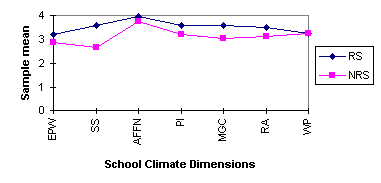
The graphical display in Figure 2 shows that they were some differences in teachers’ level of perceptions of school climate dimensions between residential and non residential school. Figure 2 shows that the means for six out of seven school climate dimensions were consistently higher for the selected residential schools (RS). Figure 2 shows that only two out of seven climate dimensions were quite similar for both residential and non residential schools. The means for the work pressure dimension for both types of schools coincided while the means for affiliation dimensions were very close to each other. This implied that there were only marginal difference in residential and non residential school teachers’ perceptions of affiliation and work pressure dimensions of the school climate. Figure 2 also displays that there was a wide gap for the student support dimension between residential and non residential schools. Therefore, it was obvious that non residential school teachers’ perceptions of student support dimension of the school climate was very low.
Figure 2: Graphical Comparison of Sample Means for the Climate Dimensions between residential and Non Residential Schools
Independent t-test was used to determine whether there were any differences in teachers’ perceptions of school climate dimensions in the selected population. Table 11 displays the means and standard deviations and independent t-test results of the seven climate dimensions between residential and non residential schools.
Table 11
Means, Standard Deviations and Independent t-test Results of School Climate Dimensions by School –Type
|
Types of Schools (N=134) |
|||||||
| Climate |
Residential (n=70) |
Non Residential (n=64) |
Independent t-test | ||||
| Dimensions | Mean(n) | SD | Mean (n) | SD | t-value | df | P |
| EPW | 3.22 (69) | 0.44 |
2.88 (63) |
0.62 | 3.48 | 111.1 | 0.01* |
| SS | 3.60 (70) | 0.65 |
2.65 (63) |
0.77 | 7.69 | 131 | 0.00* |
| AFFN | 3.97 (70) | 0.49 |
3.77 (63) |
0.52 | 2.38 | 131 | 0.02* |
| PI | 3.60 (68) | 0.47 |
3.20 (63) |
0.49 | 4.68 | 129 | 0.00* |
| MGC | 3.57 (68) | 0.43 |
3.03 (64) |
0.51 | 6.64 | 130 | 0.00* |
| RA | 3.52 (69) | 0.63 |
3.14 (63) |
0.56 | 3.68 | 130 | 0.00* |
| WP | 3.25 (67) | 0.83 |
3.25 (63) |
0.74 | 0.04 | 128 | 0.97 |
*Two-tailed significance; significant at 0.05 level.
The two-tailed significance for empowerment, student support, affiliation, professional interest, mission and goal consensus, and resource adequacy were all less than the alpha value of 0.05. Hence we conclude that:
The t-test results in Table 11 also depicts that the two-tailed significance for the work pressure dimension was more than 0.05. Hence, we conclude that :
Comparisons of Teachers’ Job Satisfaction in Residential and
Non Residential Schools
In this study teachers’ job satisfaction was measured both by the facet-specific and facet-free job satisfaction instruments. Facet specific satisfaction consists of intrinsic, extrinsic and social satisfaction whereas facet free satisfaction represents overall satisfaction measured by five global factors not specifically measured by facet specific satisfaction.
Table 12 compares the teachers’ perceived level of job satisfaction for facet specific job satisfaction variables between the selected residential and non residential schools. The findings showed that the perceived level of extrinsic satisfaction was very similar between residential and non residential schools. In other words, there were not much difference in teachers’ perception of extrinsic satisfaction. The percentages for high and low levels of perceived extrinsic job satisfaction were close for both types of schools. Only 10% of residential school teachers and 11% of non residential school teachers perceived high level of extrinsic satisfaction. Majority of the teachers, 66% for residential and 73% for non residential schools, perceived low level of extrinsic satisfaction.
Table 12 shows that there were some differences in teachers’ perceptions of high level of intrinsic job satisfaction. 38% of teachers in the residential schools perceived high level of intrinsic satisfaction while only 25% of teachers in non residential schools who had similar perceptions of high level of intrinsic job satisfaction.
In terms of social satisfaction, Table 12 shows that there was not much difference in the level of teachers’ social satisfaction. 74% and 72% of teachers perceived high level of social satisfaction in residential and non residential schools respectively.
Table 12
Distribution of Teachers’ Level of Facet Specific Job Satisfaction between Residential and Non Residential Schools
|
Types of School (N=134) |
||||
|
Residential (n=70) |
Non Residential (n=64) |
|||
| Facet SpecificJobSatisfaction |
Number |
Percent |
Number |
Percent |
|
Extrinsic Satisfaction |
||||
|
High |
7 |
10.0 |
7 |
10.9 |
|
Medium |
17 |
24.3 |
10 |
15.6 |
|
Low |
46 |
65.7 |
47 |
73.4 |
|
Intrinsic Satisfaction |
||||
|
High |
25 |
37.9 |
16 |
25.0 |
|
Medium |
31 |
47.0 |
40 |
62.5 |
|
Low |
10 |
15.2 |
8 |
12.5 |
|
Social Satisfaction |
||||
|
High |
52 |
74.3 |
46 |
71.9 |
|
Medium |
15 |
21.4 |
17 |
26.6 |
|
Low |
3 |
4.3 |
1 |
1.6 |
|
Facet Specific Overall Job Satisfaction |
||||
|
High |
16 |
24.2 |
6 |
9.4 |
|
Medium |
41 |
62.1 |
50 |
78.1 |
|
Low |
9 |
13.6 |
8 |
12.5 |
The composite scale for overall job satisfaction measured by facet specific items showed that 24% of teachers in the selected residential schools enjoyed high level of facet-specific overall job satisfaction while only 9% of teachers in non residential schools perceived high level of facet specific overall job satisfaction. With little or no difference in teachers’ perceived extrinsic and social satisfaction, the slight difference in the level of intrinsic satisfaction could have contributed to this discrepancy.
Table 13 shows a comparison of teachers’ levels of job satisfaction measured by facet-free job satisfaction instrument. 59% of residential school teachers were found to have high level of satisfaction with teaching as an occupation compared with 33% for non residential schools. 52% of residential school teachers perceived high level of satisfaction that teaching had met their initial expectation as compared with only 38% for teachers in non residential schools. 47% of residential school teachers reported high level of satisfaction with present job while there were only 25% for non residential schools.
Nearly 60% of residential school teachers reported great extent of likelihood of choosing teaching as a profession again if they had to decide all over again. Only 37% of non residential school teachers showed similar extent of likelihood. As for the likelihood of optional retirement decision, residential school teachers reported slightly lower likelihood compared with non residential schools, 60% of great extent for residential schools compared with 75% of great extent for non residential schools. Lower likelihood for optional retirement might be an indirect indicator for higher level of job satisfaction. The likelihood for optional retirement for both types of schools were high but the extent was lower in residential than non residential schools. The overall job satisfaction as measured by all the five facet free items showed that 27% of residential school teachers reported high level of overall job satisfaction as compared with only 13% for non residential
Table 13
Distribution of Teachers’ Level of Facet Free Job Satisfaction between Residential and Non Residential Schools
|
Types of School (N=134) |
||||
| Facet Free Job Satisfaction |
Residential (n=70) |
Non Residential (n=64) |
||
| Items |
Number |
Percent |
Number |
Percent |
| Occupation Satisfaction | ||||
|
High |
41 |
58.6 |
21 |
32.8 |
|
Medium |
24 |
34.3 |
34 |
53.1 |
|
Low |
5 |
7.1 |
9 |
14.1 |
| Expectation Satisfaction | ||||
|
High |
36 |
51.4 |
24 |
37.5 |
|
Medium |
23 |
32.9 |
20 |
31.3 |
|
Low |
11 |
15.7 |
20 |
31.3 |
| Current Job Satisfaction | ||||
|
High |
33 |
47.1 |
16 |
25.0 |
|
Medium |
27 |
38.6 |
27 |
42.2 |
|
Low |
10 |
14.3 |
21 |
15.7 |
| Likelihood of Choosing Teaching Again | ||||
|
High |
41 |
58.6 |
24 |
36.9 |
|
Medium |
14 |
20.0 |
14 |
21.9 |
|
Low |
15 |
21.4 |
26 |
40.0 |
| Likelihood of Optional Retirement | ||||
|
High |
7 |
10.0 |
3 |
4.7 |
|
Medium |
21 |
30.0 |
13 |
20.3 |
|
Low |
42 |
60.0 |
48 |
45.0 |
| Facet Free Overall Job Satisfaction | ||||
|
High |
19 |
27.1 |
8 |
12.5 |
|
Medium |
41 |
58.6 |
33 |
51.6 |
|
Low |
10 |
14.3 |
23 |
35.9 |
schools. 36% of non residential school teachers had low level of overall job satisfaction as compared with 14% for residential schools. This implies that the selected residential school teachers were more satisfied with their job than their counterparts in non residential schools.
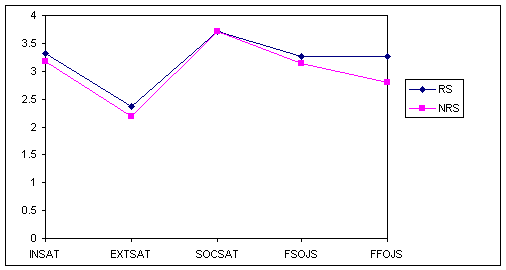
Key:
INSAT= Intrinsic Satisfaction
EXTSAT= Extrinsic Satisfaction
SOCSAT= Social Satisfaction
FSOJS= Facet Specific Overall Job satisfaction
FFOJS= Facet Free Overall Job Satisfaction
Figure 3: Graphical Comparison of Means for Teachers’ Job Satisfaction between Selected Residential and Non Residential Schools.
Figure 3 shows the graphical comparison of means for teachers’ job satisfaction in terms of intrinsic, extrinsic, social, facet specific and facet free overall job satisfaction between the selected residential and non residential schools. The graph in Figure 3 displays that there were not much difference in the means for intrinsic, extrinsic, social and facet specific job satisfaction between selected residential and non residential schools. However, the means for facet free overall job satisfaction for selected non residential schools was very much lower than that for selected residential schools.
Independent t-test was used to compare teachers’ perceived job satisfaction in the selected residential and non-residential schools. Table 14 shows the results of independent t-tests for the dependent variables of intrinsic, extrinsic, social and overall job satisfaction by school-type. The sample mean scores for intrinsic satisfaction for both residential and non-residential schools were indeed very close, being 3.32 (SD 0.67) and 3.18 (SD 0.56) respectively.
Table 14
Independent t-Test Results : Job Satisfaction by School -Type
|
Types of Schools (N=134) |
||||||||
|
Residential (n=70) |
Non Residential (n=64) |
Independent t-test |
||||||
| JobSatisfaction | Mean (n) | SD | Mean(n) | SD | t-value | df |
P |
|
| Intrinsic | 3.32 (66) | 0.67 | 3.18 (64) | 0.56 | 1.23 | 128 | 0.221 | |
| Extrinsic | 2.37 (70) | 0.97 | 2.19 (64) | 0.91 | 1.13 | 132 | 0.260 | |
| Social | 3.72 (70) | 0.62 | 3.72 (64) | 0.54 | 0.00 | 132 | 0.999 | |
| Facet Specific Overall Job Satisfaction | 3.26 (66) | 0.57 | 3.15 (64) | 0.43 | 1.21 | 128 | 0.228 | |
| Facet Free Overall Job Satisfaction | 3.26 (70) | 0.73 | 2.80 (64) | 0.77 | 3.57 | 132 | 0.001* | |
Table 14 also depicts that the means for extrinsic satisfaction between residential and non-residential schools only differed by 0.18. The means for social satisfaction for both the residential and non-residential schools were exactly the same, that is 3.72 with SD of 0.62 and 0.54 respectively. The results showed that the p-values for intrinsic, extrinsic and social satisfaction were bigger than the alpha value of 0.05. Therefore, we conclude that in the teacher population of the selected schools, there was no significant difference in teachers’ job satisfaction between selected residential and non residential schools in terms of
However, in terms of facet free overall job satisfaction, teachers from residential schools perceived that their overall job satisfaction were higher than those of their counterparts in the non residential schools. The mean facet free overall job satisfaction for teachers in residential schools was 3.26 (SD=0.73) whereas the mean for teachers in non-residential schools was 2.80 (SD=0.77). Table 14 displays that p-value for facet free overall job satisfaction scale was less than 0.05. Therefore, we conclude that there was significant difference in teachers’ facet free overall job satisfaction between residential and non residential schools (t-value 3.57, df = 132, p =0.001).
In summary, the present study found that there was no significant difference between residential and non-residential school teachers’ perceptions of the facet-specific job satisfaction which is measured in terms of their intrinsic, extrinsic and social satisfaction. Nevertheless, this study established that there was a significant difference in teachers’ perceived facet free overall job satisfaction between residential and non residential schools.
The above findings have been expected since both residential and non residential schools are government schools which are under the same ministry and education system. Extrinsic rewards such as remuneration and fringe benefits are provided by the Public Service Department. Individual schools have no say in modifying the extrinsic reward system. Therefore, the finding that there was no significant difference in teachers’ extrinsic satisfaction between residential and non-residential schools was as expected.
Teachers’ social satisfaction has been derived mainly from their collegial supports. Teachers themselves are in control of the type of interpersonal interactions and relations they wish to establish with their colleagues. Therefore, the finding that there was no significant difference in teacher’s social satisfaction between residential and non-residential schools was not surprising. Both types of schools display a sample mean of 3.72 for social satisfaction. Even the standard deviations from the means were very similar; standard deviation for residential school was 0.62 while standard deviation for non-residential school was 0.54 with a difference of 0.08.
This study anticipates that there is a difference in teachers’ intrinsic satisfaction between residential and non-residential schools. The sample data showed that there was a difference in teachers’ intrinsic satisfaction but the inferential statistics on the population of selected schools showed otherwise. Intrinsic satisfaction measured by the amount of job autonomy, professional development, accomplishment and participation in decision making do not differ much in government schools.
In terms of job autonomy, disregarding the external interventions from other bureaucratic authorities at the ministry level, teachers in both types of school have complete freedom as far as classroom management is concerned. Job interventions exist for both types of schools. Residential schools receive job interventions from the Residential School Unit of the School Division in the Ministry of Education whereas non residential schools receive theirs from the State Education Department. Both types of schools practice the same curriculum which is designed by Curriculum Development Centre of the Ministry of Education. Both types of school prepare their students for the same public examinations. The restrictions and constraints faced by the teachers in terms of job autonomy do not differ much in both types of schools. Hence, it was expected that there was no significant difference in job autonomy satisfaction.
In terms of professional development, the chances for teachers of both types of school to undergo in-service courses are not determined by the schools but by the relevant authorities from the various departments from the Ministry of Education. Therefore, there is no significant difference in the teachers’ perceptions of their professional development satisfaction.
As for accomplishment satisfaction, residential school teachers’ derived some accomplishment satisfactions when their students performed well in public examinations and are well mannered. Even though the non residential schools could not match the residential schools in terms of academic performance and in terms of student discipline, given the reality and the circumstances, teachers in non residential schools might have similarly perceived some sense of accomplishment when they see that ‘the not so good students’ perform reasonably well in the public examinations or that they are able to discipline some problematic students. The sense of accomplishment is rather subjective. The reality is that different circumstances might produce different sense of accomplishments but bring about the same perceptions of accomplishment satisfaction. The researcher is of the opinion that the above statement explains the no difference in accomplishment satisfaction.
In terms of "participation in decision making" satisfaction, most of the respondents (72%) are ordinary teachers without special status, they are the implementers of the school programs. In the Malaysian Education Systems, , most of the decision making are made by the minister, the various authorities in the Education Ministry such as Curriculum Development Centre and the Examination Board, State Education department and District Education Department. In the government secondary school itself, the organizational structure is such that the school level decision making is mainly concentrated in the hands of principal, his two senior assistants and to a lesser extent the four department heads. Since the majority (72%) of the respondents are ordinary teachers without special occupational status, it is expected that their perceptions of participation in decision making do not differ much between the residential and non residential schools.
Facet free job satisfaction instrument measures some aspects of job satisfaction not specifically measured by facet specific job satisfaction instrument. Literature reviews had shown that overall job satisfaction scale computed as sum of facet specific satisfaction items was different from overall job satisfaction measured by some global factors of job satisfaction. In this study the five global overall job satisfaction factors were designed to measure some aspects of the job satisfaction which were not or could not be measured by the facet specific satisfaction. Since not all aspects of the job satisfaction were covered by the facet specific instrument, the global measure of overall job satisfaction was a more inclusive measurement of teachers’ overall job satisfaction.
Since there was significant difference in teachers’ facet free overall job satisfaction between the selected residential and non-residential schools, further analysis was carried out on the five items that measured the facet free overall job satisfaction. As described in the earlier section, these five items measured satisfaction with teaching as an occupation (Occupation satisfaction, OCCSAT), satisfaction with how teaching measures up to initial expectations (Occupation expectation, OCCEXP), retrospective likelihood of entering teaching again (Occupation decision, OCCDEC), satisfaction with the present job (Now satisfaction, NOWSAT) and the likelihood of optional retirement (Optional retirement decision, OPTDEC).
Table 15 displays the results for the independent t-tests for the five items measuring overall job satisfaction by school-type. From Table 15, it was obvious that the sample means for all the five items for the residential schools were consistently higher than the sample means for non-residential schools.
Table 15
Independent t-test: Facet Free Overall Job Satisfaction Items by School Type
|
Residential (n=70) |
Non Residential (n=64) |
Independent t-test |
|||||
| JobSatisfaction |
Mean |
SD |
Mean |
SD | t-value | df |
p |
| OCCSAT |
3.71 |
0.97 |
3.22 |
0.85 | 3.15 | 132 | 0.002* |
| OCCEXP |
3.44 |
0.86 |
3.00 |
1.08 | 2.63 | 132 | 0.010* |
| NOWSAT |
3.38 |
0.91 |
2.89 |
1.03 | 2.97 | 132 | 0.004* |
| OCCDEC |
3.41 |
01.13 |
2.92 |
1.23 | 2.41 | 132 | 0.017* |
| OPTDEC |
2.36 |
0.99 |
1.97 |
0.85 | 2.42 | 132 | 0.017* |
* Significant at 0.05 level
Note: The OPTDEC item is a negative item and it was reverse scored with 1 being very likely, 2 likely; 3 not sure, 4 unlikely and 5 very unlikely.
Table 15 displays that the p-values for all the five items were less than 0.05, therefore, we concluded that there were significant differences between residential and non-residential schools in all the five items measuring teachers’ facet free overall job satisfaction.
This study concludes that teachers in residential schools were more satisfied with teaching as an occupation. They were more satisfied with how teaching measures up to their initial expectations. They were more satisfied with their present job. If they had to decide all over again, their retrospective likelihood of entering teaching again were higher than that of their counterparts in the non residential schools. The likelihood of optional retirement for teachers in residential schools was lower than that of teachers in non residential schools. Hence, this implied that they were more satisfied with teaching as a profession compared with teachers in non residential schools.
Teachers’ Job Satisfaction for the Combined Sample
In this section, descriptive statistics are used to describe the job satisfaction of the combined sample of 134 teachers. Levels of job satisfaction (high, medium and low), means and standard deviations of the teachers’ intrinsic, extrinsic, social satisfaction, facet specific overall job satisfaction and facet free overall job satisfaction are shown in Table 16. To have further understanding of teachers’ job satisfaction, the percentage distribution of the levels of satisfaction for all the eleven facet specific job satisfaction items were analysed in Table 17. The level of satisfaction , means and standard deviations of the five items that made up the facet free overall job satisfaction are displayed in Table 18, Table 19 and Table 20.
Table 16
Level of Satisfaction, Means and Standard Deviations of Job Satisfaction for the Combined Samples
|
Combined Samples (N=134) |
||||
| Job Satisfaction Scales |
Percentage |
Mean |
(n) |
SD |
| Extrinsic Satisfaction |
2.28 |
134 |
0.94 |
|
|
High |
10.4 |
|||
|
Medium |
20.1 |
|||
|
Low |
69.4 |
|||
| Intrinsic Satisfaction |
3.25 |
130 |
0.62 |
|
|
High |
31.5 |
|||
|
Medium |
54.6 |
|||
|
Low |
13.8 |
|||
| Social Satisfaction |
3.72 |
134 |
0.58 |
|
|
High |
73.1 |
|||
|
Medium |
23.9 |
|||
|
Low |
3.0 |
|||
| Facet Specific Overall Job Satisfaction |
3.21 |
134 |
0.52 |
|
|
High |
12.9 |
|||
|
Medium |
70.0 |
|||
|
Low |
13.1 |
|||
| Facet Free Overall Job Satisfaction |
3.04 |
134 |
0.78 |
|
|
High |
20.1 |
|||
|
Medium |
55.2 |
|||
|
Low |
24.6 |
|||
Table 16 shows that the teachers in the combined sample enjoyed the most satisfaction from social satisfaction (mean=3.72). 73% of the sample teachers perceived a high level of social satisfaction. Majority of the teachers (55%) reported medium level of satisfaction with intrinsic factors (mean=3.25). Extrinsic satisfaction was the lowest among the three aspects of facet specific job satisfaction (mean=2.28). 70% of the combined samples reported low level of satisfaction with pay and fringe benefits. The ratio of high to low level of extrinsic satisfaction was approximately one is to seven. On the whole, 70% of the teachers perceived an average level of overall job satisfaction as measured by facet specific satisfaction.
Facet Specific Measure of Job Satisfaction
Intrinsic Satisfaction: Table 17 reveals that majority of the teachers in the sample of this study enjoyed high level of satisfaction with job securities (71%) and job autonomy (63%). 41% of the teachers reported high level of satisfaction with their opportunity for professional development while quite a sizeable percentage (27%) reported low level of satisfaction with opportunity to learn new things. Only about one third of the teachers reported high level of satisfaction with their achievement including their chances to accomplish something worthwhile. 36% of them enjoyed high level of self esteem satisfaction while 28% reported low level of satisfaction. 42% reported high level of satisfaction with opportunity for taking part in decision making.
Extrinsic Satisfaction: Table 17 shows that majority of the teachers were dissatisfied with their fringe benefit and salary. All in all, 72% (low level of satisfaction) of the teachers were very dissatisfied with their fringe benefits. Close to 70% of the teachers were also very dissatisfied with the amount of pay they received.
Social Satisfaction: Table 17 shows that the collegial satisfaction derived by the teachers were very high, ranging from 66% for satisfaction with the respect received from colleagues to 80% for the satisfaction with the treatment awarded by their colleagues and 81% of high level satisfaction with friendliness of the people they work with.
Table 17
Percentage Distribution of Level of Satisfaction with Facet Specific Job Satisfaction Items
|
Combined Sample (N=134) |
|||||
| Facet Specific
Job Satisfaction Items |
Mean |
SD |
Low (1.0-2.5) |
Medium (2.6-3.5) |
High (3.6-5.0) |
| Intrinsic Satisfaction Items | |||||
| Job security | 3.66 | 0.82 |
10.4 |
18.7 |
70.9 |
| Autonomous | 3.47 | 0.92 |
20.1 |
17.2 |
62.7 |
| Professional Development | 3.14 | 0.97 |
27.1 |
31.6 |
41.4 |
| Achievement | 2.96 | 0.88 |
31.8 |
37.1 |
31.1 |
| Self esteem | 3.07 | 0.88 |
27.8 |
36.1 |
36.1 |
| Participation | 3.19 | 0.89 |
23.9 |
34.3 |
41.8 |
| Extrinsic Satisfaction Items | |||||
| Fringe benefit | 2.25 | 1.09 |
71.6 |
8.2 |
20.1 |
| Pay | 2.31 | 1.09 |
68.7 |
8.2 |
23.1 |
| Social Satisfaction Items | |||||
| Collegial friendliness | 3.78 | 0.70 |
9.0 |
10.4 |
80.6 |
| Respect received from colleague | 3.63 | 0.77 |
9.7 |
23.9 |
66.4 |
| Treatment received from colleague | 3.76 | 0.68 |
9.0 |
11.2 |
79.9 |
Likert Scale:
1=Very dissatisfied, 2=Dissatisfied, 3=Undecided, 4=satisfied, 5=Very satisfied
Facet Free Measure of Job Satisfaction
Table 18 reveals that slightly less than half (46%) of sample teachers enjoyed high level of satisfaction from teaching as an occupation (mean=3.48). However their job expectation satisfaction and satisfaction with current teaching were moderate (mean=3.23 and mean=3.14 respectively). From Table 18, it is obvious that about 45% of the teachers enjoyed high level of satisfaction that teaching had met their initial expectation. About 37% of the teachers enjoyed high level of satisfaction with their current job.
Table 18
Percentage Distribution of Level of Satisfaction with Facet Free Job Satisfaction Items 1,2 and 3
|
Combined Sample (N=134) |
|||
| Facet Free Job Satisfaction Items |
Low(1.0-2.5) |
Medium(2.6-3.5) |
High(3.6-5.0) |
| OCCSAT (mean=3.48, SD=0.94) |
10.4 |
43.3 |
46.3 |
| OCCEXP (mean=3.23, SD=0.99) |
23.1 |
32.1 |
44.8 |
| NOWSAT(mean=3.14, SD=0.99) |
23.1 |
40.3 |
36.6 |
Likert Scale: 1=Very little, 2= Little, 3= Moderate, 4=A lot, 5=A great deal
Two indirect measure of teachers’ facet free job satisfaction showed that if they had to decide all over again, about 49% of them reported great extent of likelihood to choose teaching as a profession again (see Table 19). However, quite a sizeable number (31%) reported little extent of likelihood to enter teaching again.
Table 19
Frequency and Percentage Distribution for Likelihood of Choosing Teaching as an Occupation Again
|
Combined Sample (N=134) |
||
| Likelihood |
Number |
Percentage |
| Small extent (1.0-2.5) |
65 |
48.5 |
| Some extent (2.6-3.5) |
28 |
20.9 |
| Great extent (3.6-5.0) |
41 |
30.6 |
|
Normal Score: 1=Not at all likely, 5= Very likely, Mean=3.18, SD=1.44 |
||
One interesting finding was depicted in Table 20. To a great extent, 67% of the teachers were likely to opt for early retirement when they reached the optional retirement age while only about 8% reported small extent of likelihood for early optional retirement. This implied that the sample teachers were more than likely to opt for early retirement when they reach the optional retirement age indicating that they were somehow dissatisfied with the teaching profession in one way or another.
Table 20
Frequency and Percentage Distribution for Likelihood of Optional Retirement
|
Combined Sample (N=134) |
||
| Likelihood |
Number |
Percentage |
| Great extent (1.0-2.5) |
90 |
67.2 |
| Some extent (2.6-3.5) |
34 |
25.4 |
| Small extent (3.6-5.0) |
10 |
7.5 |
Note: This item was scored reversely.
1=Very likely, 5= Not at all likely. Mean=2.17, SD=0.95
Perceptions of the School Climate Dimensions for the Combined Sample
As mentioned in Chapter three, this study of school organizational climate measured teachers’ perceptions towards seven dimensions of the psycho-social aspects of the school environment. These seven dimensions were: affiliation, student support, empowerment, professional interest, mission and goal consensus, resource adequacy, and work pressure. These dimensions fulfil Moo’s (1974) classification of human environment, that is the relationship dimensions, the personal development dimension and the system maintenance dimensions. The following sections discussed the level of teachers’ perceptions of these seven dimensions for the combined samples.
Relationship Dimensions
Affiliation: Table 21 depicts that about 70% of the teachers perceived high level of affiliation or collegial support. All in all, close to 98% of them reported medium to high level of collegial support. The measure of central tendency shows that the mean value for the affiliation dimension was the highest among all the climate dimensions (mean=3.88, SD=0.51). This mean value falls into the high level perception category. This indicated that affiliation dimension of the school climate was very positive in the four schools of the present study.
Student Support: In terms of student support, 40% of the teachers reported medium level of student support while another one quarter of them perceived low level of student support. This implied that the negative perceptions towards the student support dimension of the school climate was substantial (25%). On the whole, the perception towards the student support dimension of the school climate was at the medium level (mean=3.15, SD=0.85)
Empowerment: Table 21 reveals that the teachers’ perceptions towards the empowerment dimension of the school climate was also at the medium level (mean=3.06, SD=0.56). Majority of the teachers (67%.) reported medium level of perceptions towards empowerment. Only 17% of the respondents had perceived high level of empowerment. This implied that only a minority of the teachers perceived high level of participation in decision making. A more participative climate was lacking in the four schools of this study.
Personal Development Dimension
Professional Interest: Slightly more than half of the respondents (57%) reported medium level perception towards the professional interest dimension of the school climate. Only 33% of them perceived high level of professional interest. This means that only one out of three teachers were very actively involved in professional discussions with fellow colleagues; showed high interest in their work and actively seek further professional development. The mean value of 3.41 and SD=0.52 confirms that the overall perceptions towards the professional interest dimension of the school climate was at the medium level.
Table 21
Distribution of Level of Perceptions of the Seven School Climate Dimensions for the Combined Sample
|
Combined Samples (N=134) |
|||||||||||||||||||
|
Low (1.0-2.5) |
Medium
(2.6-3.5) |
High (3.6-5.0) |
|||||||||||||||||
| Climate Dimensions |
Mean |
SD |
n |
% |
n |
% |
n |
% |
|||||||||||
| Affiliation(n=133) |
3.88 |
0.51 |
3 |
2.3 |
37 |
27.8 |
93 |
69.9 |
|||||||||||
| Student Support(n=133) |
3.15 |
0.85 |
33 |
24.8 |
54 |
40.6 |
46 |
34.6 |
|||||||||||
| Empowerment (n=132) |
3.06 |
0.56 |
21 |
15.9 |
88 |
66.7 |
23 |
17.4 |
|||||||||||
| Professional Interest (n=131) |
3.41 |
0.52 |
13 |
9.9 |
74 |
56.5 |
44 |
33.6 |
|||||||||||
| Mission and Goal Consensus(n=132) |
3.31 |
0.54 |
10 |
7.6 |
75 |
56.8 |
47 |
35.6 |
|||||||||||
| Resource Adequacy (n=132) |
3.34 |
0.62 |
17 |
12.9 |
72 |
54.5 |
43 |
32.6 |
|||||||||||
| Work Pressure (n=130) |
3.25 |
0.78 |
24 |
18.5 |
58 |
44.6 |
48 |
36.9 |
|||||||||||
System Maintenance Dimensions
Mission and Goal Consensus: 36% of the teachers perceived high level of mission and goal consensus. Majority of the teachers (57%) perceived medium level of mission and goal consensus (mean=3.31, SD=0.54). This indicated that the consensus climate was fairly positive in the four schools under studied.
Resource Adequacy: 55% of the teachers perceived that the resource adequacy were at the medium level. 33% have high level of perceptions of the resources adequacy. The mean value for resource adequacy also indicated that the resources were adequate and readily available in the four schools (mean=3.34, Sd=0.62). This was quite expected since these four schools are located in the urban area.
Work Pressure: Only about 19% of the teachers perceived low level of work pressure while the rest perceived medium to high level of work pressure. This implied that a fairly high (mean=3.25, SD=0.78) work pressure climate dominates the school setting.
Relationship between Organizational Climate and Teachers’ Job Satisfaction
Table 22 displays the Pearson’s product moment correlation coefficients between the seven climate dimensions and the job satisfaction measures of intrinsic, extrinsic, social, facet specific overall job satisfaction and facet free overall job satisfaction. Table 23 displays Guilford’s suggested interpretation for values of Pearson’s correlation coefficient. It guides us in the interpretation of correlation or association between dependent and independent variables in Table 22. The same interpretation applies to the negative values of correlation except the direction of association. The following sections discuss the associations between the seven climate dimensions and various aspects and measures of job satisfaction.
Empowerment: Table 22 shows that the p values for intrinsic, social, facet specific and facet free overall job satisfaction are less than 0.05, therefore, we conclude that there was a positive relationship between empowerment and intrinsic, social, facet specific overall job satisfaction and facet free overall job
Table 22
Pearson’s Correlation between
School Organisational Climate Dimensions and Job Satisfaction
| Climate
Dimensions |
Intrinsic satisfaction | Extrinsic Satisfaction | Social Satisfaction | Facet Specific Overall Satisfaction | Facet Free Overall Satisfaction |
| Empowerment | |||||
|
r |
0.55* |
0.09 |
0.33* |
0.50* |
0.33* |
|
n |
(128) |
(132) |
(132) |
(128) |
(132) |
|
p |
0.000 |
0.259 |
0.000 |
0.000 |
0.000 |
| Mission & Goal Consensus | |||||
|
r |
0.53* |
0.12 |
0.35* |
0.49* |
0.39* |
|
n |
(128) |
(132) |
(132) |
(128) |
(132) |
|
p |
0.000 |
0.166 |
0.000 |
0.000 |
0.000 |
| Student Support | |||||
|
r |
0.46* |
0.06 |
0.27* |
0.41* |
0.39* |
|
n |
(129) |
(133) |
(133) |
(129) |
(133) |
|
p |
0.000 |
0.484 |
0.002 |
0.000 |
0.000 |
| Professional Interest | |||||
|
r |
0.41* |
0.10 |
0.40* |
0.43* |
0.44* |
|
n |
(129) |
(131) |
(131) |
(127) |
(131) |
|
p |
0.000 |
0.240 |
0.000 |
0.000 |
0.000 |
| Resource Adequacy | |||||
|
r |
0.41* |
0.06 |
0.36* |
0.41* |
0.30* |
|
n |
(129) |
(132) |
(132) |
(129) |
(132) |
|
p |
0.000 |
0.465 |
0.000 |
0.000 |
0.000 |
| Affiliation | |||||
|
r |
0.25* |
0.02 |
0.42* |
0.31* |
0.25* |
|
n |
(129) |
(133) |
(133) |
(129) |
(133) |
|
p |
0.004 |
0.805 |
0.000 |
0.000 |
0.004 |
| WorkPressure | |||||
|
r |
-0.31* |
-0.16 |
-0.20* |
-0.32* |
-0.20* |
|
n |
(128) |
(130) |
(130) |
(128) |
(130) |
|
p |
0.000 |
0.075 |
0.025 |
0.000 |
0.023 |
* Two-tailed significance; significant at 0.05 level.
satisfaction respectively. Based on Guilford’s interpretation, Table 22 depicts that there was significant low correlation; definite but small positive relationships between empowerment and social satisfaction (r=0.33, p=0.00); empowerment and facet free overall job satisfaction (r=0.33, p=0.00). There was a moderate correlation and substantial positive significant relationship between empowerment and intrinsic job satisfaction (r=0.55, p=0.00) and; empowerment and facet specific overall job satisfaction (r=0.50, p=0.00). The p value for extrinsic satisfaction was more than 0.05, we conclude that there was no relationship between empowerment and extrinsic satisfaction (r=0.09, p= 0.26).
Table 23
Guilford’s Interpretation of Pearson’s Correlation Coefficient
| r-value |
Interpretation |
| Less than 0.20 | Slight; almost negligible relationship |
| 0.20 - 0.40 | Low correlation; definite but small relationship |
| 0.40 - 0.70 | Moderate correlation; substantial relationship |
| 0.70 - 0.90 | High correlation; marked relationship |
| 0.90 - 1.00 | Very high correlation; very dependable relationship |
Source: ( Sprinthall R.C. 1987, Basic Statistical Analysis, Prentice-Hall Inc. p.198)
Mission and Goal Consensus
Table 22 shows that the p value for intrinsic, social, facet specific and facet free overall job satisfaction was less than 0.05, therefore, we conclude that there was a positive relationship between mission and goal consensus and intrinsic, social, facet specific and facet free overall job satisfaction respectively. Based on Guilford’s interpretation, Table 22 depicts that there was a significant low correlation; definite but small positive relationships between mission and goal consensus and social satisfaction (r=0.35, p= 0.00) and facet free overall job satisfaction (r=0.39, p=0.00). There was a significant moderate correlation and substantial positive relationship between mission & goal consensus and intrinsic job satisfaction (r=0.53, p=0.00) and facet specific overall job satisfaction (r=0.49, p=0.00). The p value for extrinsic satisfaction was more than 0.05, we conclude that there was no relationship between mission & goal consensus and extrinsic satisfaction ( r=0.12, p=0.17).
Student Support
Table 22 shows that the p value for intrinsic, social, facet specific and facet free overall job satisfaction was less than 0.05, therefore, we conclude that there was a positive relationship between student support and intrinsic, social, facet specific and facet free overall job satisfaction respectively. Based on Guilford’s interpretation, Table 22 depicts that there was a significant low correlation; definite but small positive relationships between student support and social satisfaction (r=0.27, p=0.002) and facet free overall job satisfaction (r=0.39, p=0.00). There was a significant moderate correlation and substantial positive relationship between student support and intrinsic job satisfaction (r=0.46, p=0.00) and facet specific overall job satisfaction (r=0.41, p=0.00). The p value for extrinsic satisfaction was more than 0.05, we conclude that there was no relationship between student support and extrinsic satisfaction ( r=0.06, p=0.48).
Professional Interest
Table 22 shows that the p value for intrinsic, social, facet specific and facet free overall job satisfaction was less than 0.05, therefore, we conclude that there was a positive relationship between professional interest and intrinsic, social, facet specific and facet free overall job satisfaction respectively. Based on Guilford’s interpretation, Table 22 depicts that there was a significant moderate correlation and substantial positive relationship between professional interest and intrinsic job satisfaction (r=0.41, p=0.00), social satisfaction (r=0.40, p=0.00), facet specific overall job satisfaction (r=0.43, p=0.00) and facet free overall job satisfaction (r=0.44, p=0.00). The p value for extrinsic satisfaction was more than 0.05, we conclude that there was no relationship between professional interest and extrinsic satisfaction.(r=0.10, p=0.24).
Resource Adequacy
Table 22 shows that the p value for intrinsic, social, facet specific and facet free overall job satisfaction was less than 0.05, therefore, we conclude that there was a positive relationship between resource adequacy and intrinsic, , social, facet specific and facet free overall job satisfaction respectively. Based on Guilford’s interpretation, Table 22 depicts that there was a significant low correlation; definite but small positive relationships between resource adequacy and social satisfaction (r=0.36, p=0.00) and facet free overall job satisfaction (r=0.30, p=0.00). There was significant moderate correlation and substantial positive relationship between resource adequacy and intrinsic job satisfaction (r=0.41, p=0.00) and facet specific overall job satisfaction (r=0.41, p=0.00). The p value for extrinsic satisfaction was more than 0.05, we conclude that there was no relationship between resource adequacy and extrinsic satisfaction (r=0.06, p=0.47).
Affiliation
Table 22 shows that the p value for intrinsic, social, facet specific and facet free overall job satisfaction was less than 0.05, therefore, we conclude that there was a positive relationship between affiliation and intrinsic, , social, facet specific and facet free overall job satisfaction respectively. Based on Guilford’s interpretation, Table 22 depicts that there was a significant low correlation; definite but small positive relationships between affiliation and intrinsic (r=0.25, p=0.004), facet specific overall job satisfaction (r=0.31, p=0.00) and facet free overall job satisfaction (r=0.25, p=0.004). There was a significant moderate correlation and substantial positive relationship between affiliation and social job satisfaction (r=0.42, p=0.00). The p value for extrinsic satisfaction was more than 0.05, we conclude that there was no relationship between affiliation and extrinsic satisfaction.( r=0.02, p=0.81).
Work Pressure
Table 22 shows that the p value for intrinsic, social, facet specific and facet free overall job satisfaction was less than 0.05, therefore, we conclude that there was negative relationship between work pressure and intrinsic, , social, facet specific and facet free overall job satisfaction respectively. Based on Guilford’s interpretation, Table 22 depicts that there was significant low correlation; definite but small negative relationships between work pressure and social (r=-0.20, p=0.013), intrinsic (r=-0.31, p=0.00), facet specific overall job satisfaction (r=-0.32, p=0.00) and facet free overall job satisfaction (r=-0.20, p=0.023). The p value for extrinsic satisfaction was more than 0.05, we conclude that there was no relationship between work pressure and extrinsic satisfaction (r=0.16, p=0.075).
Different Operationalizations of Overall Job Satisfaction
In this study, job satisfaction has been operationalized using facet specific items and facet free items. According to literature review, overall job satisfaction can be measured by taking the mean of all the individual items of facet specific and facet free items respectively. The purpose of the current section is to determine whether there is any significant difference in the measurement of overall job satisfaction by the taking the mean of facet-specific items and by taking the mean of facet free items in the present study. Paired t-test was utilised to test the following hypothesis:
Ho : There is no significant difference between overall job satisfaction measured by the mean of facet specific scores and mean of facet free scores.
H1 : There is significant difference between overall job satisfaction measured by the mean of facet specific scores and mean of facet free scores.
Table 24
Results of t-Test for Differences in Means between paired Comparisons for Facet Specific and Facet Free Overall Job Satisfaction
| Paired Variables | Number of Pairs | CORR | Mean | t | df | 2-tailed Sig. |
| FSOJBS | 3.21 | |||||
| 130 | 0.532* | 2.63 | 129 | 0.010* | ||
| FFOJBS | 3.04 |
FSOJBS = Mean of all eleven facet specific job satisfaction items
FFOJBS = Mean of all five facet free job satisfaction items
Table 24 shows that the 2-tailed significance was less than 0.05, therefore, we rejected the null hypotheses and conclude that there was significant difference in the paired difference in the means between OJBSFS and OJBSFR (p=0.010). The correlation in pairing was positive and moderately high (0.532) and significant at p<0.05.
As a conclusion, the above paired t-test confirmed other empirical findings that the two measures of facet-specific and facet-free overall job satisfaction were by no means congruent or equivalent. The facet free measure of overall job satisfaction appears to be more inclusive than the facet specific measure of job satisfaction. The "whole" appears to be more complex than the sum.
Abstract| Chapter 1 |Chapter 2| Chapter 3| Chapter 5|
This page hosted by  Get your own