 Research
Hypotheses
Research
HypothesesMETHODS AND PROCEDURES
Methods and procedures used in this study are presented under the following sub-headings: theoretical framework of school organizational climate; theoretical framework of job satisfaction; research framework, hypotheses, measurement and instrumentation, research sample, data collection and data analysis.
An important theoretical issue in human environment research concerns the dimensions that any measuring instrument seeks to tap. In the study of psychology and social aspects of the human environment, Moos (1974) cited both in Fisher et al. (1992) and Dorman et al. (1997) found that three general categories can be used in conceptualizing the individual dimensions characterising diverse psycho-social environments or climate in an organization. Moos’ schema for analysing human environment suggests that any instrument assessing psycho-social aspects of human environment should have the following three basic dimensions :
Theoretical Framework of Job Satisfaction
In a synthesis of research findings of job satisfaction in educational organizations, Thompson, McNamara and Hoyle (1997) had summarised three theoretical frameworks of job satisfaction.
Framework One: Content Theories of Job Satisfaction
Content theories attempt to explain job satisfaction in terms of needs that must be satisfied or values that must be attained. Some examples of content theories are Maslow’s Need Hierarchy Theory and Herzberg’s Two Factor Theory.
Framework Two: Process or Discrepancy Theories of Job Satisfaction
Process theories attempt to explain job satisfaction in terms of how categories of variables (i.e. expectancies, values and needs.) relate to or combine to cause job satisfaction. The discrepancy theories explain job satisfaction as the difference between (a) an individual’s desired work outcomes and what an individual actually receives in an organization or (b) an individual’s work motivation and organizational incentives. One example is Porter’s (1961) Need Satisfaction Theory.
Framework Three: Situational Models of Job Satisfaction
These models of job satisfaction attempt to explain how categories of variables (task characteristics, organizational characteristics and individual characteristics) combine to relate to job satisfaction. One example of the situational model is Glisson & Durick’s (1988) Predictors of Job Satisfaction.
Research Framework
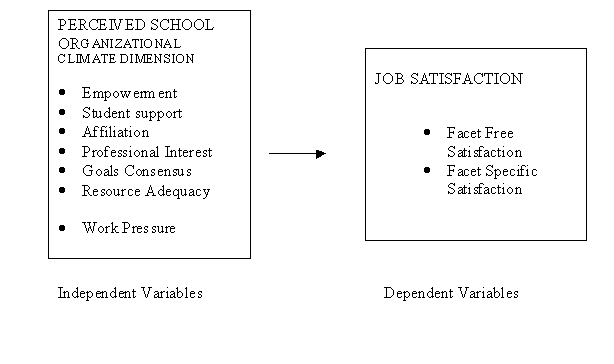
In this study, school organizational climate is conceptualized to include the following seven organizational characteristics or dimensions: empowerment, student support, affiliation, professional interest, mission and goal consensus, resource adequacy and work pressure. The instrument adopted covers Moos’ three general categories of the psychosocial aspects of the human environment. The first three dimensions are the relationship dimensions; the fourth dimension belongs to the personal development dimension while the last three are components of the system maintenance dimensions. These dimensions were adopted from Catholic School Environment Questionnaire (CSEQ), a recent (1996) instrument based on School Level Environment Questionnaire (SLEQ) which was designed especially to assess and measure teachers’ perceptions of psycho-social dimensions of the environment of the school.
In this study, job satisfaction is conceptualized to include both facet free satisfaction and facet specific satisfaction. Facet free satisfaction measures teachers’ overall satisfaction with teaching as a career while facet specific satisfaction measures teachers’ satisfaction towards specific aspects of their job and job environment and are categorised to include intrinsic, extrinsic and social satisfaction.
Empirical studies had established that the dimensions of organizational climate are associated with job satisfaction (Friedlander & Marguiles, 1969; Pritchard & Karasick, 1973; Litwin & Stringer, 1968, cited in Kopelman et al. 1990). The main intention of this study is to examine the association between the seven organizational climate dimensions and job satisfaction. The research framework is shown in Figure 1 as follow:
Figure 1: Research Framework
The research framework was guided by the following hypotheses.
Hypothesis 1:
There is a significant difference in teachers’ perceptions of school organizational climate dimensions between selected fully residential and non residential schools.
Hypothesis 2:
There is a significant difference in teacher’s overall job satisfaction between selected fully residential and non residential schools.
Hypothesis 3:
There is a positive relationship between the perceived school organizational climate dimensions and teachers’ job satisfaction.
Hypothesis 4:
There is a significant difference in the operationalization of overall job satisfaction by facet specific and facet free measures.
Measurement and Instrument
A four part self-administered questionnaire was used in this study. Part A gathered teachers’ personal attributes and professional demographic information. Part B are items about school organizational climate while Part C and Part D consist of items pertaining to facet free and facet-specific job satisfaction respectively. The English version of the questionnaire was translated into the Malay Language first by the researcher and then checked by two Malay Language teachers (one of them are also proficient in English). The translation was validated by my supervisor, Associate Professor Dr Aminah Ahmad. The associate professor patiently checked every item one by one with the researcher to be doubly sure that the translations were as close to the original meaning as possible. Further improvements on the climate instrument were made after the pre-test.
School Organizational Climate Instrument
From the literature review, it was found that the researchers have yet to develop a measure of organizational climate that can be used across different organizations. A few widely employed organizational climate questionnaires were available. These instruments include the Modified Litwin and Stringer (1968) Organizational Climate Questionnaire (OCQ), the Halpin & Croft’s (1963) Organizational Climate Description Questionnaire (OCDQ) and the School Level Environment Questionnaire (SLEQ).
Litwin and Stringer’s OCQ is more for the business organization and is not suitable for the school context. Poon et al. (1986,1989,1990) used OCD in three separate organisational climate studies in business organizations. OCDQ was a well studied school climate measure but it lacks economy in terms of testing and scoring time. It has too many items (69 items) and many items were found to be not suitable to the local school context such as "Teacher eat lunch by themselves in their own classroom", "The principal stays after school to help teachers finish their work." and " The principal tries to get better salary for teachers." In addition, OCDQ was considered an older school climate instrument used from 1960s to late 1970s.
Literature review showed that SLEQ became more popular in the eighties. Rentoul and Fraser (1983) provided one of the earlier report on the development and validation of SLEQ. Another SLEQ validity study was reported by Fisher and Fraser in 1992. Dorman, Fraser and McRobbie (1995) used the SLEQ to assess the relationship between the school level and classroom level environments .
In another study, Dorman (1996) adapted the SLEQ and developed a new instrument called the Australian Catholic School Environment Questionnaire, CSEQ (See Appendix A). Dorman (1996:187) used "school psycho-social environment" as an alternative term for school climate. The CSEQ was developed largely based on the SLEQ. Five of its scales were modifications of SLEQ scales which had been used over the past decade (Dorman, 1996: 191). SLEQ consists of eight climate dimensions: student support; affiliation; professional interest; staff freedom; participatory decision making; innovation; resource adequacy and work pressure. Dorman (1996) adopted five of the SLEQ scales; renamed participatory decision making as empowerment and modified the staff freedom and innovation into a single scale called mission and goal consensus. Literature review showed that CSEQ or SLEQ are the more recent instruments suitable for school organizational climate studies as compared to OCQ or OCDQ.
CSEQ was developed not only for Australian Catholic schools, it was also considered appropriate for use in Australian Government schools. All CSEQ items had been checked for their relevance to any contemporary secondary schools. (Dorman, 1996: 191). In Dorman’s study of school environment in thirty two schools in Australia, twelve were government schools. CSEQ has proven sound structural characteristics. In Dorman’s study, Cronbach’s alpha reliability coefficient for empowerment, student support, affiliation, professional interest, mission consensus, resource adequacy and work pressure were 0.88, 0.83, 0.84, 0.80, 0.84, 0.76 and 0.80 respectively. The discriminant validity (mean correlation with other scales) for empowerment, student support, affiliation, professional interest, mission consensus, resource adequacy and work pressure were 0.34, 0.28, 0.32, 0.37, 0.38, 0.20 and 0.08 respectively.
This study adopted CSEQ (based on SLEQ) as the instrument to measure the perceived school organizational climate. Since SLEQ has been widely used in the studies of teachers’ perceptions of psycho-social dimensions of the school environment across country of different cultural background, it is deemed to be content valid. CSEQ was chosen as the instrument to measure school organizational climate based on its noteworthy features such as its consistence with the literature, coverage of Moo’s three general categories for conceptualizing all human environments, salience to practising teachers, specific relevance to schools and its economy (Rentoul & Fraser, 1983; Fisher & Fraser, 1992).
The perceived school organizational climate was measured with 56 statements pertaining to the following seven dimensions: mission and goal consensus, empowerment, student support, affiliation, professional interest, resource adequacy and work pressure. Teachers were asked to respond to each item based on a five point Likert scale with the responses of strongly disagree, disagree, not sure, agree and strongly agree. The statements are presented in a cyclic manner without references to scale or indicator identity. In accordance with established standards of instrument development, both positively and negatively worded items appear in the questionnaire (Anderson 1981 as cited in Dorman 1996). Scale allocations are shown in Table 4. The negatively worded items were underlined. The underlined items were reverse scored.
|
Scale |
Items |
| Mission or goal consensus | 1,8,15,22,29,36,43,50,52,56 |
| Empowerment | 2,9,16,23,30,37,44, 50, 51,53,54 |
| Student support | 3,10,17,24,31,38,45 |
| Affiliation | 4,11,18,25,32,39,46 |
| Professional interest | 5,12,19,26,33,40,47 |
| Resource adequacy | 6,13,20,27,34,41,48,55, |
| Work pressure | 7,14,21,28,35,42,49 |
Since Dorman’s (1996) CSEQ was largely based on SLEQ and SLEQ had been widely used in educational administration research across Australia and the USA, the instrument was assumed to be universal. As Dorman’s (1996) CSEQ had been checked for its relevance to any contemporary secondary schools, it was assumed to be suitable for the current study. A perusal of the instrument showed that there was not a single item which can be identified as unique only for the Catholic schools.
In this study, job satisfaction was envisaged as to consist of facet-free and facet-specific satisfaction. Facet free satisfaction instrument consist of five items, each with a five point Likert scale. The first three items inquired about satisfaction with teaching as an occupation (occupation satisfaction, OCCSAT), how teaching measures up to initial expectations (occupation expectation, OCCEXP) and satisfaction with the present job (now satisfaction, NOWSAT). These three items were scored on a five point Likert scales with responses of very small extent, small extent, undecided, great extent and very great extent. The fourth and fifth items measured the retrospective likelihood of entering teaching again (occupation decision, OCCDEC), and the likelihood of optional retirement (optional retirement decision, OPTDEC). The last two items were scored on a five point Likert scale with responses of very unlikely, unlikely, undecided, likely and very likely. All five except the last item were adopted from the overall job satisfaction instrument used in a five-country study of the work perceptions of secondary school teachers by the Consortium for Cross Cultural Research (A.Menlo et al., 1990). The last item inquired about the likelihood for optional retirement was included in this study for the first time because of its relevance in the current Malaysian context (under the New Remuneration System) as described earlier in the introduction section. The last item is a negative item and it is reversely scored. Face validity is suggested for this newly added item in that it was assumed that teachers who are most satisfied would be least likely to opt for early retirement. The facet free overall job satisfaction was determined using the mean of the five facet free satisfaction items, that is Facet Free Overall Job Satisfaction = (Occsat + Occexp + Occdec + Nowsat + Optdec) divided by five. In the original five-countries study, using a similar approach of taking the mean of the four facet free satisfaction items, the alpha reliability of facet free overall job satisfaction was found to be 0.79.
The facet specific satisfaction was measured by an eleven-items job satisfaction instrument, adopted from FORUM Corporation, Boston, Massachusettes, obtained from Schnake (1983: 806-807). The eleven-items instrument employed a five-point Likert-scale with responses of very dissatisfied to very satisfied. Using factor analysis of the eleven items, Schnake (1983) found three factors which represent intrinsic, extrinsic and social satisfaction. The items factor analysed by Schnake formed the priori scales of facet specific job satisfaction for the present study. In Schnake’s (1983) study, the internal consistency reliability coefficients for the three factors were 0.86, 0.64 and 0.85 respectively.
The priori scale for intrinsic satisfaction was comprised of six items which measured teachers’ satisfaction with regard to the respect they received from colleagues; their chances to accomplish something worthwhile; the amount of job freedom; the chances to do something that make the them feel good about themselves; the opportunity to take part in decision making; the opportunity to learn new things for personal growth; and job security. The priori scale for extrinsic satisfaction was comprised of two items which measured teachers’ satisfaction with the amount of pay and the fringe benefits they received while the priori scale for social satisfaction was comprised of three items which measured teachers’ satisfaction with the treatment; the respect they received from their colleagues and the friendliness of people they worked with. The facet specific overall job satisfaction was determined using the means of the eleven job specific items.
The target population were teachers with at least one year teaching experience in two residential and two non residential secondary schools in Kuala Lumpur. Samples were taken from these four schools in late July and early August of 1997. The total teacher population of the selected schools were estimated to be around 400. A sample size of 160 was used for this study. Forty sets of questionnaires were sent to each of the four selected schools. A total of 134 usable forms were returned. This represents a response rate of 84%. The samples consisted of both male and female teachers, irrespective of types of discipline, who have served at least one year in their respective schools. The rational for this sample selection was to ensure that teachers who answered the questionnaires had at least some experience with the present school and were in a better position to assess his or her school climate and job environment. This was to ensure that the respondents were valid samples.
This study used the self-administered questionnaires survey method as a mode of data collection. Questionnaires were sent to a fully residential schools and a non residential schools for pre-testing during second week of July 1997. These schools were not part of the population. However, the researcher believed that the schools involved in the pre-test resembled the sample schools of the study since they are in the same vicinity and are under the same educational systems. Teachers in the pre-testing schools were assumed to have encountered more or less similar problems with respect to their school organizational climate and issues of job satisfaction. The tested and revised questionnaires were then sent to the principals of the schools involved in the study by personal delivery during the first week of August 1997. Each principal or his assistant was briefed on how the questionnaires were to be given to the teachers. List of teachers with at least one year teaching experience was determined from the school’s official list of teaching staffs. The first element was selected randomly from the list, then systematic random sampling technique was used to select the rest of the sample by choosing every kth member in the list so as to have forty respondents from that particular school. The principal or his assistant was asked to give the questionnaires to the teachers selected in such a manner. The respondents were given a time frame of three to five working days to complete the questionnaires. To show the researcher’s appreciation of the respondents’ willingness to participate in this study, each respondent was given a 2B pencil. The questionnaires from each of the four schools were picked up personally on a frequencies of two to three times during the time frame mentioned. This was to keep track of the progress of the data collection process while at the same time to enable data coding and data entry to be carried out simultaneously.
Pre-Testing
A pilot test of the instruments was conducted during the second week of July 1997. The purpose of the pre-test was to identify any ambiguous items and to check the reliability of various school organizational climate and job satisfaction scales in the instruments. Fifteen copies of the four parts questionnaires were hand delivered to the respondents in the pre-testing schools. All the fifteen sets of questionnaires were returned. All except one of the questionnaires were fully completed. In the uncompleted questionnaire, three items in the school climate instrument were left unanswered. These three items were:
The pre-test had shown that three out of the fifteen respondents were confused with the word "guru penolong" of item four in the part A of the questionnaires. They seemed to be confused the phrase with " guru penolong kanan". Subsequently, the phrase was changed to "guru biasa" in the final set of the instrument. Feedback from some respondents showed that item 7 in the school climate instrument was ambiguous. Subsequently, item 7 was modified from "Guru sekolah ini sentiasa mendapat desakan untuk terus bekerja." to " Guru sekolah ini sentiasa mendapat desakan/tekanan untuk terus bekerja." The original items in the English version was "There is constant pressure to keep working." Item 17 in Part B was also found to be ambiguous and it was changed from " Kebanyakan pelajar adalah menyenangkan dan mesra dengan guru mereka" to " Kebanyakan pelajar adalah disenangi dan mudah mesra dengan guru mereka".
Reliability of the Instruments
During pre-testing, the alpha-reliability or the internal consistency of three out of seven school climate scales were found to be low (See Table 5). As a result, two items were deleted from the empowerment scale to improve the alpha-reliability coefficient from 0.51 to 0.70. These were item 51: "Kerapkali guru dikehendaki mengambil bahagian dalam membuat keputusan mengenai prosedur dan polisi pentadbiran" and item 54 "Saya kurang peluang bagi menyuarakan pendapat dalam hal mengenai perjalanan sekolah ini". Possibly, these items were not reliable because majority (70%) of the teachers were ordinary teachers and were not involved in the administration of the school. One item, that is, item 13 "Bekalan alatan dan sumber-sumber adalah mencukupi " was deleted from the resource adequacy dimension of the school climate instrument to improve the alpha-reliability coefficient from 0.47 to 0.71. Four out of seven items for the work pressure dimension were deleted to improve the alpha-reliability coefficient from 0.36 to 0.72. Items deleted were item 14 "Guru-guru perlu bekerja untuk tempoh masa yang panjang supaya dapat menghabiskan semua kerja mereka."; item 21 "Guru tidak perlu bekerja keras di sekolah ini."; item 35 " Guru boleh ambil sikap mudah tetapi kerja masih dapat diselesaikan" and item 42 " Guru jarang diperlukan untuk menepati tempoh siap kerja". These items were possibly unreliable because they are too subjective. Teachers’ perceptions towards work pressure are very much subjected to teachers’ attitude towards their work. Some teachers may have the perceptions that the work that cannot be finished today can always be done tomorrow while others who are more committed may think otherwise. Thus, diverse interpretation may be the cause of the low reliability. Literature review had shown that the work pressure dimension was not the original dimension of the School Level Environment Questionnaire (SLEQ) and Catholic School Environment Questionnaire (CSEQ). It was added to the SLEQ and CSEQ to complete the view of the school environment (Fisher &Fraser, 1992: 117). No validation data for the new work pressure scale was available in Fisher and Fraser’s validation study of SLEQ (Fisher and Fraser 1992:128). However, alpha-reliability coefficient of work pressure scale was found to be high (0.80) in Dorman’s (1996) study using CSEQ which was derived from SLEQ. The discrepancy may provide us some justification in deleting four items out of seven items because of the instability of the new work pressure scale. However, a cross validation of the pre-test reliability might proved to be a better option than deleting the items if time factor was not a constraint.
Table 5
Alpha Reliability Coefficients of the Climate Scales at Pre-test and Actual Test
| Pre-Test | Actual Test | ||||
| Climate Scales | No.of items | Alpha reliability for original items | No. of items left | Alpha reliability for original items | Alpha reliability for original items |
| Empowerment |
10 |
0.51 |
8 |
0.70 |
0.74 |
| Student Support |
7 |
0.72 |
- |
- |
0.87 |
| Affiliation |
7 |
0.83 |
- |
- |
0.66 |
| Professional Interest |
7 |
0.69 |
- |
- |
0.65 |
| Mission and Goal Consensus |
10 |
0.70 |
- |
- |
0.81 |
| Resource Adequacy |
8 |
0.47 |
7 |
0.71 |
0.62 |
| Work Pressure |
7 |
0.36 |
3 |
0.72 |
0.50 |
Alpha reliability analysis for the actual research showed that the internal consistencies of the various school climate dimensions vary from 0.50 for work pressure to 0.87 for student support. The reliability level of 0.50 is considered sufficient for basic research purposes (Guilford 1954). Cook and Campbell (1976, cited in Schmitt & Klimoski 1991: 30) pointed out that the potential threat to internal validity includes among others, selection of participants and instrumentation. As the internal reliability for six other dimensions were reasonably high, the researcher ruled out the possibility of participant selection as the cause for low reliability for the work pressure dimension. The consistently low alpha reliability for the work pressure dimension may be due to the of the instrumentation itself since it is a newly added dimension to the SLEQ and CSEQ in order to complete the view of school climate. In retrospect, it might be better to keep the original seven items instead of deleting four items for the actual research.
During pre-testing, the internal consistency for the facet-free satisfaction instrument was satisfactory (alpha=0.67) while the alpha reliability for the facet specific job satisfaction instrument were found to be high, ranging from 0.67 to 0.88 as depicted in Table 6. All the original items for the two instruments were kept for the actual research. For the actual test, the alpha reliability for the facet-free overall job satisfaction instrument was 0.83 while the alpha reliability for the facet-specific job satisfaction instrument ranges from 0.65 to 0.78. (see Table 6).
Table 6
Alpha Reliability Coefficients of Facet Free and Facet Specific Scales at Pre Test and Actual Research
| Job Satisfaction Scales | No. of items | Alpha Reliability (Pre-test) | Alpha Reliability (Actual Research) |
| Facet Free Overall Job Satisfaction |
5 |
0.67 |
0.83 |
| Facet Specific Job Satisfaction | |||
| Intrinsic Satisfaction |
6 |
0.84 |
0.78 |
| Extrinsic Satisfaction |
2 |
0.88 |
0.65 |
| Social Satisfaction |
3 |
0.67 |
0.74 |
Data Analysis
The data were coded on the right hand column on the questionnaires itself. Special care was taken to made sure that the negative items which were scored in the reverse manner were coded correctly. The coded data was transferred to the computer for analysis. The "SPSS For Windows Release 6.0" program was used for data analysis. Before the actual data analysis, the raw data were printed out to check for any irregularity in patterns. This served the purpose of detecting error in data entry.
New variables representing the seven school climate dimensions and the two measures of overall job satisfaction were computed based on the priori assigned items. The procedure used to compute a new variable was to sum up the relevant items and then divided by the number of items for that particular dimension. This procedure was adopted so as to exclude a case as long as there was one missing item among the other items that constitute a particular new variable to be computed. The alternative of using the existing built in mean function would have a value computed for the new variable despite one or more missing items. In other words, the built-in mean function would still compute a value for the new variable based on the all the items minus the missing item or items. The researcher is of the opinion that such computed values would have "diluted" the values for the composite variable compared with the values if there were no missing items. The researcher would rather prefer a smaller number of valid cases than having some values that were not reflective of the "supposed to be" values. Since the sample size of the study was statistically large enough, a smaller number of valid cases would not pose any problems in statistical analysis. One other alternative of replacing the missing value or values with mean would depend on the normality of the distribution. New variables for intrinsic satisfaction, extrinsic satisfaction, social satisfaction and overall job satisfaction were computed in the similar manner.
The continuous data for the respondents demographic information such as age, salary, teaching experience, experience with the present schools and number of teaching periods were re-coded into interval measurements for clearer presentations. In order to categorise the levels of perceptions of organizational climate dimensions and the levels of job satisfaction, the mean values of all the independent and dependent variables were re-coded into three categories of low (1.0 - 2.5), medium (2.6 - 3.5) and high (3.6 - 5.0). The data were explored using the SPSS program for normality of distribution. This was done by charting the histograms or executing the P-P plot of normality for the various variables.
Descriptive statistics such as frequency distribution and measures of central tendency were utilised to describe the profile of the respondents. Independent t-tests were used for hypothesis testing of any significant differences in teachers’ perceptions of various school organizational climate dimensions, facet-specific job satisfaction comprising intrinsic, extrinsic and social satisfaction and facet free overall job satisfaction among residential and non residential schools. The Pearson’s product moment correlation analysis was utilised to determine the strength and direction of association between independent variables of various school climate dimensions and dependent variables of intrinsic, extrinsic, social, facet specific and facet free overall job satisfaction. Paired t-test was utilised on the means of the two measures of overall job satisfaction to test for the hypothesis that there is a significant difference in the measurement of the two overall job satisfaction instrument.
Abstract|Chapter 1 |Chapter 2| Chapter 4| Chapter 5|
This page hosted by  Get your own