Fetal Development
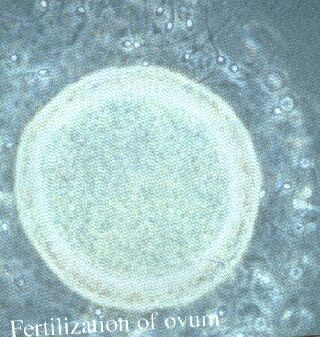
DAY 1 Sperm joins with ovum to form 1 cell- smaller than a grain of salt. The
new life has inherited 23 chromosomes from each parent, 46 in all. This
one cell contains the complex blueprint for every detail of human
development - the child's sex, hair color and eye color, height, skin tone.
DAY 3-4 The fertilized ovum travels down the fallopian tube into the uterus,
where the lining has been prepared for implantation.
DAY 5-9 During this time, the fertilzed egg implants itself in the rich lining
of the uterus and begins to draw nourishment.
DAY 10-14 The developing embryo signals it's presence through placental chemicals
and horomones, preventing the mother from menstruating.
DAY 20 Foundations of the brain, spinal cord and nervous system are already established.
DAY 21 The beart begins to beat.
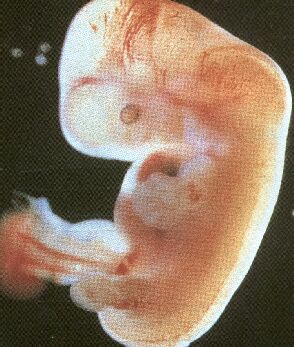
DAY 28 The backbone and muscles are forming. Arms, legs, eyes and ears have begun to show
DAY 30 At one month old, the embryo is 10,000 times larger then the original fertilized egg-and
developing rapidly. The heart is pumping increasing quantities of blood through the
circulatory system. The placenta forms a unique barrior that keeps the mother's blood
separate while allowing food and oxygen to pass through to the embryo.
WEEK 5 Five fingers can be discerned in the hand. The eye darken as pigment is produced.
DAY 40 Brain waves can be detected and recorded.
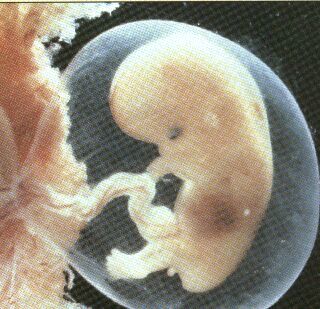
WEEK 6 The liver is now taking over the production of blood cells, and the brain begins to
control movements of muscles and organs. The mother is about to miss her 2nd period
and has probably confirmed that she is pregnant.
WEEK 7 The embryo begins to move spontaneously. The jaw forms, including teeth buds in the
gums. Soon the eyelids will seal to protect the embryo's developing light sensitive
eyes, and will reopen t about the 7th month.
WEEK 8 At a little more than an inch long, the developing life is now called a "fetus" -
Latin for "young one" or "Off spring." Everything is now present that will be found
in a fully developed adult. The heart has been beating for more than a month, the
stomach juices and kidneys have begun to function. 40 muscle sets begin to operate
in conjunction with the nervous system. The fetus's body responds to touch, although
the mother will not be able to feel movement until the 4th or 5th month.
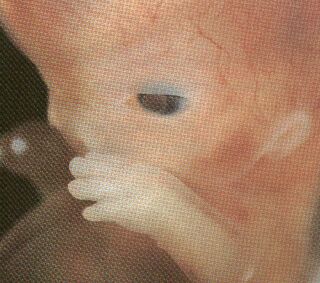
WEEK 9 Fingerprints are already evident in the skin. The fetus will curve it's fingers around
an object in the palm of it's hand
WEEK 10 The uterus has now doubled in size. The fetus can squint, swallow and wrinkle it's forehead
WEEK 11 At this time, the fetus is about 2 inches long. Urination occurs. The face has assumed a baby's
profile, and muscle movements are becoming more coordinated.
WEEK 12 The fetus now sleeps, awakens, and excercises it's muscles energetically-turning it's head,
curling it's toes, and opening and closing it's mouth. The palm, when stroked, will make a tight
fist. The fetus breathes amniotic fluid to help develop it's respiratory system.
WEEK 13 Fine hair has begun to grow on the head, and sexual differentation has become apparent.
MONTH 4 By the end of this month, the fetus is 8-10 inches in length and weighs 1/2 lbs or more. The
mother will probably start to show now. The ears are functioning, and there is evidence that
the fetus hears quite a bit: the mother's voice and heartbeat as well as external noises. The
umbillical cord has become an engineering marvel, transporting 300 qts. of fluids per day and
completing a round trip of fluids every 30 sec.
MONTH 5 Half the pregnancy has now past, and the fetus is about 12 in. long. The mother has begun to
feel movement by now. If a sound is especially loud or startling, the fetus will jump in
reaction to it.
MONTH 6 Oil and sweat glands are functioning. The delicate skin of the growing baby is protected
from the fetal waters by a special ointment called "vernix" If the baby were born in this
month and given proper care, he would survive.
MONTH 7 The baby now uses the 4 senses of vision, hearing, taste, and touch. He can recognize his
mother's voice.
MONTH 8 The skin begins to thicken, with a layer of fat stored underneath for insulation and
nourishment. Antibodies increasingly build up. The baby absorbs a gallon of amniotic
fluid per day; the fluid is completely replaced every 3 hours.
MONTH 9 Toward the end of this month the baby is ready for birth. The average duration of
pregnancy is 280 days from the mother's last period, but this varies. Most babies are
born between 266 and 294 days. By this time the infant normally weighs 6-9 lbs and his
heart is pumping 300 gallons of blood per day. He is fully capable of life outside the womb.
Abortion Procedures
keep in mind that by the time you find out you are pregnant, the baby's nervous system is present and she can feel everything being done to her.. There are a few types of abortion procedures that are done:
MENSTRUAL EXTRACTION
This is used very early in pregnancy. It is a suction vaccum pump that sucks out
everything in the uterus. Including the weeks old child and placenta.
D&C
In this procedure the cervix is dialated, which is very painful, sometimes even more so
than birth because this is forced open in a short time frame rather than allowing nature
to takes it course. A loop shaped knife is then inserted into the womb to cut up
the baby into pieces then pull her out. The uterine lining is scraped to remove the
placenta.
SUCTION CURETTAGE
The cervix is dilalated with various shaped metal rods, then a sharp, knife like
suction tip in placed in the uterus and turned on. As the baby is pulled toward the
tip it shred the baby into pieces while it sucks her into the machine.
D&E
The baby is much larger now (14-16 weeks) so the cervix is opened even wider. The
baby is dismember by the abortionist who grabs the limbs with an instrument and twists them off
The skull is crushed and her spine snapped for easy removed. A sonogram is sometimes
done to check for missed body parts. To soften the body, sometimes urea is injected
into the amniotic fluid or the water is broken and the umbilical cored cut to starve the baby
24 hours before the abortion
SALINE INJECTION
The abortionist injects a salt solution into the amniotic fluid through the mother's abdomen.
This causes burning and poisoning as the baby digests the fluid. Prostaglandin is also injected to start labor
and the mother delievers a dead baby. This is extremely painful for the child and the contractions can last
for hours upon hours for the mother. Sometimes a live child is born, severely malformed from the
attempted abortion.
HYSTERECTOMY
like a c-section, the abortion open the uterus and removes the baby and the placenta. The child
who could many time be saved in the 2nd and 3 trimesters, is left alone to die
D&X AKA = Partial birth abortion.
The child can live outside the mother's body at this time. Labor is induced and the live
child is delivered all exepct the head, which is held inside the vagina by the abortionist,
to keep the birth from being completed or else the law would step in. A pair of surgical scissors
is then jamed into the base of the child's skull and the hole is enlargened by opening and rotating
the scissors. then a suction tube is inserted and the child's brain is sucked out and the skull collapsed.
This has been going on in the USA for years and is NOT as rare as they say it is, and is absolutly NOT needed.
There is no situation where this must happen to save the life or health of the mother! if birth is going to harm or
kill the mother, then it has already been done, the birth is basically already done! This is just outright infanctide.
CANCER RISKS BY ABORTION
girls under 18 who have an abortion during the first pregnancy have increased their breast
cancer risk by 150%. Woman 30 and over who abort during first pregnancy has raised their
breast cancer risk by 110%. Anyone who aborts any pregnancy has increased their breast cancer
risk by 50%. The reason for this is: the cells that wait for the signal to start milk production
never get that signal. cells that have no instructions are more susceptable to cancer setting in.

 Get your own Free Home Page