

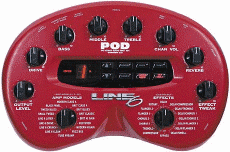
I've had some time to play around with my POD, but only recently did I make an important discovery regarding effects pedals and POD.
As regular visitors to this site will know, I own a fair number of overdrive/distortion pedals. One reason why I held off buying a POD for so long was the price, but a second and almost as compelling a reason was that I'd assumed the POD would make my pedals obsolete.
I was assured by music shop employees that I could have the best of both worlds by combining the two.
However, until a few days ago, my experiences had proven otherwise. None of my pedals were able to improve upon the tones I was getting from POD; in fact, in most cases, the pedals actually detracted from the overall sound.
Keep in mind that I'm talking about overdrives/distortions. Other pedals worked just fine.
I'm almost embarrassed to reveal how I resolved the situation, but if it helps anyone else, then a bit of red-facedness on my part is a small price to pay.
Quite simply, I rolled off the "Drive" control. POD owners know (or should know) that the Drive is initially a volume boost (more or less) and only becomes an overdrive/distortion after some kind of manipulation. Yes, I know the manual says one uses the "Tap Hold" function, but that doesn't seem to work for me. Instead, I have to turn the control fully counter-clockwise to engage the effect.Now that the amp model of choice is in "clean" mode, most pedals make a significant difference to the POD tone. For example, my beloved BOSS SD-1 simply SINGS in any of the Fender models, much as it does with the real deal.
|
The bottom line? POD has just become that much more enjoyable for me. Oh, and I won't be selling any of my pedals. |
 Line 6 POD 2.0 Recording Amp
|






|