|
|
|
| History of Modbury Church........ By Helen Harris |
|
There have been three Methodist churches in the Modbury area. First Church built 1863, second 1962 and third built in1971. Before the first white settlers arrived in the area now known as Modbury it was inhabited by what was known as the Adelaide tribe of Aboriginals – the Kaurna people. The Aboriginal name for the area was “ Kirra–ung-dinga”, translated “As the place where Red Gums grow by the creek”. With settlement, the Aboriginal tribe gradually died out. By the 1850’s very few Aboriginal people remained in the area, only occasionally passing through. Most of the early settlers in Modbury came from England and were interested in the Christian Faith. Services of worship were conducted in private residences in the 1840’s. |
|
|
|
Robert Symons Kelly settled in the district in the 1840’s and named the settlement of Modbury after his home town in the south of England . The original church site was opposite the now T.T.Plus. The first two churches 1863 & 1926 were erected there. Robert Kelly was a public-spirited man, interested in the community and was chairman of the district council from 1860-62. When he donated the piece of land in 1863 to the church, the Wesleyan Chapel was built. Kelly stipulated the chapel should also be used for a day school. |
|
In 1865 he gave another piece of land close to the chapel for a recreation ground. The original Modbury Oval and latter tennis court (now civic park) were there. Today the new council chambers Library and car park are part of this area also. In January 1867 the people of Modbury held a New Years Day gathering where they had a picnic and cricket match. The afternoon tea was laid out in the Wesleyan Chapel. Robert Kelly also gave the land for the Institute building, which now houses Youth and Community Affairs. Robert Kelly also gave the land for the old Modbury primary School, which is now part of Sfera’s on the Park. Robert Symond Kelly figured prominently in the foundation and running of the 1863 church, he was an original trustee and church steward. He was also the church organist from 1863 until the 1890’s when his daughter Carolyn took over the position and continued for the next 30 years. Mr. James Cronk was also closely connected to the church. His son Henry Cronk took a leading part in the church before the turn of the century and was Sunday School Superintendent from 1890 to 1906. George Morris was the original secretary of the 1863 church and also a church steward. He was the only living original trustee when the 1926 church opened. Jack Morris (son of George) was Sunday School Superintendent from 1906 –1910. Jack’s brother Frank was also a church trustee and Sunday school teacher in the late 1890’s. The Marrett family was also closely associated with the Modbury church. Mr. James Dicker and family were very active in the early church. The Dicker farm (later owned by the Buder family) is where the new church was built in 1971. Other people associated with the first church – the South family, Elliot’s, Nelson’s and Mr. & Mrs. Edward Michelson. Mr Mitchelson was the first Post Master of Modbury and he was also the Registrar of Births, Deaths and Marriages for the district. The church built in 1863 had stone walls and an iron roof and was approximately 40 feet long and 20 feet wide. The pews were hand made and lighting for the evening service was by hanging three kerosene lamps. The first known Minister was Reverend John Waterford who conducted services in 1865. Two other early preachers were Robert Flockton and Mr. Walter Hill. The marriage of Mr. and Mrs. Gilmore was the first to take place in 1886. Mr. R. E Lucy (who was a Justice of the peace) and family from “Alderly farm”, (later known as Stonehenge ) were also active in the church. Miss Ethel Lucy was the third church organist and played from 1920-1936. She was also involved in the setting up of the Sunday school room, which was erected at the rear of the church. The room was 24 feet by 20 feet and served as kindergarten section of Sunday school from 1924-1966. The new Kindergarten was opened in 1923 from funds raised by locals of the district Mrs. W. Lokan was one of the main organizers in raising these funds. A Miss Bowey (Mrs. John Tilley) was the winner of the Queen competition, which was held to raise funds for the new kindergarten as well. As early as 1914 a new church building fund had commenced. In that same year – 3rd May 1914 the church Jubilee (50th Anniversary) service was held. Other early settlers in the area were George Bowey (first special constable) Lokan, Lloyds, Elliots, Hancock, Roberts and Wilkeys all settled in Modbury. The Boord family served the church for 50 years. With the turn of the century many more families such as the Ropers, Holbrook, Harris, Wright, Wren, Richardson, and Manly families all had close association with church and Sunday school. Miss Jean Manly was the first bride to be married in the new 1926 church, The Avery and Phillips family were also active church workers. In October 1924 the roof of the church was destroyed by a thunderstorm. On the 7th of January 1926 the trustees decided to replace the original church building with a new brick one which was estimated to cost between 800-1,000 pounds. The Lokan Brothers carted all the materials for the building, which then served the town of Modbury until the late 1960’s. Due to the increase in population a new church was built in 1971. The church building is the third to be erected at Modbury since the start of settlement. The foundation stone at the Modbury Uniting church on Montague Road . “To the Glory of God” Laid for the Pioneer Methodist of the Modbury District. The Reverend John Watt holds Church services on Sundays at 9am and there is also Sunday school. Karadinga
recreation Centre (after the aboriginal name) that is attached to the
church is also run by the Uniting Church. There are squash courts, table
tennis club, and various community groups who use the centre. The mural on
the front of the building depicts the heritage of the local area with the
old Methodist church in foreground.
|
|
|
Early
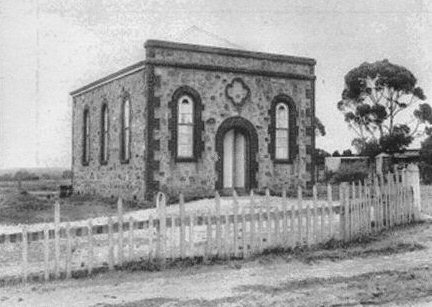
History of the Baptist Church In Tea Tree Gully’ Records show that the Baptists held services in their homes as early as 1858 in Tea Tree Gully and Hope Valley . One home mentioned is that of Mr. Job Mills. As numbers increased Mr. William Haines, Snr., gave them the use of his cottage in Tea Tree Gully. To provide adequate room a partition-wall was removed. The cottage, which is still standing, is situated at 1360 North East Road almost opposite the Tea Tree Gully Hotel and was until recently the home of the late Mrs. Marie Clarke. This prosperity was so encouraging that it was on May the 30th 1860 the Church was formed and was attended by fifteen people. The Rev. George Prince presided. ‘The profession of belief’ of the ‘Ebenezer’ Particular Baptist Church was read and accepted by those present. Tea Tree Gully Baptist Church was formed as a branch of the ‘Ebenezer’ Church. Messrs. William Haines and Robert Carter were elected Elders and each presented with a bible on behalf of the parent church. On Sunday May the 11th 1862, three sermons were preached in the Wesleyan Chapel, at a locality referred to as Steventon, Tea Tree Gully, one Baptist, one Wesleyan, and one Independent, in aid of the building fund for a new church in the area – The Tea Tree Gully Baptist Church. A successful tea meeting and fundraising effort followed on the Monday evening. The land on which the Ebenezer and Metcalf building now stand, was presented to the church by Mr. John Flavel and a nominal payment of ten shillings was made to satisfy legal requirements. Nine members were appointed trustees. The first Baptisms were conducted by the pastor on the 28th of April, 1861. These must have been in the open, because the Ebenezer Chapel was not opened for public worship until 29th of March, 1863. It seems a tank was used or a baptistery dug and formed, before building the church. The building cost about 250 pounds. The pulpit and eight seats were given by the North Adelaide ‘Ebenezer’ Church. Tea Tree Gully Baptist Church , 1862 In 1865 the Church joined the Baptist Association which, in 1895, was incorporated as the Baptist Union of S.A. A Sunday school was commenced in June 1866. A remarkable service at the beginning of 1868 connects with more recent history. An elderly lady and her grand daughter were baptised on this occasion. The girl eventually became the mother of one who was prominent in Baptist affairs for many years and was largely instrumental in establishing the ‘Illoura’ Baptist Homes for the Aged, namely, Mrs. E.K. Wilcox. First Deaconess’ – Sisters Garret and Wicks – were appointed in December 1868. In his honour the second building was called the ‘ Medcalf Memorial Baptist Church ’ and his daughter, Mrs. H. Fisher along with Sir Charles H. Goode, laid foundation stones, in October 1913. The Church after about seven years of planning and money raising was completed in 1914. |
|
|
Greenwith
Uniting Church ‘Celebrating 140 years’ 1863 –
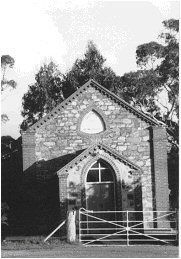
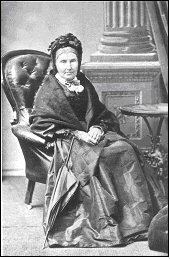
2003 Before the chapel was built services were held in the cellar of the home of Thomas and Hannah Roberts. One of the early settlers of Golden Grove was George Robinson who was associated with the Salisbury Primitive Methodist Church.It was the people of that church who were the instigators of building a church in the Golden Grove area. The first meeting of the Trustees of the Greenwith Primitive Methodist Chapel was held on the 9th of June 1863. Paul Roberts of Greenwith Farm, son of Thomas and Hannah, donated ½ an acre of land and it was agreed to build a chapel with inside measurements of 30 feet long x 18feet wide and 14 feet in height; two Gothic windows on the east and the west and a door to face north. The Roberts family named their farm after Greenwith in Cornwall U.K. which is still pronounced Green-with. Hannah Roberts laid the foundation stone at a service and tea meeting on Tuesday 30th June 1863. Unfortunately this stone was never written on. The tender by George Robinson of 2/6d per yard for the masonry work was accepted. He carted stone for the walls from nearby creeks and members of the Salisbury Church carted bricks for the quoins by bullock dray at 2 pounds per 1000. Although unfinished, opening services for the church were held on 15th and 22nd of November 1863. The total cost to this time was 173 pounds. It was over twelve months before the church had a ceiling. The building wasn’t completed until 1868, which was the reason for that year being written on the front of the church. (This date was changed to 1863 some time ago.) The church was used as a school from 1864 – 1869. The chapel experienced hard times in the 1880s and was closed for some years, re-opening in 1893. This was a period of growth with the church being full and at times over flowing. Greenwith was part of the Salisbury Primitive Methodist Circuit until Methodist Union in 1901 when it became part of the Modbury Methodist Circuit. The centenary was held on the 29th September 1968. Around this time it was discovered that the church actually began in 1863. For some years attendance was small with services being held quarterly. From May 1980 monthly services were held, from February 1981 there were fortnightly services and regular weekly services commenced in the mid eighties. The original slate roof was replaced in September 1930 with an iron roof at a total cost of 10 pounds 15 shillings and 4 pence. The iron was replaced in December 2002 with the help of a Heritage Grant from the City of Tea Tree Gully Council. On 22nd June 1977 the inauguration of the Uniting Church took place and in January 1979 the Greenwith Congregation was welcomed into the Golden Grove Uniting Church Parish. The building has been well preserved and remained almost unchanged until the nineteen eighties when a meeting room and toilet block were added and also the front porch. During this period the local people showed their characteristic foresight by purchasing additional land. People saw the benefit of being a separate congregation for mission in the area, so on the 26th of October 1998 Greenwith became an independent congregation with a part time minister. Morning services began in September 1999 and a Sunday school commenced in May 2000 with two children. The Sunday school soon outgrew the back room so a tent was used until a transportable building was erected. This room has been very useful for other functions as well as the Sunday school. For most of it’s life Greenwith was a small rural church in a farming area. It is now a growing church in a fast growing suburban development. Thank you to the Greenwith Uniting Church for the above information.
|
|
 Hanna Roberts |
|