|
As
often happens when researching stories,, I have found a few
discrepancies!
A story tells of Robert arriving in S.A. aboard the Anna Robertson in the company of his wife Alison and that they lived
for
a while in Gilles Street, Adelaide, before acquiring land on Dry
Creek in 1843.
After
looking at the Biographical Index of S.A., it seems Robert Milne
married Alison Knox in Adelaide on the 4th of April 1844! Alison
Knox was born in Aberdeen., Scotland in 1818. Alison's father
was called William. Knox.
There
was a man by the name of William Knox living in the Dry Creek
area. Did they all travel together or did Alison meet Robert
Milne after he arrived in Adelaide?
Robert Milne
Robert Milne was born near Aberdeen in Scotland.
In 1839 he arrived in South Australia aboard the '.Anna
Robertson'. Robert was 28 years old.
Although
Milne settled his land at Dry Creek in 1843), the transfer of title
for the land was dated 19 th February 1853). Giles, the previous
landowner, could have resold to Milne on the ' Lease - Purchase
Scheme '- Title not passing until payment completed.
The Title
was for 'Drummener'.
After
Robert Milne's death in 1866, the Title was transferred to his
wife and three others as Trustees for his son Spencer A. Milne.
Trustees' were Alison Milne, George Phillips, Ironi
Flonger of Adelaide, Robert Symons Kelly - Farmer
of Modbury and James Campbell - Farmer of Dry Creek.. The
Title passed to Spencer Alexander Milne on the 2nd of October
1889.
Spencer A. Milne was born on 22nd March 1858. so
it would appear he was over 31 years when he actually inherited
the property.
Robert
Milne named his property 'Drumminer' after Drumminer Castle in
his native Aberdeenshire . Sometime over the years the
spelling changed to 'Drumminor' as sometime happens with names,
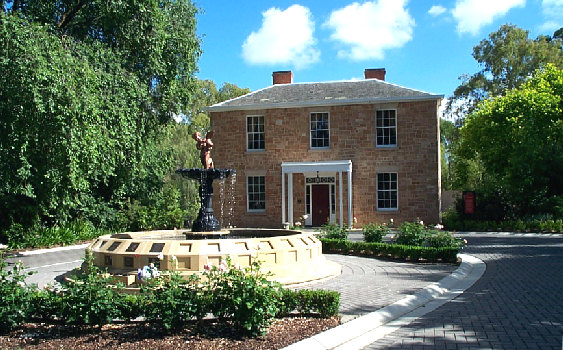
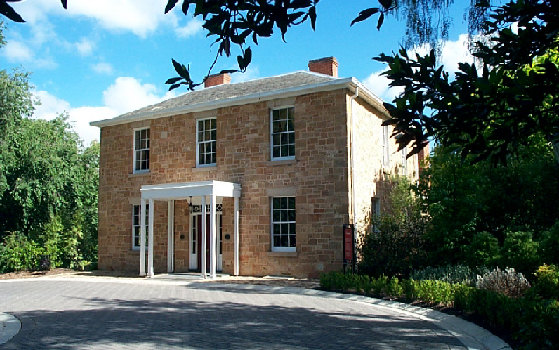
as can be seen with the Title! The large two storey
residence was built in the 'Georgian' style, perhaps to mirror
the architecture of the Castle from which he borrowed the name.
The
house was built as a complete unit, this can be verified by the
original quoins still in place on the corners of' the building,
so it appears the basic stone structure was not added to over
the years, (at least not until after the 1930's). The house was
built of local stone and the roof of imported Welsh slate. The
interior wood paneling of Mahogany and the solid Cedar wood,
used in much of the construction, is thought to have come from
the wood of ships.
The
extensive wine cellar is as wide as the building and half the
depth and although Robert Milne was known to keep a 'fine
cellar'. He would not have considered himself a vigneron.
Found in the cellar in recent years, was a cask date
stamped '1795 - London to Sydney - Gordons Gin'. This is in the
possession of the present owners.
By 1862 Robert Milne had 500 acres of land under
cultivation. and as well as his large two storey house,
he had a nice garden, a commodious cellar, large water tank, a
good stone barn. stables and outbuildings. As proof that the
owner was a gentleman farmer.. it was reported "even the
machinery is under cover",
Robert
Milne was perhaps one of the district's most progressive
agriculturist's and as such was thought to be the first farmer
in the district to construct catchment drains on his property.
He was one of the very first settlers in the colony to use
barbed wire fencing and certainly, the first farmer in the
district to use it. Some can still be found attached to posts on
the property.
In
June of 1854 he wrote to the 'Observer' advocating the general
use of wire in place of post and rail and 'live� fences. He
stated in a portion of the letter, "I find that a 3
wire fence can be put up cheaper than a 2 rail and post
fence: the cost will be 7s. per rod and �112 per mile". The
first wire was a thick black untempered wire known as 'bull
wire', this did not resume its shape when leant on. At the
Adelaide Exhibition of 1855, a wire was on show called 'Bright
wire�. �A more
tempered, more elastic wire but this was expensive.
.�Live'
fences, in the English style, were much favoured by early
settlers in the district. Remains of these 'live' fences were
still visible in the less closely settled parts of the district
until quite recently. Prizes were given at district shows for
the best five rods of 'live' fence. Plants considered suitable
included the Common Rose bush, Dog Rose. Prickly Acacia,
Boxthorn. Kaffir Apple. English Furze and Olive. Two men
could lay down rose cuttings round an eighty acre section
in one week, and �the only expense was trimming� when the
bushes grew!
During
the early 1850s, men and boys' from the district left in droves
for the gold fields in search of their fortune, bringing the
district and indeed most of South Australia to a virtual
standstill. Although
people were despondent. Robert Milne made this very astute
observation in 1852:
'The
unprecedented influx of immigrants
to the neighbouring colonies for the next Year or two,
will open up such a market
for the produce of the corn grower as will inevitably,
assure good prices'.
His
canny foresightedness proved correct.
Although
Ridley invented the 'Reaping Machine' in 1843, Robert Milne in
reply to a questionnaire in 1854 stated that �no new or
improved agricultural implements had been introduced into the
district�. Another
district farmer had replied. "Reaping machines are
injurious to the land, fill it with weeds and prevent good
crops. Hand reaping is best�. The reaping by hand continued on
many farms as late as 1874, where large areas of crops cut for
hay, were still done with a scythe! However, in 1862 on the
Milne property, a large part of the wheat crop was reaped by
machine and threshed with a threshing machine.
Robert
Milne was one of the first five Councillors, when the District
of Highercombe was
proclaimed on July 14th 1853. He became the second Chairman of the
Highercombe District Council and as well as being a successful
farmer, was a member of the Agricultural Society, a Magistrate
and an Officer in the Nth Congregational Church from the time of
its formation.
Under
quite large areas of the district, especially Hope Valley, brown
coal or lignite, had been found, but proved too expensive to
extract commercially. There are a number of cases of people
sinking wells in the district and discovering a seam of coal, as
did Milne in 1843, whilst sinking a well on his property.
In
1861, Robert Milne, then Chairman of the Highercombe Council,
granted the use of his land for the first annual Modbury and
Upper Dry Creek, ploughing match. A gun was fired at 10.00am and
29 entrants, with a class for lads under seventeen, commenced
ploughing. "Each man and boy to plough 1/2 acre in five and
a half hours". First prize was "one of Hornby's best
ploughs and l pound".
As
Milne was described as 'The Squire of Modbury', he presided at
the banquet held at the Modbury Hotel.
Ploughmen
who completed their 1/2acre in the allotted time, received their
dinner free; all others had to pay 5/-
'Drumminor'
was
the
home
of the Milne family for nearly 100 years. Robert and Alison
Milne had 9 children, five females and four males, tragically
six of their children died very young.
A
boy just 10 hours old in June 1845 - no name was recorded.
A girl Jeannie Findlater, perhaps one of the most tragic, born
in 1847 - died 1849 from burns received when a kettle of
boiling water fell from the open kitchen fireplace. A boy, James
Robert, born 1850 - died 1856. A boy William Knox born
1854 - died 1855. A girl Anna Rosina, born 1856 -
died 1857, a girl Mary Rosa born 1862 - died 1865.
Another
daughter Alice Harriet, survived to adulthood, before passing
away in 1881, aged 32 years. The two remaining children,
a boy Spencer Alexander, the heir to the Milne property, reached
79 years and a girl Margaret Bameard (Bemard?) who passed away
in 1930 aged 78 years.
Robert
Milne died in August 1866, aged 55 years and was buried at West
Terrace Cemetery. His wife, Alison lived until 1908 when she
passed away aged 92 years. The title of the 'Drummener'
property, passed
to a son Spencer Alexander Milne in 1889. Spencer Milne died in
1937, and the property was sold to A. & 0.J. Willison of
Modbury.
In
1962 - 'Drumminor' house, which had become derelict, was in need
of extensive repairs. It was purchased and saved by Mr. &
Mrs. Gavin Sandford - Morgan, who restored the house as
near to the original, when built in the 1840s. (Mr. Sandford - Morgan was a well
known collector of antique cars,
the collection of which included the only 'Le
Mans Jaguar' left in existence).
In
1974 the 'Drumminor' once again changed hands to become the
prestigious 'Drumminor Restaurant'
run by Mr. V. & Mr. J. Ieso. The Restaurant closed
its doors with the last social function, perhaps fittingly being
held, on New Years Eve 2000 (The Millenium).
Since
that time the 'Drumminor' property has been sold to Brenton Hill
and Wendy Blades.
The
old buildings in the grounds that were falling into ruins, the
stables, sheds and out buildings, have been stabilised, also the
old cottage near the entrance to the property. These all form
part of the layout of the new and extensive buildings that is
'Harrison�s Heritage Park' Funeral Directors.
These
new buildings have been built on the land facing West, near the
old stables and outbuildings that overlook the Golden Grove
road, so 'Drumminor' house has been left untouched, as heritage
demands. With a lot of expense and thought,
the mix of old and new,
blends together very tastefully and is a credit to the
new owners. 'Drumminor House',
has been left as an historical monument to times past,
overlooking what are now called 'Drumminor Gardens',
the cemetery part of 'Heritage Memorial Park'.
A fountain has been placed as a central point to the gardens in
front of Drumminor
House
and
named in memory of Jeanie Milne. the little girl who died so
tragically in 1849. No record could be found of the burial of
the little girl - there is every possibility she was laid
to rest somewhere on the property as so often happened with
babies and small children in those days. The present owners felt
the fountain centre piece, would be a fitting and tasteful
tribute to her memory and ultimately to the Milne name, that was
so much a part of the early European settlement of the area.
|
|
|
Written
by C.Simmonds October 2004. from stories, research and
information from the following:
Ian Auhl's book. From
Settlement to Citv
A History
of the
District of Tea Tree
Gully.
The
City of T.T.G. Local History, Local History Room V.
Files, and staff & volunteers.
SAGHS - South
Australian Births 1842 - 1906.
South Australian Deaths
Register 1842 -1915.
Digger - South Australian
Marriages, Registrations 1842 -1916
Biographical Index of
Sth Australia 1836_1885
With thanks to Brenton Hill of Harrisons
Heritage Memorial
Park, a present
owner of the 'Drumminor' property, for his time and help
with extra information.
|

