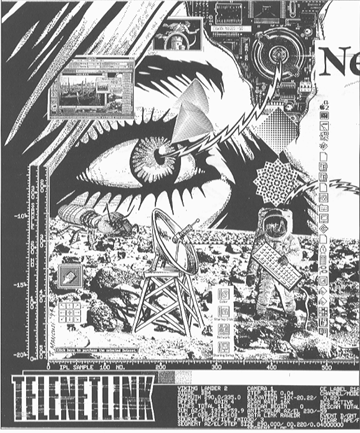
(Above) Tim Mancusi's Telenetlink is a collage cover design for
Crackerjack Kid's Summer 1995 publication of Netshaker, a special issue
devoted to the 1995 Networker Telenetlink.
NETWORKER TELENETLINK 1995:
THE MAIL ART-INTERNET LINK
"Tele" is a Greek word for "far off," "at a distance." Netlink is
terminology meaning "to interconnected networks," especially communication
networks that are perceived to be distant. Artists impart attitudes, values, and
sensibilities in their shared communication with others. Aesthetic
sensibilities, when coupled with social hierarchy and economic inequality,
create media boundaries, "netclubs." Mail art networking attempts to soar above
these distances, to fly beyond all media boundaries-to telenetlink!
Mail art is communication that travels a physical/spiritual distance
between senders and recipients. For nearly forty years mail artists have been
enjoying interactive mail characterized by free, open, often spirited
visual/textual correspondances. Mail artists have worked hard to abolish
copyrights through dispersed authorship. In the distant, parallel world of high
technology, telecommunication artists often work in the same collaborative
fabric interwoven with mail art. But emailartists network online in a simulated,
textual, paperless world. No wonder there are mail artists who prefer the
tangible, tactile, handcrafted encounter of pen, pencil, collage, paint, and
handmade paper.
It is true that some postal artists are suspicious of art and
technology. they view telecommunications as hasty, simulated, impersonal
interaction lacking in privacy. These mail artists find the time-lag of postal
delivery a desirable quality. Conversely, there are telecommunication artists
who view mail artists as unskilled in aesthetic differentiation, hopelessly lost
in a slow, antiquated, and expensive postal bureaucracy. Distances widen between
these communication forms, especially by the stilted influences of normative art
standards. Such attitudes obscure the notion that art communication is an
intermedia concept.
The Artist As Networker
Distance between mail art and electronic art is sometimes more imagined
than real. The notion that mail artists are hostile to high technology is one
common misconception. Experimentation with mass-media technology hastened the
evolution of mail art long before the advent of telecommunications technology.
Mail artists experimented with electrostatic (copier art) technology in the
1960s, and in the late 1980s embraced the technology of telefacsimile.
Throughout the 1980s mail artists matured into networkers who reached for an
inter-cultural transformation of information.
Mail art networkers experience the form and content of the information
age. They dare to apply values that will nurture a larger global society. It
comes as no surprise that pioneering telecommunication artists like Judy Malloy,
Carl Eugene Loeffler, Anna Couey, George Brett, and Fred Truck were all active
mail artists during the early 1970s before they moved towards telecommunications
art. Time has obscured the fact that many idealistic, democratic values of early
mail art were carried forth in the development of today's online
telecommunications community.
Networkers use both telecommunications and mail art as tools rather
than boundaries. These intermedia networkers embrace immediate, direct concepts
of exchange that sometimes lead to real-time, face-to-face conferences.
Networkers are equally comfortable using the postal mailstream to meet
vicariously as "tourists." The hallmark of both mail and telecommunications art
resides in attitudes of creative freedom, collaboration, the abolition of
copyrights, and independence outside mainstream art systems. Telenetlink is a
forum created to celebrate this interactive spirit between mail art and
telecommunications artists.
Evolution of the Telenetlink Project
The international Telenetlink evolved in June 1991 as an interactive
part of Reflux Network Project, an artists' telecommunication system created by
Brazilian artist Dr. Artur Matuck. Reflux Network Project was an ambitious,
progressive experiment that interconnected 24 on-site nodes located in
university art departments, art research sites, and private internet addresses.
Through Reflux, the Networker Telenetlink became mail art's first active online
connection with the world of internet.
Telenetlink became an active component of mail art's Decentralized
World-Wide Networker Congresses, 1992 (NC92). Throughout 1992 the Telenetlink
Project functioned as the only continuously active online mail art resource in
which the role of the networker was actively discussed. An international
community of mail art and "internet-workers" were introduced to each other
before and during the NC92 Telenetlink. Telenetlink's emailart addresses were
first actively exchanged in an international scale by Reed Altemus (Cumberland,
Maine) in collaboration with Crackerjack Kid (Chuck Welch). This list has grown
exponentially through mail art magazine email lists from Ashley Parker Owen's
Global Mail, (now online with her CompuServe address), Mark Corroto's
Face and by Telenetlink's continued emailart connections to internet;
ArtCom, Post Modern Culture Electronic Journal, and numerous other
online sources.
Some mail artists claim that the 250 sessions of Networker Congresses
in 1992 were carbon copies of the smaller 1986 Mail Art Congresses. But NC92
differed from the 1986 Mail Art Congresses in a major context. Participants in
the 1992 Networker Congresses were challenged to interact with other marginal
networks parallel to mail art; to build, expand, introduce, alert, and
interconnect underground network cultures. These objectives were underscored
when the Networker Telenetlink bridged the telecommunications art community and
the mail art culture. I chose internet as the focal point for understanding the
role of the networker. Why internet? Because it is the world's largest
information superhighway that is moving art towards new communication
concepts.
The Mail Art-Internet Link
Internet is a parallel world to mail art, but Telenetlink envisioned
mail art as emailart; an effective global tool for electronically altering art
images, building network interaction, assembling large numbers of people for
online conferences and creative workshops. Already, internet is a moving,
virtual world of over 20 million people networking from an estimated 1.7 million
computers in over 135 nations including the former Soviet Union. Internet was
paid for and created in 1972 by the U.S. Defense Department's ARPAnet, built to
survive a Soviet missle attack on the U.S. Today nobody (yet!) governs internet
save its individual member networks. Anybody from senior citizens to average
working people can play "keypal" with the establishment or underground network
cultures.
Internet relays over 2,000 online newsgroup networks with subjects
ranging from books and fishing to alternative sex. Telenetlink made connections
with internet's Usenet Newsgroups when NC92 invitations and updates were
circulated via alt.artcom, rec.arts.fine, and the Well. Through these
connections hundreds of networker congress messages were exchanged online.
Mainstream magazines like Whole Earth Review introduced their readers to
the Networker Telenetlink in my article entitled Art That Networks.
Decentralized and fit for global congress conferences, internet was the
conference table where mail artists and telecommunication artists were
introduced to each other. Global emailart was birthed on internet.
Clearly, more discussion, strategies and internet-action are welcome in
the Networker Telenetlink 1995. Increasing network interaction is an important
first step. In 1991 there were roughly two dozen mail artists with PCs and
modems, mostly Americans, who could access one another through information
superhighways like internet, bitnet, CompuServe and America Online. In 1994 the
Telenetlink 1995 organized mail art FAXcilitators and many online connections to
internet organized by Telenetlink operators like Dorothy Harris (America Online,
[email protected]), Honoria, (Internet,[email protected]), and many
others
Telenetlinks, Outernets & Electronic Bulletin Boards
Between late 1991 and 1993 an online community of rubber stampers often
discussed rubber stamp art and listed mail art shows over the commercial Prodigy
network. Prodigy networker (America Online) Dorothy Harris, a.k.a. "Arto Posto,"
was active in organizing the first online mail art course for beginners.
Unfortunately, interaction on Prodigy was limited to American participants who
had no access to the larger global internet system. Eventually, access to
internet was made possible by Prodigy in November 1993. By that time Prodigy's
rates had increased, causing most rubber stampers to quit the
network.
The same form of "CorrespondencE-mail exchanges found on Prodigy were
predated by three Mail Art BBS' organized by Mark Bloch (US), Charles Francois
(Belgium), and Ruud Janssen (the Netherlands). These BBS "outernets" each had
its own set of services and protocols for initiating online dialogue, remote
login, file transfer, and message posting. Like Prodigy, however, access to mail
art BBSs remains costly and cumbersome.
Mail art Bulletin Board Services are host-operated netlinks akin to
private mail art correspondancing-anybody can cut in, but you have to
follow your partner's lead if you want to be in their dance. "Outermail" BBSs
are capable of establishing emailart gateways to the internet, but few do. Mail
art BBSs will likely follow in this direction as the advantages of internet
become more evident. At present, electronic mail "gateways' move messages
between "outernets" and internet and increasingly commercial servers are gaining
access to internet's World Wide Web.
Since 1991, Telenetlink continues to nurture a deep, transpersonal,
inter-cultural community of networkers who explore both high and low technology.
Strategies for the dispersal of Telenetlink have been widespread and include the
March 1994 mailings by Swiss mail artist Hans Ruedi Fricker. Thousands of copies
of the Telenetlink proposal were distributed in ND Magazine, Issue No.
18, and in the September 1993 issue of Crackerjack Kid's Netshaker , PO
Box 370, Etna, NH.
Netshaker Online, became internet's first mail art electronic
magazine on January 1, 1994 when Crackerjack Kid organized a group of
Telenetlink facilitators who forwarded Netshaker Online to Prodigy,
CompuServe, and America Online subscribers. Issued bi-monthly, Netshaker
Online is accessible by contacting Crackerjack Kid at
([email protected]). The zine is sometimes posted in the EMMA
library (http://www.dartmouth.edu/people/emailart/emmalibrary.html).
Other active discussions of Telenetlink occurred in public congresses
during 1994. Free Dogs & Human Values, an Italian festival of alternative
creativity, convened at several sites in and around Florence, Italy from May
5-15, 1994. Organized by Gianni Broi and Ennio Pauluzzi, the Free Dog sessions
included Gianni Broi's reading of the Telenetlink proposal and widespread
distribution of the text in Italy and Europe.
Reid Wood of Oberlin, Ohio has organized a 1995 Telenetlink Fax Project
entitled Eye re:CALL. Participants include mail artists and cyberspace
artists alike; John Fowler, Karl Joung, John Held, Ashley Parker Owens, Greg
Little, Wayne Draznin, Artoposto, Rafael Courtoisie, Guy Bleus, Ruggero Maggi,
Jean-Francois Robic, and Crackerjack Kid, among many others.
The Networker Telenetlink remains an open proposal to all interested
parties. Embracing the possibility of enlarging network community, developing
emailart as an expressive, interactive online medium, and discussing new roles
are necessary and welcome. Please help by dispersing this message by mail or
email. Translation of this invitation into other languages is also
desirable
Networker Telenetlink 1995: The Open Proposal
THE MAIL ART CONGRESS BODY LEFT IN 1992/ A SPIRIT NETWORKS NOW/ THE
SPIRIT LIVES IN EVERYONE/ WE MET-A-NETWORK INFANT/ A MEDIA-CHILD WAS BORN/
TELENETLINK IS ITS NAME/ IT LIVES IN NETLAND NOW/ THE FUTURE OF THE NETWORKER IS
TELENETLINKED/ MAIL ART IS EMAILART/ FAXMAIL ART/ EMBRACE THE CHILD/ TELENETLINK
IN 1995 AND BEYOND!
OPEN OBJECTIVES
Objectives for a Networker Telenetlink Year in 1995 are open for
discussion, but encourages interACTION now. Possibilities? Embrace the telematic
medium and explore its parameters; develop a local/global emailart community;
exchange cultural communications; interconnect the parallel network worlds of
mail art and telematic art through internet and the World Wide Web; contact
online communities of mail artists working on commercial networks like
CompuServe, America Online, Prodigy, and other connected email gateways; place
networker archives online; experiment with telematic technology; participate as
a FAXcilitator; exhibit in the Electronic Museum of Mail Art; interact in public
and private forums; merge media; mail and emailart; and enact networker ideals
invisioned for the millennium.