One of the interesting, worldwide
phenomena in art in the eighties of the twentieth century was
correspondence art, or the incredibly fast development of the mail
art networks using postal services. Every time a need emerges
simultaneously and en masse, there is a reason and an explanation:
the work of the mail artists building postal networks can be seen
as an antecedent of the electronic worldwide web that emerged in parallel
with but independently of theirs.
In essence correspondence art is dialogical and pieces of
information that can be linked together are organised into a system by
discussion and dialogue keeping each other in balance in the
network. Dialogues store discussions, and discussions provoke
dialogues. Persons are holons (simultaneously wholes and parts), at times
participants, at other times initiators, and in both cases autonomous;
every operation is a result of personal intention and
decision.
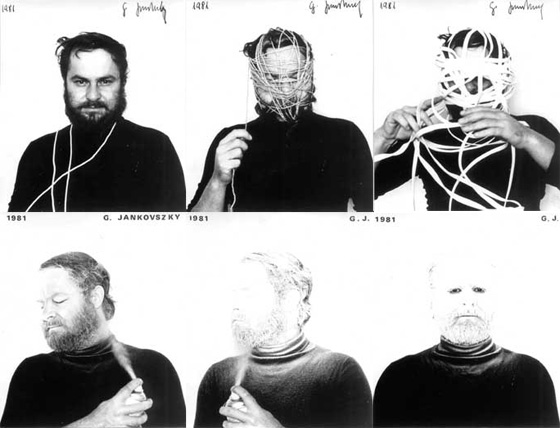
György Jankovszky made his self-portrait series in 1981, for Artpool’s
invitation for the “World Art Post” artist’s stamp project, and
then he reused them as stamp images. There are several interesting
questions to be asked in connection with the series of images. Why
does somebody, e.g. an artist/a photographer make a self-portrait, i.e.
why does he look into the mirror or into his
camera?
A self-portrait is a means by which an
individual makes an attempt to objectively view himself. The
Latin word for mirror is speculum, from which the word “speculation” is
derived. In the old Hungarian language speculation actually meant
scientific thinking and examination. The camera as a mirror is the
photographer’s work tool. “The photographer is a person who attempts to
place, within the image, information that is not predicted within the
program of the camera. Image: a significant surface on which the element
of the image act in a magic fashion towards one another. Significance: the
aim of signs. Sign: a phenomenon that signifies another. Magic: a form of
existence corresponding to the eternal recurrence of the same. Rites:
actions corresponding to the magic form of existence.” (Vilém Flusser: Towards a Philosophy of
Photography)
The strength in György Jankovszky’s
self-portraits is in their conceptuality. Duality as identity
appears in his attitude on a conceptual level – in the gesture of an
action. While he is releasing his camera with the self-release
button, he is extinguishing the picture of his own face. The
action is carried out in two ways, so it can be seen as two series. In a
trivial way, we could say about the first series that “it hurts”, and
about the second that “it doesn’t hurt”. The first one is reality and the
second one is a dream: it is happening but I take no notice of it. Of
course there could be other contextual explanations according to cultural
and social points of view, but that would lead too far away. One thing
must be added however: in the eighties, in the last decade of the Kádár
era the actual environment of art was the culture of silence (and
interception), shortage economy, and the right social behaviour:
mediocrity.
Jankovszky was not the only one who made such
self-portraits. There were some antecedents which, albeit not
widely known, are worth mentioning here since similarities that come into
being independently usually amplify one another.
Miklós Erdély: Self-lighting – Light Eats Man Up, 1969
Arnulf
Rainer: Self-depictions, 1971-76
Sándor Pinczehelyi: Sickle and Hammer, 1973
Gábor Attalai: I can be foolish too, 1973
Endre Tót: TÓTalJOYS /
I am glad if
I can read a newspaper, 1973/75
György Galántai: Window-mirror (local), 1975 - Ego Problem (local), 1976
András Baranyay: Self-portrait, 1977
Tibor Hajas: Torture of the Surface I, 1978
Endre Tót: Communism made
me glad, 1978/89
Kálmán Szijártó: Metamorphoses, 1978
INCONNU GROUP - Péter Bokros:
Ego, 1979
However, György
Jankovszky’s self-portraits reused on postal stamps are unique in the
whole world. Nothing close to this was ever made before or after
it. Of course, only because these pieces have not become known up until
today.
The most important thing about Jankovszky’s stamps
is that he not only made them but posted them too, or rather
had them posted to his own address, on
63 envelopes posted in 34 countries, which all arrived stamped. To use
a modern expression, it was a postal “hacking” action, in the most
positive sense, since the post did not suffer any damage because
Jankovszky had purchased valid stamps. Thus, hacking refers to the content
of the stamp images here and not to conning the post. (There are a lot of
examples of conning the post, from various fake “artist’s” stamps to
counterfeiting stamps.)
The content of the stamp images is
subjected to an official procedure in every country before it
enters circulation, which means that every tiny postal stamp is
the territory of the country that issues it. It is exactly these
territories to which Jankovszky smuggled his self-portrait without
being noticed. Although this project is symbolic, if it is given
publicity, it can work as a cultural virus (meme) because its significance
is its meaning. This reminds me: a meme is nothing more than an
information pattern which happens to have developed a form which makes
people repeat that pattern. Included among typical memes are individual
slogans, phrases, melodies, discoveries and fashions. It might sound
ominous that people are hosts of mind-altering strings of symbols, but in
fact this is all that human culture actually is. (Glenn Grant)
The story and background of
writing this article
I hadn’t met György Jankovszky since the Stamp Images exhibition in 1987. Last year, when I
was organising the Parastamp exhibition, I tried to contact him, but
without success. Then, at the beginning of this year he contacted me,
asking me to write about his stamps for the catalogue of an exhibition
that would be organised in the Hungarian Museum of Photography in Kecskemét. I kept
telling him that writing was not my forte, but he insisted that no one
else could write about his stamps. Okay, I’ll give it a try, I answered,
but I won’t promise anything. Then I asked him to bring me all his
original pieces, and that might get me going. The next time we met he
brought the album and left it with me for a few months. When he came to
inquire how the writing was going I had not managed to come up with
anything, despite having spent quite a few days trying to approach the
subject as part of an extensive study.
Using my method of
“self-assembling writing” I developed during the years, I started
collecting and grouping those key notions that would build up the content
of the future piece of writing, as a kind of raw material for an
assignment. Of course these (self/I-picture portrait, self-portrait
history age-reflexive / means, media, apparatus, age-identitical |
place-reflexive / present/ place-identical
self-reflexive/personal/self-identical holon, part-whole,
networker/artist, functionary) didn’t get me far, but at least enabled me
to prepare myself a bit. When we last met I had the idea of having a
conversation recorded on tape, one that would perhaps help me get started
with the writing. A lot of time passed by again and then I thought that
the material of Jankovszky’s stamp project put on the Internet would be
interesting as it was, so even if I ended up not writing the article, I
would upload it. After this the writing started self-assembling itself but
not at all as I wanted to think it would but rather the way I could have
thought it would.
While I was writing, it became clear to me what
the reason was for Jankovszky’s choice, since this is what made the
writing write itself. It also occurred to me that I first saw the stamp
“Kepler Orbits” on the envelopes I received from Jankovszky, and right
after that I made my rubberstamped sheet of stamps entitled "Refunctioned object".
(György
Galántai,
2008)
Andorra
Australia
Austria
Belgium
Canada
China
Cuba
Czechoslovakia
East Germany
Finland
France
Greece
Hungary
India
Iraq
Italy
Liechtenstein
Luxembourg
Monaco
Netherlands
Norway
Pakistan
Poland
Romania
Soviet Union
Spain
Sweden
Switzerland
Turkey
United Kingdom
United States
Vietnam
West Germany
Yugoslavia