About The Production
"Sleepy Hollow" was filmed almost entirely in England. Director Tim Burton, along with director of photography Emmanuel Lubezki, production designer Rick Heinrichs and costume designer Colleen Atwood, chose a style for the film that Burton describes as reminiscent of the horror films of the 50's and 60's. As a frame of reference, Burton encouraged his team to watch films like Mario Bava's "Black Sunday," Roman Polanski's "The Fearless Vampire Killers" and Hammer horror films. "They're beautiful, those movies. They really have an art to them and those are my favorite kind of movies," says Burton.
The film's fairy tale-like images are enhanced through Lubezki's highly stylized lighting and a tightly controlled color palette that permeates everything from set design to costumes. "We wanted an almost black and white feel, very monochromatic with a lot of contrast," says Lubezki. The wardrobe provides accents of color.
After
scouting a number of Dutch communities in upstate New York and
the Hudson Valley, where the real town of Sleepy Hollow is located,
the filmmakers agreed that Burton's vision could best be
achieved by shooting primarily on stages. While many of the villages
were historically accurate, they didn't serve the emotional
side of the story. "It's more like a 'fantastic tale,'
not a realistic historical reconstruction," says Lubezki.
"We have to enhance certain elements to accentuate the 'fantastic.'
The Hammers did it without knowing they were doing it. We do it
because we like it."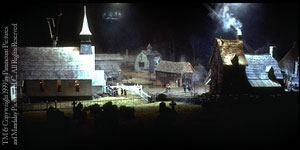
Additionally, the filmmakers decided to build the entire town of Sleepy Hollow in a contained environment. "What's great is to try to take something unreal and make it real, which I feel excited about. It's always a challenge to walk that line of unreality/reality," adds Burton.
At the suggestion of producer Scott Rudin, the film company moved to London where the combination of available stages and craftsmanship provided Burton the opportunity to create a singular self-enclosed world. It also enabled Burton and Heinrichs to be reunited with many of their top London collaborators from "Batman," including art director Les Tomkins, construction manager Terry Apsey and set decorator Peter Young.
The film's strong design element necessitated that nearly everything be built and handcrafted. "The biggest challenge was creating so many 'exterior' settings on stage," says production designer Heinrichs, who has collaborated with Burton in varying capacities for more than two decades. "What emerged was a sort of 'stylized naturalism' which is very beautiful. It's a combination of using real materials with painted backings and very old-fashioned techniques of displaying perspective. It creates a very theatrical and painterly feeling." By the time production was complete, Burton and his team created more than fifty diverse sets.
Principal photography began in England on November 20th, 1998 on sound stages at Leavesden Studios, where production designer Heinrichs and his team built the grand and elegant Van Tassel Manor House and surrounding orchard. The entire cast, along with 75 extras dressed in elaborate period costumes, gathered for the annual harvest party and Ichabod's (Johnny Depp) arrival to Sleepy Hollow.
Filming
continued at the Van Tassel estate for several weeks before moving
to Shepperton Studios where filmmakers constructed the impressive
Western Woods. "It had to have great visual impact -- a place
where the child in you is afraid to go," says Heinrichs.
Under the supervision of production designer Heinrichs, supervising
art director Les Tomkins and art director Ken Court, a steady
crew of more than seventy workers sculpted this enchanted and
foreboding set over a 12-week period. Thirty-foot tall trees constructed
of fiberglass and steel were made from molds of oak trees in Windsor
Great Park. Real branches were supplied by Palm Brokers and gathered
under supervision from the forestry department.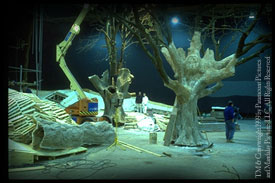
The centerpiece for the forest is the 'Tree of the Dead.' Its branches reach far and wide, knotted and gross, "like agony captured in wood sculpture," according to Heinrichs. The 'Tree of the Dead' is the horseman's resting place -- a gateway between this world and the netherworld. The structure was sculpted from polyethylene, then textured with layers of real bark, moss and branches.
The film's most elaborate and ambitious set is the village of Sleepy Hollow, built on twenty acres of English private property (the Hambleden Estate) in the Lime Tree Valley, an hour's drive north of London. When Burton and his team first scouted the location, the site consisted only of an unspoiled meadow and a duck pond -- a hollow surrounded by a myriad of trees. It reminded Burton of upstate New York, to which he feels a very strong affinity. "I love it there," he says. "I like it for its mood. It's got a very strong haunted feeling. It's one of the reasons I wanted to make this film."
A team of eighty construction workers, engineers, painters, molders and craftsmen labored for four months to complete twelve structures, several with detailed interiors as well as exteriors. The collection of period buildings, which designer Heinrichs calls 'Colonial Expressionism' included a covered wooden bridge, a church, a general store, a doctor's office, a tavern, a blacksmith, a notary public, a bank, a mill house and several residences.
"One of the things we were trying to do," explains Heinrichs, "was inspire a sense of scary portentousness in the village. I think it's different from Irving's Sleepy Hollow which is described as a dozing Dutch farming community. If our Sleepy Hollow is asleep, it's a fitful sort of sleep with nightmares."
One of the biggest challenges for designers was the weather, as heavy rains sent torrents of water through the center of town leaving equipment and workers knee-deep in mud. Crews had to build roads and even install a drainage plant.
During the night shoots, director of photography Lubezki illuminated this set using three huge lighting units that hung from 120-foot-tall cranes. Police fielded several UFO citings from neighboring residents. "The town feels theatrical in a good way," says Burton, "almost like we built it on stage."
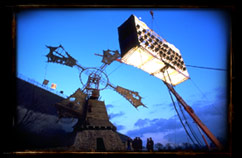
Filming returned to Leavesden Studios where a multitude of sets were built including a crone's cave, a windmill powered by hydraulics, and a New York City watchhouse with medieval torture devices designed by Burton, Heinrichs and special effects supervisor Joss Williams. "These contraptions are supposed to make you confess to whatever it is you haven't done," explains Williams.
The
windmill was a combination of several interior and exterior sets,
full-scale and miniature. "There isn't any windmill
in our reference books that looks like our windmill," says
Heinrichs. "The sails are pure Tim Burton batwings!"
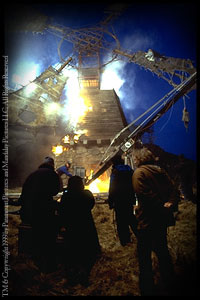
Leavesden's largest sound stage ('A') underwent almost weekly transformations, changing from a sun-dabbled rain forest to a barren field with haystacks to a freezing snow-covered battlefield. Even a family of birds nesting in the ceiling grids were fooled by the changing seasons. When stage 'A' was revamped into a snowy battlefield, the birds flew next door to stage 'B' where designers had created a colorful cherry orchard for the spring dream sequences.
Filming 'exteriors' inside a sound stage required ingenuity and constant collaboration from director of photography Lubezki, production designer Heinrichs and the special effects department. "The biggest challenge," according to Lubezki "was creating a false sense of sky." To achieve this, Lubezki pre-rigged the stages with hundreds of space lights (strung from the ceiling) that could be individually controlled by a dimmer board. Prior to each shot, special effects crews masked the lights with heavy layers of fog and smoke, giving the illusion of mist and sky.
A series of colorful dream sequences, featuring actress Lisa Marie, provide a visual contrast to the film's muted and overcast ambience.
To shoot the elaborate New York City street scenes, the filmmakers took over two square blocks near London's historic Somerset House. The scene involved period vehicles, props and hundreds of extras, all elegantly styled by costume designer Colleen Atwood. "Our set was just a backdrop for Colleen's beautiful clothes," says Heinrichs.
"Sleepy Hollow" marks Atwood's fourth collaboration with Tim Burton. She earned an Academy ® nomination for Gillian Armstrong's "Little Women" and a second nomination for Jonathan Demme's "Beloved." She previously worked with Burton on "Mars Attacks," "Edward Scissorhands" and "Ed Wood."
For "Sleepy Hollow," Atwood's research focused on period paintings and visual descriptions of costumes from books. "There were no existing photographs," comments Atwood, "but since this film is not a history lesson, the work becomes very impressionistic."
In the film's opening scene, Depp wears a constable's uniform which Atwood describes as incredibly chic. "Uniforms of the period were beautifully made," she says. "They weren't the polyester we have today." Once Ichabod travels to Sleepy Hollow, he essentially wears one costume in varying stages -- a long black waistcoat with hand-sewn gold trimming and a hand-printed silk lining that kicks back light when he moves. "People didn't have a lot of clothing unless they were incredibly wealthy," Atwood explains. "The idea with Ichabod's costume was to make it very minimal, sleek and long in feeling, a sort of shadowy feeling to his character."
The
more elaborate costumes were worn by the villagers of Sleepy Hollow
-- each one intricately crafted by Atwood and her team from specially
chosen fabrics. "They're sort of like country folk that are
five or six years behind the minute," says the designer,
"but with the maximum amount of trim and gear to show their
money on the outside." The most extravagant dresses belonged
to Lady Van Tassel (Miranda Richardson). "She's definitely
ruling the roost. When a character aspires to something greater
than what they've had, they take it to a whole different level."
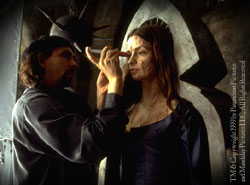
One of Atwood's favorite costumes is a black and white dress worn by Lady Van Tassel in the film's climactic chase scene. "It was such a challenge to create, and the way Miranda Richardson wore the costume was fantastic. The original inspiration was that it reminded me of bark in the forest. I wanted it to fit in the woods, but still be very grand and of her own world. Miranda really understood what the architecture of the dress was, that it went from light to dark. When she walked in it, she walked straight forward and then turned to the side, so you got the play of light on the costume."
"Sleepy Hollow" features several action set pieces, including stunts, pyrotechnics and special effects. Among the highlights: a masterfully choreographed fight scene between Ichabod (Johnny Depp), Brom (Casper Van Dien) and the Headless Horseman (Ray Park), and a suspense-filled coach chase through the Western Woods. The latter was filmed inside Leavesden's 'flight shed' where designers built a 400-foot-long forest.
Stunt
coordinator Nick Gillard, whose recent film credits include "Star
Wars -- The Phantom Menace," brings originality and humor
to every action sequence. In addition to choreographing the fight
scenes, Gillard, along with horse master Steve Dent, also gave
riding instruction to the entire cast. Depp's horse, Gunpowder,
is a Belgium carriage horse. The Headless Horseman's horse,
Daredevil, was brought over from Seville, Spain and trained from
scratch. "Spanish horses have the best nature," says
Dent. "You just have to work with them for ten minutes and
they're revved up like a Ferrari."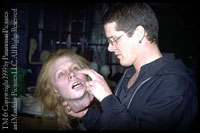
To capture the film's horror, filmmakers used the latest special effects and make-up techniques. Creature effects artist Kevin Yagher admits his greatest challenge was finding unusual ways for people to die. "Tim wanted very stylized decapitations, nothing that we've seen before," explains Yagher. In one instance, it meant a head spinning and rotating on axis three or four times before being lopped off.
Cast members had 'life casts' taken of their heads and bodies, a process some describe as "incredibly claustrophobic." The heads are plastered and silicone painted, then sculpted and textured by artists. Hairs are individually punched in, eyeballs are inserted, and acrylic teeth are fit into the gums. On average, a head takes five weeks to complete and the results are often staggering for the actors.
"I was sitting in the make-up truck gossiping over a cup of coffee," recalls actor Richard Griffiths, "when one of the effects guys asked 'have you seen your head yet?' I said thank you, no. So he pulled it out of a box. Well the jolt, the thump, somewhere underneath your fourth rib that you get when you see it. Talk about intimations of mortality. I've seen my head in somebody else's hands!"
In
addition to creating more than a dozen realistic looking heads,
the creatures department had an even 'bigger' project on
their plate -- the building of a life-sized (and life-like) mechanical
horse to double as Daredevil, the Headless Horseman's horse.
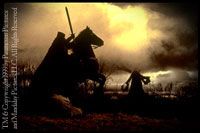
To
create an exact replica of Daredevil, the creatures department
had to mold, sculpt, skin and fur a life-size version of the horse,
a process that took several months. The shell was then fitted
onto a vintage mechanical horse, the same one Elizabeth Taylor
rode in the 1944 film "National Velvet." The gears were
retrofitted by the special effects department and brought up to
date. The horse was then programmed by radio controls to canter,
gallop and rear its head, and given a full range of facial expressions
including eye blinks, flaring nostrils, and blowing steam out
its nose. This mechanical version of Daredevil was used by Christopher
Walken for precision shots and close-ups. Comments Walken, "Now
that's my kind of horse!"