The Avro Lancaster
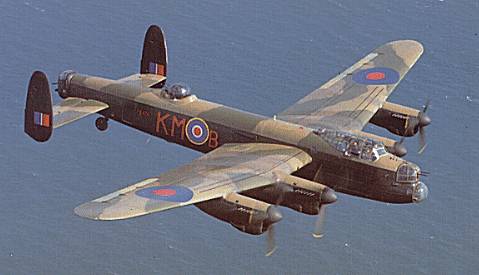
The Avro Lancaster
AVRO's entry in the heavy bomber category was the last, and best, English
heavy bomber of
WWII. They flew more missions, and dropped a greater tonnage of bombs
than all of the other
English heavy bombers combined. The origins of the Lancaster came from
the development of the
AVRO Manchester bomber powered by two Rolls-Royce Vulture engines. It
wasn't long after the
Manchesters made it into service in 1940 that it was realized the complex
and under-powered
Vulture engine would not suffice. Roy Chadwick, the designer, replaced
the two Vulture engines
with four Merlin engines and tested the aircraft. Voila! The Lancaster
was born with superb handling
characteristics, relatively high speed and the capability of hauling
a heavy load over a long distance.
If empty of bombs it could fly on one engine, although losing height.
On two engines it could maintain
level flight. It could be handled like a fighter aircraft, being able
to dive sharply to over 400 mph.
These characteristics helped a lot of bomber crews reach their targets
and get home again.
The first Lancaster I's took to the air in October, 1941. Other than
the engines it differed from it's
progenitor in the adoption of a mid-upper and belly turrets. Soon the
belly turrets were removed as
they were at first useless for night flying. They would have been some
use against German fighters
equipped with upwards firing cannons in 1944. Lancaster I models fought
throughout the rest of the
war, although individually few made it to 100 operational sorties. A
high production schedule of
Lancasters soon meant that Merlin engines were in short supply (they
were also used in Spitfires,
Mosquitos, Halifax bombers and many other aircraft). This necessitated
adopting an alternative
power plant. The Lancaster I was fitted with the Bristol Hercules radial
engine and renamed the
Lancaster II. After a long testing program it went into operational
service in March, 1943. The mark
II possessed good overall flying characteristics, but it never equalled
the Merlin-powered model.
The Hercules-powered aircraft had better takeoff, ascent and low altitude
flight characteristics than
the Lancaster Is, but they flew slower and used more fuel. The arrival
of American-built Merlin
engines doomed the Lancaster II after a production run of 301 aircraft.
The American-built,
Merlin-powered Lancasters were the III model, however, they were nearly
identical to the I. There
was also a mark VII built by taking mark Is and IIIs, adding a four-bladed
propellor, and removing
the nose and tail turrets. They were loaded with electronic jamming
equipment. These were the
special aircraft of No. 100 (Bomber Support) Group designed to fly in
the bomber stream and jam
the German electronic defences. Lancaster Xs were Lancaster Is built
in Canada by the Victory
Motor Works of Malton, Ontario. The Lancasters continued well into the
1950's with England,
Canada, and Australia. A total of 7,366 Lancasters of all Marks were
built.
Technical Details
The Lancaster I carried a crew of seven; pilot, flight engineer, observer/nose
gunner/bomb aimer,
navigator, wireless operator, mid-upper gunner, and tail gunner (see
below). It was powered by four
Rolls-Royce Merlin XXIV, 12 cyl. V block, liquid-cooled engines of 1,620
hp each. It's maximum
range, speed and bomb load were all dependant on each other. With a
typical bomb load, it reached
a maximum speed of 286 mph (462 km/h) , an ceiling of 24,671 ft (7,500
m) and a range of 2,527
miles (4,070 km). It carried eight 0.303 caliber machine guns, two in
the nose, two in the upper
turret and four in the rear turret. Total shells carried reached 14,000.
The bomb load in 1941 was
8,000 lb. and could be a wide mixture of high explosive and incendiary
bombs. It eventually reached
22,000 lb (a single Grand Slam bomb) with special modifications to strengthen
the fusilage and
removal of the bomb bay doors.
The Lancaster II carried the same crew members. It was powered by four
Bristol Hercules VI, 14
cyl radial, air-cooled engines of 1,735 hp each. It had a maximum speed
of 264 mph (426 km/h), a
ceiling of 18,552 ft (5,640 m), and a range of 2,547 miles (4,103 km).
Of course this all depended
on the distance to the target, bomb load, etc. It carried armament as
the Lancaster I. Due to it's
abbreviated production span, the mark II carried up to 14,017 lb (6,350
kg) of bombs in a wide
mixture.
For more see
Compare a Lancaster to a Halifax
and
Photo
Cut Away
More
and Even More
and More Yet
and a very comprehensive site about
Bomber Command in general and the Lancaster in particular