The Halifax Bomber
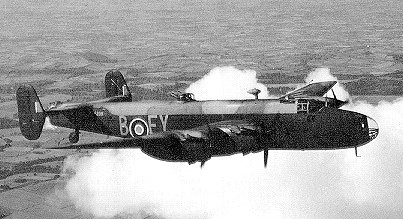
The Halifax Bomber
The Halifax heavy bomber proved itself to be England's second best heavy
bomber, eclipsed only by
the superb AVRO Lancaster. It was first flown only three months after
the Short Stirling, but proved
to be far superior to that aircraft in most ways. The Halifax's overall
performance classed it as one of
the best combat planes of the war, something that is rarely recognised
today. The Halifax was made
in numerous versions, the most numerous being the Mk. I and II with 2,050
produced.
Unfortunately, the Halifax Mk. I had a serious flaw in the design of it's
tail structure that caused it to
go into a rapid, uncontrollable spin if it was flung about the air too
much. This undoubtedly caused a
number of fatal crashes. The design of the tail structure was changed
in the Mk. II and III versions.
These proved to be far superior to the Mk. I. A total of 2,060 Mk. IIIs
were produced from Feb.
1944 to the war's end. Mk. VI and VII versions were completed at the war's
end with more
powerful engines and longer range. The Halifax was primarily a night heavy
bomber, but it was also
used in Coastal Command to hunt U-boats as the Mk. V and for dropping
paratroops, it was also
used to ferry troops, as an air ambulance and a glider-tug. In the night
bomber role Halifaxes flew a
total of 75,532 missions, dropping more than 227,000 tons of bombs. Only
four Halifaxes made it to
100 missions. Today there is no complete Halifax bomber on display. One
is being reconstructed
from a plane that crashed in Norway.
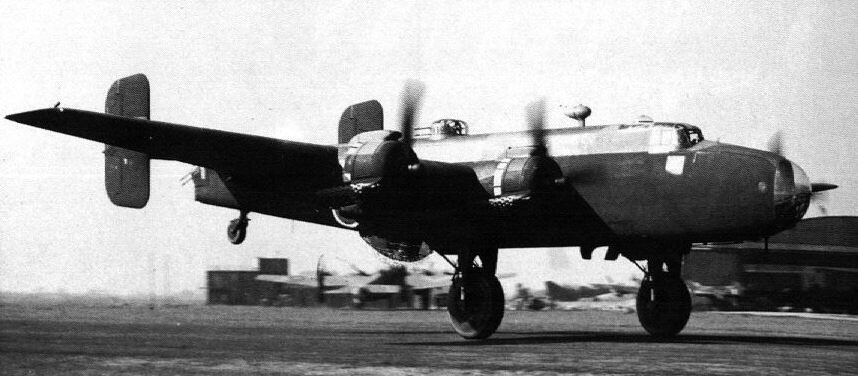
Technical Details
The Mk. I Halifax heavy bomber carried a crew of seven, these being pilot,
engineer, bomb
aimer/observer, navigator, wireless operator, mid-upper gunner and tail-gunner.
It was powered by
four Rolls-Royce Merlin X engines each generating 1,280 hp using three-bladed,
variable pitch,
metal propellers. It had a maximum speed of 265 mph (426 km/h) at 17,500
ft (5,300 m), with a
ceiling of 22,800 ft (6,950 m) and a range of 1,860 miles (3,000 km).
It carried six 0.303 in.
machine guns, two in the mid-upper position and four in the tail turret.
It was capable of hauling
13,000 lbs (5,890 kg) of bombs or mines.
The Mk. II had more powerful Merlin engines, a machine gun for the bomb
aimer and a redesigned
tail structure that improved handling characteristics considerably.
The Mk. III was the second major production variant. It had a radical
change in engine, with the
Merlin being replaced by the Bristol Hercules XVI air-cooled engines each
developing 1,615 hp. At
the time Merlin engines were in great demand and the AVRO Lancaster with
Bristol engines proved
to be underpowered.
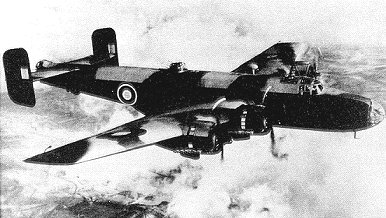
For more see Compare a
Lancaster to a Halifax