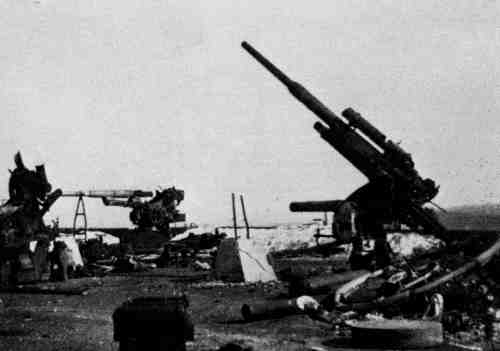
Flak

German Anti-aircraft Flak  The Germans produced an incredible number of "Flak" guns to protect their troops in the field and eventually to provide a moderately effective system of radar directed Flak and searchlight systems to protect their major industrial cities, in particular those of the Ruhr valley.  
 
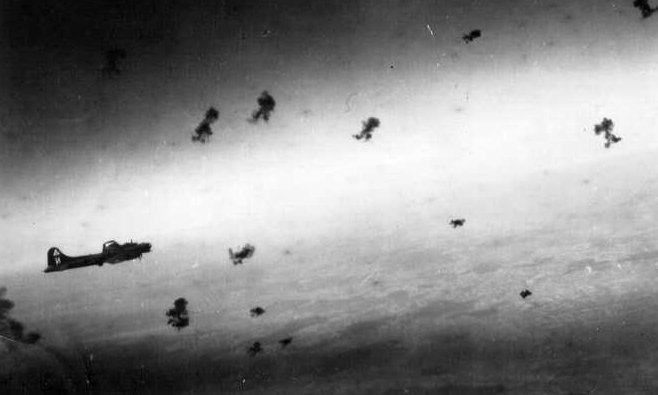
Flak was the nightmare of bomber crews as it wasn't predictable, you couldn't see it coming and if you swerved to avoid the bursts in front, you could just as easily fly into the next set of shells. They exploded in daylight with puffs of black smoke with little red interiors, and made muffled "krumppp" sounds (due to the high levels of noise in the Allied bombers).
 
At night they flashed quickly yellow or red and disappeared. When one hit close the shards of shrapnel banged through the aircraft and pinged off of more solid members.    With a direct hit from an 88 mm or larger shell the aircraft would stagger, sometimes stall, fill with smoke and screaming wounded airmen.
 
Sometimes a wing would fold up and the bomber would go straight down in flames. Other times the entire aircraft would simply vanish in a dirty ball of fire, smoke and bits of plane and man. Many other times the aircraft and men would fly on, riddled with holes but still fighting. Only to have to try to land somewhere with damaged under carriages, missing engines and wounded or dead crew. Often they bombed their targets only to die in a crash landing.          
From: http://pages.zdnet.com/vancell/b26tailgunner/id17.html


The accuracy and effectiveness of FLAK or anti-aircraft artillery fire was derided at the start of the war but it gained a healthy
respect as the war dragged on. By 1942 15,000  88mm (3.46 in) guns formed the bulk of heavy flak defenses for Germany.
Large numbers of 37mm (1.47 in) and 20mm (0.79 in) guns filled the skies with shells during every air raid. Often arrayed in
"belts" around a city or target 88s could fire 22 lb (10 kg) shells up to 35,000 ft (10600 m) at a rate of 15-20 rounds per
minute. The excellent 88mm (3.46 in) gun proved very effective especially when radar was used to help with aiming. The shells
exploding at a preset altitude sending metal splinters flying in all directions. Later groups of up to 40 heavy flak guns
Grossbatterien fired rectangular patterns of shellbursts known as box barrages that proved very deadly to enemy bombers.

In 1944 Flak accounted for 3,501 American planes destroyed, enemy fighters shot down about 600 fewer in the same time
period. More flak guns gradually appeared, mainly the 128mm (5 in) German Flak accounted for 50 of the 72 RAF bombers
lost over Berlin on the night of March 24th, 1944. An incredible 56 bombers were destroyed or crippled by flak during a
B-17 raid on Merseburg in November of 1944.

Flak
                                              
The German Flak arm was also being strengthened by increasing the size of the 88 mm light batteries from 4 guns to 8. To
guard the more important targets Grossbatterien comprising 2 or 3 of the enlarged single batteries were created (up to 40
heavy flak guns) firing rectangular patterns of shells known as box barrages that proved deadly. Each battery, large or small,
was controlled by a single predictor which meant that up to 18 guns might engage one bomber at a time. The firepower also
increased as larger calibre guns were introduced including a 105mm weapon and the largest of all a massive 125mm gun.

A true proximity fuse or variable time fuse was never developed by Germany despite extensive efforts to do so. Allied
planners estimated that German FLAK would be about three times more deadly if they had proximity fused shells.

                           
The guns were grouped in fours with a predictor (a device used to estimate where the aircraft would be by the time the shell
reached it and thus provide information as to where to aim). The searchlights were sited in threes with a sound locator which, as its name implies, located the position of an aircraft by fixing on the sound of its engines. The range of the sound locators
was about 6,000 yards but, in view of the time taken for the sound to reach the instrument, the calculated position of the
target could be up to a mile behind its actual position, a discrepancy which had to be allowed for in aiming the guns.

When the flak batteries pinpointed an aircraft the guns were fired in salvoes designed to burst in a sphere of 60 yards in
diameter in which it was hoped to entrap the target. Each gun, usually of 88mm calibre, could project a shell to 20,000 feet
and could knock out an aircraft within 30 yards of the shell burst. However, the shrapnel from the explosion was still capable
of inflicting serious damage up to 200 yards.

In daylight the predictor crews followed the aircraft by telescope but at night the sound locators directed the searchlights
(which had a range of 14,000 yards in clear weather). However, by night or day, the effectiveness of the flak arm in this
early period was severely curtailed by clouds.
                               
In January of 1944 there were 20,625 FLAK guns (7,941 heavy guns and 12,684 light/medium guns) with 6,880 searchlights
defendin Germany. Stationed on other fronts were another 9,569 anti-aircraft guns and 960 searchlights, these totals do not
include Army and Navy FLAK units.
Flak Gun

By August 1944  10,30  FLAK 18, 36 and FLAK 37 guns were defending the Reich. 279 of the improved FLAK41 were
in use by Febuary of '45 in the air defense role.

Since the eight-eight could be used to good affect against tanks as well as aircraft the use of so many in the air defense role
was consistenly questioned. By some estimates 3,343 shells costing a total of 267,440 reichsmarks ($107,000) were required to bring down one bomber. By the end of 1944 it was taking about 33500 rounds for each aircraft downed compared to the
4057 rounds required in 1942. The hard pressed Germans fighting on the Eastern front could have nearly doubled their
anti-tank strength with the guns defending the Reich from enemy planes.

Ammunition consumption soared from a monthly average of 500,000 shells in 1941/42 to 3,175,400 shells in
December 1944! At peak strength over 2 million soliders and civilians are involved in ground anti-aircraft defenses. 30% of all gun and 20% of heavy ammuninition production went for air-defense in 1944.


1