Air-Bomber
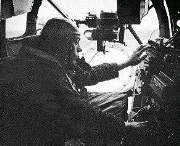
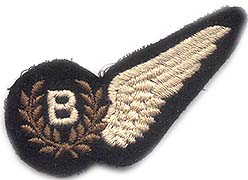
Air-Bomber and Bomb Aimer were the RAF/RCAF terminology
in contrast to the American term "Bombardier".
From Bruce Lewis' Aircrew:
The role of bomb aimer, like that of flight engineer, was created through
the need for greater efficiency in bombing operations, utilizing the effectiveness
of four-engine bombers. Until the arrival of these larger aircraft, the
business of dropping bombs was left to the navigator. With increased specialization
anong aircrew, better aircraft, improved equipment, radar navigation aids,
bigger and more potent bombs, the highly trained bomb aimer became the prime
member of the crew at the moment of attack, guiding his pilot towards the
aiming point....
.... over the target where the flak was normally at its thickest, the bomb
aimer was exceptionally vulnerable. Stationed in the nose, which was constructed
only of transparent perspex and a thin metal skin, he lay stretched full
length along the floor of his small compartment, his face above the lens
of the bombsight, his whole body exposed to any piece of white hot, jagged
shrapnel that might enter the front of his plane at any moment during the
crucial bombing run.
Bombsights:
CSBS - (Course Setting Bombsight)
ABS - (Automatic Bombsight)
SABS - (Stabilizing Automatic Bombsight)
Mark VII - introduced in 1932.
Mark IX - introduced in 1939.
Mark X - cancelled due to its unsuitability for night bombing.
Mark XIV (T1) - introduced in August of 1942 with the PFF.
SABS Mk IIA - precision bombsight introduced August 1943.
Mark XIV (T1) - introduced in August of 1942 with the PFF.
By 1943 the Mark XIV was installed in all RAF heavy bombers. The USAAF also
used the Mark XIV bomb-sight
designated T1.
It was designed to enable the run up to the target flying straight and level
to be restricted to a mere ten seconds and enable the
pilot to carry out evasive manoeuvres on his approach to the target. It
could be used to bomb both on the climb and the glide.
The bombsight consisted of a computer cabinet mounted to the left of the
Air Bomber and a stabilised sighting head with optical graticule. The sight
was one of the first practical uses for a mechanical computer.
This was the bombsight of choice for Bomber Command until the end of the
war and beyond. Shortly after its entry into
service, its manufacture was subcontracted to the Sperry Gyroscope Company
in America who after re-engineering it to meet
American standards, arranged for A.C. Spark Plug , Division of General Motors
to manufacture in quantity. Known as the ‘T1’ version a total of 23,000 were
made for use in the RAF and Commonwealth airforces. In some respects, it was
a mechanical improvement on the British manufactured sight but was fully compatible
with it in every way.
The principal source of inaccuracy was the need to set on the computer the
wind speed and direction which under operational
conditions, could be often in error.
A T1A version was produced for use with the faster Mosquito and to allow
for the greater operating height. T2 and T4
versions were British manufactured developments based upon the T1 bombsight
and used on post-war aircraft and to allow
for a connection to Green Satin radar systems. The MkXV and MkXVll versions
were intended for Coastal Command but never entered production.
August 1943 as the SABS Mk IIA tachometric precision bombsight precision
sight. The SABS provided an even more
complex mechanical computer being able to calculate its own ‘wind’ and to
automatically release bombs. These were
qualities it shared with the Norden and probably the German Lotfe sight.
Starting in 1941 Barnes Wallis had designed a range of very large bombs,
namely the Tallboy of 10,000 lbs and Grand Slam of
22,000 lbs. These bombs to be effective, had to be dropped within 150 yards
of the target from 20,000 ft and the SABS
MkllA proved to be the ideal sight for this purpose. A direct hit was not
required as it was anticipated that the bomb if landed
just short of the target would travel forward under the target before detonating.
The resulting explosion would destroy the
foundations of the target causing a degree of damage that would take many
months to repair.
This sight was mainly fitted to the Lancasters of 617 squadron and used
in their precision bombing of tunnels, V1 and V2
launch sites. In company with 9 squadron using ‘Tall boy’ and ‘Grand Slam’
earthquake bombs the German battleship
Tirpitz was sunk in 9 minutes of commencement of attack. To achieve such
a high level of accuracy required a considerable amount of bombing practice
on the bombing range. These attacks were carried out by day or by night.
The accuracy of 617 squadron improved greatly with an average radial error
of 170 yards being recorded over the period of
June to August 1944 and improved to 125 yards in the period of February
1945 to March 1945. Two other precision bombing squadrons were formed based
upon the Mk XlV bombsight and in the period of February to March 1945 their
average error was 195 yards. It is not surprising that when the Norden was
offered to the RAF later in the war it was rejected.
Less than 1,000 SABS bombsights were manufactured and after the war great
difficulty was experienced in finding sufficient
sights to equip two Lincoln squadrons for precision bombing against Japan.
Compare this with the 23,000 T1 sights
manufactured in America.
There was in Bomber Command at the time much discussion on the comparative
merits of the two bombsights. The SABS
although potentially more accurate lacked the degree of tactical freedom
afforded by the Mk XlV/T1. As a result the Mk
XlV/T1 was known to Bomber Command as the ‘area’ bombsight of the RAF and
the SABS as the ‘precision sight.’
It was a much more complex sight to use and to maintain than the Mk XlV/T1
and required more man-hours in manufacture.
For the majority of the squadrons in Bomber Command the Mk XlV/T1 was still
the preferred sight.
For a good picture and description of the Mark XIV bombsight,
click here
.