How CDMA works
The words "code" and "division" are important parts of how CDMA works. CDMA uses codes to convert between analog voice signals and digital signals. CDMA also uses codes to separate (or divide) voice and control data into data streams called "channels."
These digital data stream channels should not be confused with frequency channels.
|
Generating a CDMA signal There are five steps in generating a CDMA signal. 1. analog to digital conversion 2. vocoding 3. encoding and interleaving 4. channelizing the signals 5. conversion of the digital signal to a Radio Frequency (RF) signal The use of codes is a key part of this process.
|
 |
Analog to digital conversion
The first step of CDMA signal generation is analog to digital conversion, sometimes called A/D conversion. CDMA uses a technique called Pulse Code Modulation (PCM) to accomplish A/D conversion.
Vocoding
The second step of CDMA signal generation is voice compression. CDMA uses a device called a vocoder to accomplish voice compression.
The term "vocoder" is a contraction of the words "voice" and "code." Vocoders are located at the BSC and in the phone.
How compression works
People pause between syllables and words when they talk. CDMA takes advantage of these pauses in speech activity by using a variable rate vocoder.
Variable Rate Vocoder
A CDMA vocoder varies compression of the voice signal into one of four data rates based on the rate of the user's speech activity. The four rates are: Full, 1/2, 1/4 and 1/8. The vocoder uses its full rate when a person is talking very fast. It uses the 1/8 rate when the person is silent or nearly so.
Vocoder types
CDMA systems can use either an 8 kbps (kilobytes per second) or a 13 kbps vocoder. The earliest CDMA systems used the 8kbps vocoder to maximize capacity. The 13 kbps vocoder was later developed to provide a more land-line quality voice signal. The great improvement in quality was worth the slight reduction in capacity. Recently the CDMA community adopted a new 8 kbps vocoder. This new vocoder is usually referred to as the EVRC (Extended Variable Rate Coding). It combines the quality of 13 kbps vocoding with the capacity of the 8kbps data rate.
Encoding and interleaving
Encoders and interleavers are built into the BTS and the phones. The purpose of the encoding and interleaving is to build redundancy into the signal so that information lost in transmission can be recovered.
| How encoding works The type of encoding done at this stage is called "convolutional encoding." A simplified encoding scheme is shown here. A digital message consists of four bits (A, B, C, D) of vocoded data. Each bit is repeated three times. These encoded bits are called symbols. The decoder at the receiver uses a majority logic rule. Thus, if an error occurs, the redundancy can help recover the lost information. |
Burst errors
A burst error is a type of error in received digital telephone signals. Burst errors occur in clumps of adjacent symbols. These errors are caused by fading and interference. Encoding and interleaving reduce the effects of burst errors.
| How interleaving works Interleaving is a simple but powerful method of reducing the effects of burst errors and recovering lost bits. In the example shown here the symbols from each group are interleaved (or scrambled) in a pattern that the receiver knows. De-interleaving at the receiver unscrambles the bits, spreading any burst errors that occur during transmission. |
|
Channelizing
|
Two kinds of codes
CDMA uses two important types of codes to channelize users. Walsh codes channelize users on the forward link (BTS to mobile). Pseudorandom Noise (PN) codes channelize users on the reverse link (mobile to BTS).
Walsh codes
Walsh codes provide a means to uniquely identify each user on the forward link. Walsh codes have a unique mathematical property--they are "orthogonal." In other words, Walsh codes are unique enough that the voice data can only be recovered by a receiver applying the same Walsh code. All other signals are discarded as background noise.
PN codes
Pseudorandom Noise (PN) codes uniquely identify users on the reverse link. A PN code is one that appears to be random, but isn't. The PN codes used in CDMA yield about 4.4 trillion combinations of code. This is a key reason why CDMA is so secure.
Digital to Radio Frequency (RF) conversion
The BTS combines channelized data from all calls into one signal. It then converts the digital signal to a Radio Frequency (RF) signal for
transmission
Digital to analog conversion.
After the CDMA signal is transmitted, the receiver must reverse the signal generation process to recover the voice, as follows:
1. Conversion of RF signal to digital signal 2. Despreading the signal 3. Deinterleaving and decoding 4. Voice decompression 5. Digital to analog voice recovery
|
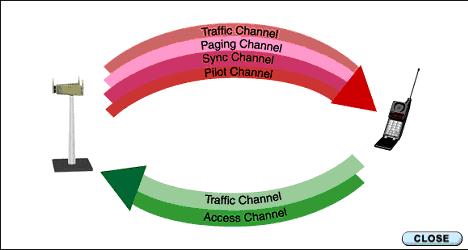
Code channels used in CDMA. A code channel is a stream of data designated for a specific use or person. This channel may be voice data or overhead control data. Channels are separated by codes. The forward and reverse links use different types of channels.
|
 |
Forward link channels
The forward link uses four types of channels to transmit voice and control data to the mobile. The types of forward link channels are: · Pilot · Sync · Paging · Traffic
Pilot channel.
The BTS constantly transmits the pilot channel. The mobile uses the pilot signal to acquire the system. It then uses the pilot signal to monitor and adjust the power needed in order to transmit back to the BTS.
Sync channel
The BTS constantly transmits over the sync channel so the mobile can synchronize with the BTS. It provides the mobile with the system time and the identification number of the cell site. The mobile ignores the sync channel after it is synchronized.
Forward link traffic channel
CDMA uses between fifty-five and sixty-one forward traffic channels to send both voice and overhead control data during a call. Once the call is completed, the mobile tunes back in to the paging channel for commands and pages.
Reverse link channels
The reverse link uses two types of channels to transmit voice and control data to the BTS. The types of reverse link channels are: · Access · Traffic
Access channel
The mobile uses the access channel when not assigned to a traffic channel. The mobile uses the access channel to: · Register with the network · Originate calls · Respond to pages and commands from the base station · Transmit overhead messages to the base station
Reverse link traffic channel
The reverse traffic channel is only used when there is a call. The reverse traffic channel transmits voice data to the BTS. It also transmits the overhead control information during the call.
Call processing stages
There are four stages or modes in CDMA call processing: · Initialization
mode · Idle mode · Access mode · Traffic mode.
Initialization mode
During initialization, the mobile: · acquires the system via the Pilot code channel · synchronizes with the system via the Sync code channel
Idle mode.
The mobile is not involved in a call during idle mode, but it must stay in communication with the base station: · The mobile and the base station communicate over the access and paging code channels · The mobile obtains overhead information via the paging code channel
Access mode
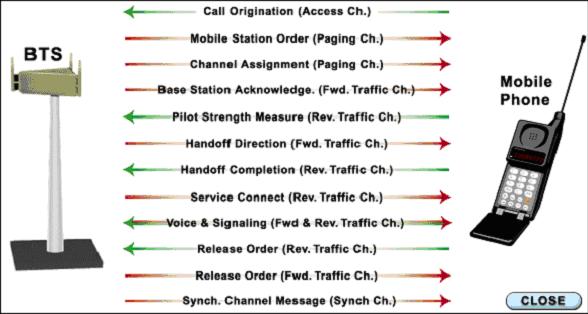
The mobile accesses the network via the Access code channel during call origination. The Access channel and Paging channel carry the required call set-up communication between the mobile phone and the BTS until a traffic channel is established.
Traffic mode
During a land to mobile (LTM) call: · The mobile receives a page on the paging channel. · The mobile responds on the access channel. · The traffic channel is established and maintained throughout the call. During a mobile to land call (MTL): · The call is placed using the Access channel. · The base station responds on the paging channel. · The traffic channel is established and maintained throughout the call.
| Call processing (messages) During the call overhead messaging continues on the traffic channel in a limited fashion. This messaging uses "Dim and Burst" or "Blank and Burst" signaling, which replaces part of the voice traffic with system messages. The user does not detect this signaling, however, due to the strong data recovery schemes inherent to CDMA. |
 |