|
So, what have I learned over the years of developing my carts?
- Do not underestimate the stresses that are imposed on the whole system. On
the flat these would not be small, but over bumpy ground and uphill they gets
much greater.
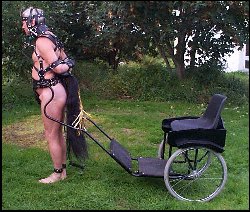
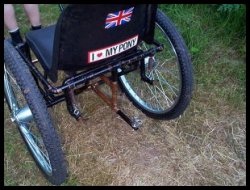
- Using copper tube and steel conduit enables a light and strong cart to be
made using basic hand tools and a gas torch. The conduit passes through the
reduced diameter of the copper 'T' joints, making a joint along a length
that much stronger. Another advantage is that the cart can be assembled
without soldering, so it can be fiddled with to get the design right - and
as you have seen, it can be carefully unsoldered to make modifications
later.
- If you use copper tube as I have, make sure the gas torch is a fairly big
one. The joints take a lot of the stress, and you will not make a good one
if it does not get really hot.
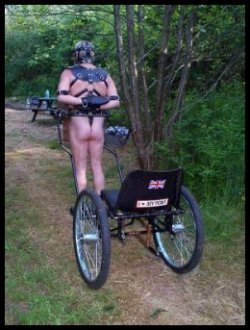
- Unless you are planning to use the carts only on flat level ground, stout
wheels are essential. Even the mountain bike wheels were slightly buckled by
the time I stopped using them!
- Keep the centre of gravity reasonably low. I have seen a couple of
potentially nasty accidents where a cart turned over, taking the pony with
it because they were harnessed in with no use of their arms.
- Look at other peoples carts - I am always searching for pictures. You can
get an idea for what works and what may not, or just see a design that you
like and try to copy it. Part of the reason for putting this site together
is to give something back to the pony community for a change.
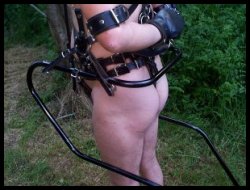
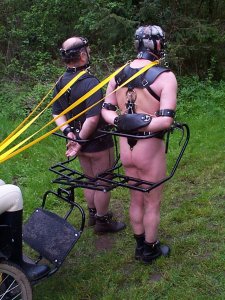
- Look for 'standards' in existing designs, which in my case was mainly where the pony is
attached to the shafts. This will enable other ponies to use your cart, and
mean that your harness is compatible with other carts.
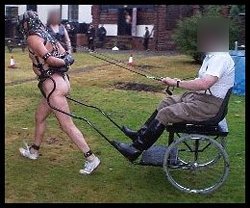
- The position of the driver over the wheels is very important for the
comfort and safety of the pony - there should be a slight bias towards
putting weight on the front. If possible, make your seat position front to
back adjustable. If you intend to use it for one pony only, the correct
balance can be built in, but if it will be available for others to use, some
ponies may find it hard going. This was evident when a shorter pony than
myself was harnessed to my second cart, which has quite a bit of forward
weight to start with. Because the cart tipped down at the front, the
driver's weight was forward of the axle, thus making the problem worse. By
moving the seat back an inch or so, the weight of the driver was back just
behind the axle, and the correct balance was achieved. As you can probably
imagine, this balance is particularly important when a male driver has a
ponygirl in front. If he is too far back there will be a tendency to lift
the pony into the air.
|