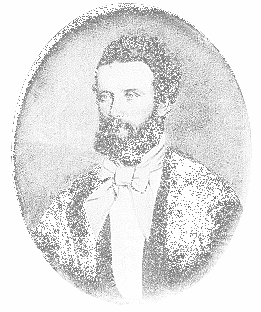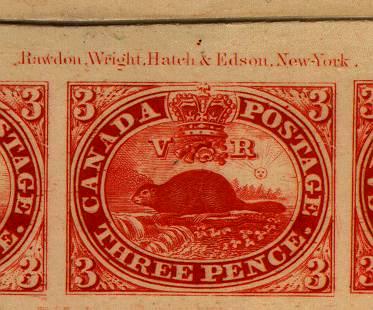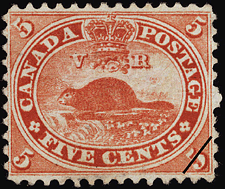
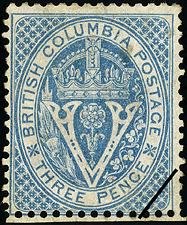

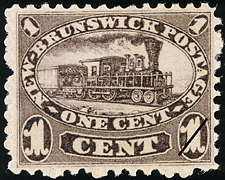
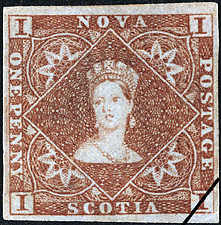
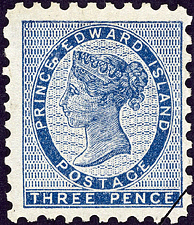
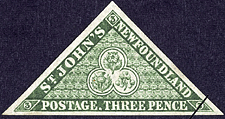
To Canada Post its the year of the snake. To stamp collectors, it's the 150th anniversary of Canada's first adheseve postage stamp, the 3-penny beaver. The stamp was designed by Sanford Flemming, a Scot.
Prior to 1851, letters could be sent in Canada without stamps. The cost was borne by the receiver. In 1850 Britain's colonial office, which was running affairs in Canada, decided that postal matters should be turned over to local authorities. James Morris was the first postmaster-general, although Benjamin Franklin had held a similar post for Canada and the American colonies before the American Revolution.
Although Morris had a package of proposed designs for the expected stamps, he decided to see what "Canadian talent" could produce. Fleming was a volunteer who met Morris at Ellah's Hotel in Toronto and produced his sketches for the stamp in February 1851.
Flemming was born Jan.7,1827, at Kilkeady Fife. He studied the relatively new process of lithography printing in Scotland, before he and his brother came to Montreal in 1845.
On April 29,1849, rioters set fire to Canada's Parliament buildings, Flemming was a draughtsman student in Montreal, and a witness, and rushed into the burning building to save a painting of a youthful Queen Victoria.
The next day he left for Ontario, the painting in his baggage. Its image became one of Canada's first stamps, known as the 12-penny black.
But the3-penny beaver was the first stamp to be issued, on April 23, 1851.
The first printing was from a lithographic plate, but Canadian authorities insisted that the Canadian stamp be engraved. The contract was given to an American firm, Rawdon, Wright, Hatch and Edson, the firm that printed the first U.S. stamp. They were printed in sheets of 200. The order was for 100,00 at 20cents per 1000. In 1856 the printers received permission to print the stamps in lots of 100 to make gumming easier.
Three (3d.) pence 'Beaver' engraved plate proof issued by the Province of Canada, 1851
On Sept.16, 1977, Canada issiued a 12 cent stamp to honor Flemming, noting that he had mapped the route for the Intercontinental Railway, for which he was knighted. It is less well known that Flemming designed the international standard time system. He devided the globe into time zones based on longitude, a system that exists to this day.

From an article written for the Montreal Gazette Jan. 6, 2001, by Larry McInnis.
13/07/02 9:54:12 AM
 Can Index