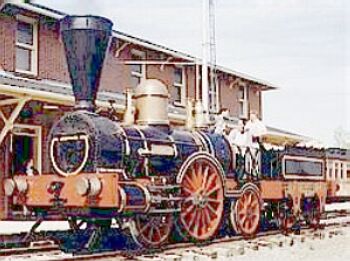

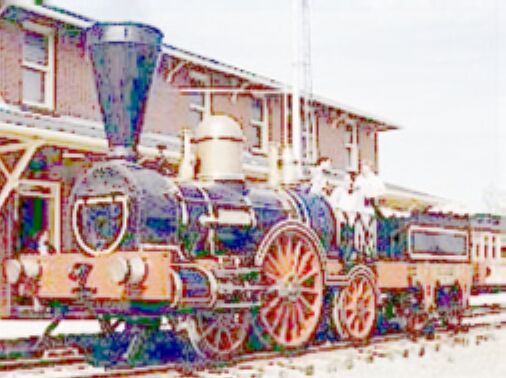

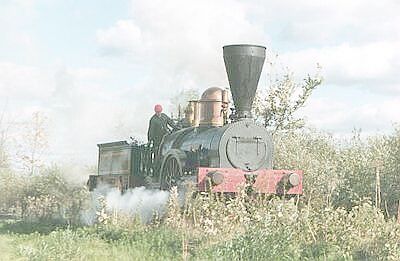
 The modern-day "John Molson," a replica, is based on an 1849 engine once used on Canada's first public railway. |
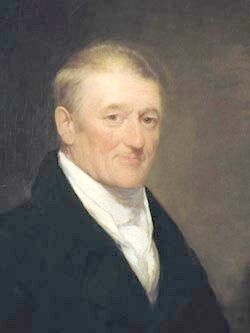
The first member of the Molson family to come to Canada from England was John Molson who
established a brewery in Montr�al in 1786. The second son of John Molson, Thomas (1791-1863)
married his cousin, Martha Molson and joined the family business in 1816. Aside from a decade
spent in Kingston, 1824-1834, Thomas was involved in a series of family oriented partnerships in
Montr�al. These partnerships, which revolved around the brewing and distilling business eventually
included his sons, John Henry Robinson, William Markland and John Thomas (1837-1910).
Educated at Montreal High School, John Thomas joined the family's business concern in 1861.
From 1868 to 1880 he spent his time travelling in Europe, yachting and fishing. He returned to the
firm in 1880 and continued his association until his death in 1910. John Thomas married twice: his
first wife was Lillias Savage (1839-1866) and his second wife was Jane (Jennie) Baker Butler
(1850-1926) of Waterloo, Qu�bec. The eldest son of Jennie and John Thomas was Herbert
Molson (b.1875) who later served as a governor of McGill University.
This 2-2-2 locomotive is
an operating replica of a locomotive once used on the Champlain &
St. Lawrence Rail Road, Canada�s first public railway. Running between
La Prairie and Saint-Jean in what is today Quebec, the line by 1852
was extended to connect with several American railroads at Rouses Point,
New York. Constructed in 1849 in
Scotland by the Wallace Foundry of Kinmonds & Company, the original
John Molson was a mechanically simple engine. A wood burner,
only the wheels of its tender sported brake shoes--as was common for
the era. This early locomotive�s lively colors and gleaming brass fittings
showcased the importance of the steam locomotive in the 1850s as a symbol
of industrial progress. This full-sized replica,

 Doctors in 1839 warned prospective passengers that a ride behind "De Arend" would be breathtaking. |
Hailing from The Netherlands, De Arend ("The Eagle"), a 2-2-2, was built in 1839 by English locomotive builder R. B. Longridge of Bedlington, under license from Robert Stephenson. It was the first locomotive to haul a train from Amsterdam to Haarlem that same year. In spite of doctors� warnings against train travel (they feared it would literally be breath-taking!), the 16 kilometer (10 mile) distance was covered in less than one-half hour--at the astonishing speed of 38 kilometers per hour (23 mph).
Among the locomotive�s remarkable characteristics is its wide 6 foot, 4 inch gauge (distance between the rails). The original De Arend was scrapped in 1857. This replica was constructed by Railway Works Zwolle in 1938 for the following year�s centennial celebration of railroading in The Netherlands. It has attended railway fairs in Europe, including the 1997 festival of pioneer locomotives held in Lucerne, Switzerland. This is De Arend�s first visit overseas; appeared at Railfair �99 courtesy of its owner, the Dutch Railway Museum of Utrecht.