|
Welcome Guide for Significant Others of students at St. George's University |
||
| Airport, Airlines, Customs | ||
|
Grenada has one airport, located about 5 minutes from the school's main campus. Getting through the airport can be intimidating at first. When you get
off the plane, you will proceed to immigration, where there will be quite
a line if you arrive when most students do. Families see the immigration
officer together. Be sure to bring the letter from the school stating
your student will be attending the University as well as your passports.
Be sure to fill out the arrival card given on the plane before you reach
the immigration officer. When you are asked where you are staying, True
Blue, Grand Anse, or L'anse Aux Epines will do fine. Do not say you aren't
sure yet or you will end up in an office making a hotel reservation. From
there you will pick up your baggage and proceed to customs. Getting through customs can sometimes be a problem, but here are a few
guidelines to make the process easier. There is a red line, which is for
when one has an item to declare, and a green line, which is when one has
nothing to declare. If you go through the green line, and they find you
have items that can be charged duty, you will either have to go to the
end of the red line (which can be very long and slow) to be reassessed
and pay the duty, or it could be a greater penalty depending on the customs
officer. If you are bringing a computer, you will have to declare it through
customs, and you will be required to pay a duty (tax) on 5% of the value.
It helps to have a receipt for the computer, even if it is one you typed
up at home. After you pay your duty you will get a receipt, it is important
to keep it to show the next time you bring the computer through customs.
Customs may go through some of your bags. If they find electronics you may be charged duty on these items. Again, it helps if you have a receipt for it. Get a receipt for any duty paid so if you travel with the item again you have proof of duty already paid and you will not be charged again. Items that look new or still have price tags will be charged a higher duty; therefore, before you pack, remove tags and make sure the items packed do not look new.There is no set duty on any item, so be sure to smile and be polite and respectful. Customs officials have a great deal of latitude in determining duty fares and may increase the charges if you are rude, argumentative or act like you are in a hurry. It is a good idea to arrive in Grenada with enough cash to set up housekeeping, including the phone deposit, and odds and ends you may need. Traveler's checks are accepted, but credit cards are not always taken (although they do take them at the grocery stores). Make sure you have transportation from the airport. Taxis are always willing to take you, just be sure they do not charge more than $25 EC or $10 US during the day and $35EC at night. There are plenty of taxis waiting outside the airport to take you to your new home. There are public telephones available to the left on the outside wall once you exit the customs department as well. There is usually a greeting committee of SOs waiting outside the airport to assist you, but to assure that you are greeted, please let the SO public relations officer know when your flight is scheduled to arrive (See email address at end of survival guide). |
||
| Apartments and Housing | |
|
If you are planning to bring a family to Grenada, the best advice from previous SOs is to arrive a week or more before school starts in order to find a place to live. Rent can run from $300 to $2500 US depending on the size, number of bedrooms and location. There are some decent places under $500, but they are usually 1-2 bedrooms and are small if you have a family. Check out the new Unofficial Housing Guide for detailed housing search
tips and apartment listings: http://www.w4designs.com/sguhousing 1. Location True Blue, L'anse Aux Epines (pronounced lance uh peen), Grand Anse, Calliste and Point Salines are all within a 5-10 minute drive from both campuses and grocery stores. While the rent tends to be high when compared to other parts of the island, the convenience and the opportunity of being near other families and students is well worth the extra money. The roads beyond these locations can be poor and may cause you to spend more time in a car then necessary. 2. Security Are there security bars on all the windows? This is especially
important if you live on the ground floor. What condition are the doors
and locks? Have there been any break-ins on the property? Is the yard
fenced in and has a gate that can be locked? While a fenced in yard is
not always necessary, it is a good added security measure especially with
children or dogs. It is a good idea to check with the previous tenants
about crime problems or other safety issues. Many apartment complexes
have security gaurds at night. 3. Landlord Find out as much as possible about the landlord or property
manager. Are there other students currently living on the property? Talk
to those students about how responsive to repairs and other problems the
landlord has been. 4. Lease Make sure everything the landlord promises is written in the
lease. Read the lease carefully and find out who is responsible for repairs
on appliances, screens, gates, etc. Find out if you will have to pay rent
during the summer (school break) to ensure that your place is available
and not subleased during the summer months. Many units are rented during
Carnival if the rent is not paid for July and August. 5. Water During the dry season (January-May), water supply can become
a major problem. Be sure to ask what size water storage tanks the house
has to ensure you will have water. The minimum size recommended is two
1000-gallon tanks. Will they be full when you arrive? Is there a water
pump? Water pumps are necessary in order to obtain water pressure. If
your house/apartment is on a hillside, water problems can be more frequent.
Check the lease to see if the landlord will be providing water delivery
during the dry season, and from what source. Private water deliveries
can get expensive. 6. Hot Water Does the house or apartment have a hot water tank or electric showerhead? Some places are equipped with solar panels(so no hot water on cloudy days) or gas heaters. Some do not have hot water at all. If a hot shower is important to you, make sure the place is equipped before you rent. Electric water heaters for the shower are available to buy and have installed. 7. Cooking Gas Most houses/apartments have gas stoves. The gas tanks
can either be large or small. Be sure to ask which size the house is equipped
to hold. Both work just as well, but take transportation into consideration
if you need to transport a portable tank yourself. Also ask to see if
your rent includes the cost of the gas tanks. 8. Telephone Some rental places have telephone service already set up
in the landlord's name. The advantage to having the phone already set
up is you will not have to pay the phone deposit or wait for the installation.
However, some of the phones will not allow outgoing long distance phone
calls to be made. Again, you may use the internet (Dialpad) or use an
international calling card. They are sold at the University mailroom. 9. Pest Control Ants, cockroaches, mice, rats and other insects and rodents
are prevalent in Grenada. Find out if the landlord will provide regular
extermination visits and if the pesticide will be placed around the perimeter
of the house. This is very important if you plan on bringing pets with
you. Make sure all the windows you will be opening have screens that fit
the window on them and that the doors fit the doorway tightly. You may
want to bring a sweep for the door if the doors do not. Screens are a
must from August through December when the island is wet. Top floor apartments
tend to have less bugs than the bottom; however, if bottom floor apartments
are properly sealed and kept clean there shouldn't be any problem. Check
if the areas around drainage pipes and electrical wires are tightly sealed.
Centipedes and some other creatures tend to enter the house through drainage
pipes.NOTE: While centipedes are rarely seen, they are poisonous and are
attracted to milk and damp areas. They are fast moving insects that can
grow to 8-10 inches long. Pesticides generally do not have an immediate
effect on them. The best way to kill them is by cutting or smashing them
with something large. If anyone in your family gets stung, contact the
school physician extender or a doctor right away. 10. Air Conditioning, Fans and Breeze When viewing the house, open the
windows and check if there is a breeze. This is very important because
running the air conditioner all day can become quite an expense. If there
is a cool breeze running through the house an air conditioner will not
be necessary. Invest in a fan and you will save a lot of money. Fans cost
around $75-150EC, and can be purchased used. 11. Extras A television, microwave, cable TV, laundry services, housekeepers, or gardeners may or may not be included in your lease. It will save you time and effort if you find these things out before you decide to move into your new place. If there is not a TV in your house/apartment, you may want to bring one, especially if you have children. You can have cable installed (except on True Blue campus at this time), and most channels are available such as NBC, CBS, ABC, FOX, TLC, HBO, CNN and about 35 others. Domestic Help Domestic help in Grenada is readily available and inexpensive. You may wish to hire people to help with cleaning, laundry, babysitting, or gardening. Word of mouth is the easiest and most reliable way of finding help. If you are living off campus, you may want to check with your landlord before hiring. Sometimes landlords have specific cleaning people they work with and many hotels or apartment buildings offer cleaning services at no extra charge. The Round Houses include weekly maid service for all tenants. Laundry services are helpful because sometimes the machines are backed up causing you to spend quite a bit of time in the laundry room. If you hire help you can leave the laundry in the morning and pick it up in the afternoon. Laundry There are several laundry facilities available to you. On True Blue Campus, there are two laundry rooms. They both have several washers and dryers. Also in each dorm building on True Blue Campus, there is one washer and one dryer in the main hallways. Another laundry facility is located at the Grand Anse Campus. The laundry at Grand Anse has roughly 8 washers and 10 dryers. There is no cost to use the laundry facilities, however they can be quite crowded at peak times. Wherever you decide to do your laundry, all facilities are accessible by the bussing system provided by the University. |
|
| Banks | |
|
The banks on the island are:
There is an RBTT branch and ATM machine on campus. All banks have ATM machines that allow you to withdraw money from your home accounts for a fee (you will probably also be charged a fee by your home bank). It may be helpful to open a local bank account while you are on the island. Financial Aid checks come to you on the first day of classes. This money could be hard to send back home to put into a US account. Opening a local account will simplify transferring money and loan checks. When you leave Grenada to go to St. Vincent, simply ask for a money order from your local bank in a $dollar amount of your account balance. There is a small fee for this, but it is an easy way to transfer money from an island account to a US account. Using an ATM machine to withdraw money from a local account also prevents being charged for ATM withdrawals. Grenadian money is in Eastern Caribbean dollars. The exchange rate is approximately 2.67. For instance, $100 US dollars equals $267 EC because 100 x 2.67 = 267. |
|
| Bringing kids to Grenada, Kid's playgroup, Local Schools | |
|
Most children of all ages adapt well to living in Grenada. There are a few guidelines that might make the adjustment a little easier on you and your children. The SO group has a family coordinator, who is available to help with the transition.Formula is not too expensive here. However, baby foods, disposable diapers, diaper wipes and ointments are expensive. Bring as much as you can from home. If you have visitors ask them to bring some down with them also.The school has given the SO group a small building on Grand Anse campus as a retreat. Currently, most SOs with children meet there on Tuesday mornings for a playgroup session, and again on Thursdays for a beach outing. The building, called the Grand Anse Playgroup or the GAP, is a nice place to hang out in the air-conditioning while waiting for laundry to finish. A key is available from the security gate at Grand Anse. All SOs are welcome to use the GAP at any time, not just SOs with kids. Some children attend the Westmoreland Private School. There is also a Mennonite run school in the Limes neighborhood. Home schooling is also a popular choice here on the island. Contact the family coordinator for more information on school choices. |
|
| Bringing pets to Grenada | |
|
In order to bring a dog or cat to Grenada, you need clearance from the Veterinary General. You must contact the Department of Veterinary and Livestock in Grenada; and obtain a permit to import a dog or cat. You must also obtain a certificate of health from your veterinarian a few days before arriving in Grenada to insure the pet has all his/her shots and is in good health. If flying BWIA, a veterinarian must be waiting in Grenada to check the pet once it arrives. American Airlines does not require the veterinarian to be at the airport. One must put the animal on flea and heartworm pills before coming to Grenada because both problems are prevalent. If the pet is not taking these medications while in Grenada, his/her life is at stake. Bring a supply of pills from home. It is recommended to bring as much pet food as you can from home. Pet food is very expensive here and not always fresh. Cat litter is not always available.American Airlines will let a cat or small dog ride in the passenger section if they are in a carrier small enough to fit under a seat. Larger animals must ride in the cargo hold of the plane. A duty can be charged on pedigreed animals if you say they are a pedigree at customs. Ten or twenty dollars is sufficient. American Airlines may have a pet embargo at the time you come to the island. This means that they will not transport animals in the cargo hold, therefore if your pet cannot fit in a carrying case under the seat you are in on the plane, then they cannot come. This especially becomes a problem if you are already in Grenada and need to bring a pet home. Call American before you come to make clarify if a pet embargo is in place. |
|
| Campus Information and Campus Safety | |
|
There are two main campuses on Grenada: True Blue and Grand Anse. All medical classes are held on True Blue campus. The Founder's Library and the fitness facility are on True Blue. Grand Anse campus is located right next to Grand Anse beach. It features a number of student apartments and two popular eating establishments: The Ladies, and Green Jeans restaurants. Campus Safety Crime does occur in Grenada frequently, although most crimes are petty theft. Don't walk around off campus after dark, keep your doors locked at night, and remember general safety guidelines from home. Security guards patrol both campuses twenty-four hours per day. |
|
| Car Buying and Renting, Registration, Licenses and Parking | |
|
Depending on where you live, a car can be more of a necessity than a luxury. Buying and maintaining a car is expensive. If you don't live on the bus line, a car will probably be very important to you. In addition, a car offers much more freedom and makes everyday chores such as grocery shopping and laundry easier. If you choose to buy a car, consider buying from a sudent who is leaving the island. If this is not possible, get a referral from a student who bought and has had good luck with their purchase. The road here are hard on cars and some repair work will probably be necessary while you are here. You will want to have a mechanic inspect the car before you purchase it. When you buy a car in Grenada, the car is brought to you for convenience. You get to test drive it and can take it to a mechanic (a lot of the students rely on a local man, named Mr. Lords) and have it looked at. If you decide you like the car, depending on if it is a student or local, the car could be yours in a matter of days. Some of the students here put up For Sale flyers around campus to sell their cars. Some students put a condition on the purchase meaning you may buy it right away but have to wait to get possession until the end of the term so that they can get full use out of their car. However, this is not always the case, some students once they find a buyer, will gladly hand over the car once the proper procedures have been met (ie. paper work - Insurance documents have been changed over). There are quite a few insurance dealers on the island. Most of the agencies are located in downtown St. George's. The previous owner will accompany you to the insurance agency here. They will sign over the car to you in your name. One thing I can not stress enough down here is, although life is very relaxed here, Grenadians are sticklers for their documents. So make sure that when you purchase a car that the previous owner has proper documentation for the car. You would hate to get in an accident here and not have insurance - I am sure you could imagine your own nightmare for this situation. To obtain a license here is quite easy. You go to one of the police stations on the island (the most convenient one is located just around the corner from Grand Anse campus) and purchase a local license. This is assuming you already have a valid US, Canadian, UK, etc. licence. You show the police officer your driver's license and he writes you up a paper slip which then becomes your valid license while you are driving in Grenada. For those of you renting a car, I believe the car rental office will issue you a license. The only hassel to local licensing is the fact that you can only get one issued for up to three months - how does that work, most students are on the island for 4 months. Some students forego renewing their licenses for the remainder of the term but again I will warn you, if you don't have a valid local license and you get in an accident, the insurance company will not vouche for you. Which means instead of paying another $30 EC to renew your license for another 3 months (one or two of those months you will be absent from the island), you may have to pay a heck of a lot of money to pay for damages to your car or to another's. You way the odds! The school does have parking for students. Although due to all the construction right now, the parking is limited. In order to be permitted on campus with a car, you must have two things - a student sticker and an inspection sticker. The student sticker may be obtained from the Chancellory office barring that you have paid your car insurance for the year. When you go to get the student sticker for your car make sure to bring your up-to-date insurance papers. The school is very strict about vehicles on campus - like getting your yearly physical, your car must undergo a yearly physical to be allowed on campus. Once a year, your car must go for an inspection. This is done at the police garage on the Dusty Highway. This procedure is a bit of a headache but believe me getting it done will prevent future headaches with the school and the local police. In order to receive an inspection sticker you must go down town to St. George's with your insurance papers. There is a building located at the end of the carnage on your right hand side (ask another student the name of the building), it's not hard to miss. Go to the second floor and you will wait in line for about an hour along with all the locals while they wait to pay (I think it's $60EC) a man located at the ticket booth where the man will issue you a document (this is the apparaisal for the police to fill out at the garage). You take the appraisal document to the police garage located on the Dusty Highway (yes you have to drive all the way back from St. George's). You wait in a line of cars until it's your turn (there is a lot of waiting on this island, best get used to it). The police officer will direct you - usually you just have to beep your horn, flash your highbeams, use your left and right indicator, put your car in reverse, step on the break and that's about it. Hint - check your car before going to do all of this, if you have a burnt out tail light or something like that, get it fixed before getting your car inspected, it will save you time. If everything checks out okay, then you take the appraisal back to the building in St. George's and go to the second floor and pass the ticket booth and hand the sheet into a police officer at the counter. They will then issue you a sticker. Hallaleuh! This sticker is valid for one year from the date of issue. Don't bother trying to be ahead of the game - the police garage will not appraise cars until their due date (check your sticker for the month of inspection). One final message - the roads here are somewhat bumpy and in poor shape (the main roads are great but the side roads tend to be rough so having to purchase new tires isn't unusua1). A lot of the students just buy retreaded tires which costs about half the price of a new tire. They work just as well - just something to think about. Again, if you are renting a car, check the policies for replacing tires, the car rental agency may do this for you. Renting a car is another option. This works well if a number of students share the care and cost, as renting is expensive. Rates are usually between $350 and $500 US per month. Some rental companies replace your car if it is damaged and they also take care of tune-ups. As with buying, check with other students who have rented and have them steer you toward a reliable company. Shipping a car from anywhere off the island is not recommended, due to the astronomical duty charged. |
|
| Churches | |||||||||||||||||
|
Below is a list of churches in Grenada that students may want to attend. Please call the contact numbers listed for more detailed directions.
|
|||||||||||||||||
| Communicating with Family and Friends | ||
|
Have your family obtain an International Calling Plan such as AT&T
long distance. Prices from the US to Grenada with these plans are about
50 cents US per minute. If you call home from Grenada it will cost about
between $2.00 EC and $5.00EC a minute depending on the time and day you
call. Many students use internet calling options such as Net2Phone or DialPad. DialPad, at http://www.dialpad.com, works by calling the person in the US (it works for calls to the US only) over the internet. The phone of the person you are calling rings, and you speak to them using the microphone on your computer. It is helpful to use a headset, such as one from a walkman, and to bring an external microphone for your computer, although the quality of the sound will increase using a headset with an attached microphone. DialPad and Net2Phone charge a small per minute fee for the calls. Some people have no problems using DialPad, while others say that there is a delay, and there can be bad connections. For a completely free option, try downloading MSN Instant Messenger or Yahoo Instant Messenger and use the call function on either one. To use this, both parties must have the program downloaded onto their computers (it is free), you must schedule a time to talk, and depending on the popularity of the time you call, you may get a delayed response. But hey, it's free! While it definitely helps to have a computer, there is a computer lab on campus, with approximately 30 computers, all with access to the internet. The computer lab is usually open from 10am until 10pm, and is open to SOs as well as students. DialPad and other internet calling services are not allowed in the computer lab. The lab is often very crowded, so expect a wait during peak times. Mailing letters and post cards from Grenada is easy and painless. Simply go to the campus mailroom and pay for the postage. For more on this, click on this Post Offices link. |
||
| Day Trips from the Island | |
|
These ideas were taken from www.lonelyplanet.com Bathways Beach Levera Beach Carriacou Petit Martinique Grand Etang Road Sauteurs |
|
| Electricity in Grenada | |
|
The voltages and plugs in the United States and Grenada are different. This document will explain the differences in the power, and also explain the differences between adapters, converters, and transformers. You need to understand this before you try to hook anything up, because if you don't you will probably fry whatever it is you're trying to use. Let's start with the electricity: United States voltage 110V, Grenada
voltage 220 V. As you can see, the voltage here is twice what it is in
the United States. A 110-volt fan, stereo, computer, or what-have-you
will be very unhappy if you try to run it on 220 volts. Fan motors melt.
Stereos stop working. Adapters simply have a plug that fits in the wall here at one end, and
an American style outlet that you can plug American electronics into at
the other. These are dangerous because it makes it easy to plug 110-volt
appliances into 220 volts. As a general rule, STAY AWAY FROM ADAPTERS.
There are two ways to make 110volt electronics run in Grenada: 1. Converters Converters are electronic devices very~much like a light
dirurner. They work by "chopping" the electricity, only allowing
current to flow part Of the time. If the box can fit in the palm of our
hand and is rated between 1000 and 2000 watts, it's a converter. Converters
are OK to use only on what are called "resistive loads," which
is a fancy way of saying stuff that gets hot-hot plates,toasters, light
bulbs, that sort of thing. Most electronic equipment will run for awhile
on a converter but may be damaged when used with a converter. The reasons
are complicated and will be explained in further detail later. Heating
type appliances work well with the "Foreign Travel Voltage Converter"
from Radio Shack. 2. Transformers Transformers actually take 220 volts and step it down
to nice, clean 110-volt power. Generally, for all electronic equipment,
this is the way to go. EVERYTHING WILL WORK OFF A TRANSFORMER. If you're
going to use anything electronic, you need a transformer. Now the question
comes down to "what size" and "how many." It is a
good idea to check the number of watts on the electronics that you plan
to bring. Add up the number of watts and this number will tell you what
size transformer to buy. Keep in mind that irons and hair dryers take
up a large amount of wattage. Both of these items are available at most
stores in the US in a dual voltage, which cuts down on the size of transformer
you need. Some peole choose to buy two transformers, while others choose
to buy one large transformer and bring several extension cords. Transformers
are readily available in Grenada, most students buy them once they arrive.
The size of the transformer is how much electricity, measured in watts the transformer can safely supply. It will be clearly printed on the transformer. As long as the total load is less than what the transformer is rated, the transformer will run okay. If you exceed the transformer's rating, it will overheat? and may burn out.So how do you figure out how much you need? Generally, if a hot plate or other cooking device is going to be used, get a transformer with the same wattage rating or larger than the hot plate. Since this is the largest load, and won't be on all the time, when it is off you'll have plenty of capacity to run everything else in your room. If you are going to run a lot of stuff at the same time-like a stereo, lights, a computer etc., you will have to look at the data plate on each device to figure out how much of a load there is. Most AC adapters for stereos are under 25 watts. AC adapter for most computers are about 100 watts. Figure about 350 watts for the average desktop computer. (Doesn't a desktop computer with a 250-watt supply use 250 watts? NO! There are conversion losses and power factor losses). Figure 350 watts for a 250 watt computer and you'll be safe.If this sound too complicated, here's a general guideline that will work for most people. If you are not planning to cook, use a desktop computer, or use a hair dryer, then generally a 250-watt transformer is sufficient. If you are not planning to cook, but use a desktop computer, then a 400-500 watt transformer will generally work. If you are planning to cook or use a hair dryer, you need a transformer rated the same or larger than whatever you are going to use to cook or dry your hair with. If you hair dryer is rated 1500 watts, then you will need at least a 1500 watt transformer. |
|
| Fitness Activities and Classes | |
|
There are a number of fitness classes available on True Blue campus. They include step aerobics, kick-boxing, yoga, dance, and self-defense. Fitness classes are held every day of the week and are a wonderful way to stay in shape while on the island. The schedule changes every term and can be found in the gym at True Blue. Along with fitness classes, there is also a gym with free weights and machines. The gym is open-air so we can feel the cool Caribbean breezes while working out. |
|
| Food Shopping | |
|
There are five grocery stores-2 Food Fairs and 2 Food Lands-and the Real
Value in the Spiceland Mall. Real Value, which opened in August 2000,
has a wide variety of foods, and most US brands. Food Fair and Real Value
are close to the Round Houses, which are on the bus route. The prices
and items in each store vary. Try them all and see which works best for
you. If you have storage space in the freezer or refrigerator, buy in
bulk. An item you see today may not be there tomorrow or the next week.
Check pricing at all the supermarkets and try local brands (Trinidad and
Barbados as well). Only Real Value is open on Sundays. There is an open-air
market in town, which sells fruits, vegetables and spices. Bring lots
of $1 and $5 EC ($1US = $2.67EC) because they tend not to have change.
You must also bring a knapsack because there are no bags or packages.
One can negotiate prices at the open-air market.C.K.'s is a bulk store
located in Grand Anse. If you plan on buying in bulk,CK's is your best
bet. Most people also buy their chicken from here. Soda can be purchased
in bulk but a vehicle is necessary to get them home. A case of twenty-four
one liter bottles is 24 EC (about 9 US), plus a refundable 12EC deposit
on your first purchase. You may find some items in the store, and then not see them again for several months. Fresh milk, sour cream, cream cheese and other dairy products are usually available, but at times are not. Meats are available but expensive. For example boneless, skinless chicken breast is available off and on, and usually costs about 9EC(3.37 us) per pound. You may find that you have to go to more than one grocery store to find everything you need. Many SOs bring their favorite items from home, such as packets of ranch dressing mix, Lipton onion soup mix, canned chicken (available but expensive), olive oil (very expensive) and crystal light. Other ideas include cooking spices such as garlic salt, season salt and oregano. With the new Real Value grocery store, most of the foods you are used to are available. There is even a candy store at the new mall. |
|
| Identification Cards for SO's | |
|
Identification cards are available for Significant Others of St. George's University students. Simply go to the Founder's Library and speak to a librarian about obtaining a card. The cards are free and are used for identificationm purposes on the island. |
|
| Jobs for SO's at SGU | |
|
There are job opportunities for SOs, no matter what you may hear. However, few pay on the scale many were used to at home. Finding a job outside of the university community is very difficult, no matter how qualified you may be and how needy the employer may be. Work permits are extremely difficult to obtain, even for professions that are always in need such as teachers and nurses. Positions available at SGU include the school mailroom and store, which is run by the Student Government. Usually 5-6 SOs work in the mailroom/store, and they usually hire new employees at the beginning of the term. There are also jobs answering phones at the Wellness Clinic and the Chancellery. The Department of Educational Services hires 5 SOs, although usually at the end of the term. The school clinic hires 5-6 students or SOs who are nurses, nurse practitioners or physician's assistants to be on call during the evenings, nights and weekends. There are two positions per term for couples as resident assistants, and hiring is done at the end of the term. Keep in mind that 1/3 of all students leave for St. Vincent each term, so if a job is not available right away, it may be at the end of the term. Jobs at the University do not require a work permit. Many SOs have earned incomes by teaching art, dance, swimming, foreign languages, yoga or preschool classes. Some SOs work as nannies for professors' children. Other SOs bake for students, and some have even done laundry. You probably won't find a 40 hour per week job, but you should be able to find something to earn a little extra money. However, it probably would be a good idea not to factor in any extra income into your budget until you are sure of a position. |
|
| Map of the Island | |
|
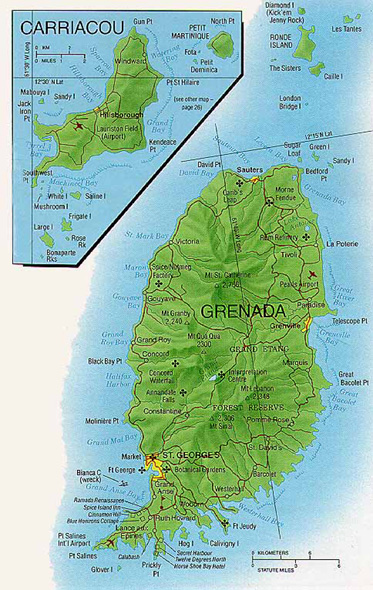
It may be hard to believe for most people, but Grenada does not use what we would typically refer to as "driving aids". There are basically no road signs, no street names, and no address numbers. For this reason, it is almost impossible to tell where you are or how to get somewhere without help or prior experience. Don't worry too much about getting lost because the area is small, there are few main roads, and most people are very helpful. The best advice we can give is to meet another SO (see the Contact list) who knows how to get around, and tag along with them. Because many people living in Grenada are natives and know the island very well, there are also few detailed maps on the island. Below is a map you may want to use in order to become familiar with the island after arriving, and can also be helpful for road trips.
|
|
| Medical Insurance | |
|
Medical care in Grenada is not up to par with the United States. The school has a clinic on True Blue campus, staffed by MDs and an RN. The clinic is open from 9:30 until 4:30 Monday through Friday. Students and SOs who are RNs, PAs or NPs are on-call after hours, and drive the school ambulance. They can be paged by the resident assistant on either campus, or by security. Most students who need hospitalization opt to go to the private hospital, St. Augustines, as the Grenada General Hospital's facilities are less than desirable. It is required for students, and strongly suggested for SOs and children to obtain adequate insurance coverage that includes medical evacuation. Keep in mind that most international insurance does not cover maternity benefits. As an aside, the school insurance plan is amazingly expensive for SOs and children. There are other choices available both on the internet and through many US insurance agents. If you come to Grenada pregnant, or become pregnant, prenatal care is available either at the school clinic or through an OB/GYN practicing in Grenada. Ultrasonography is available. Most SOs choose to go home at least once during their pregnancy for a full exam, as standards of care are different here. Also, most SOs choose to return home for delivery as complications cannot be managed as well in Grenada. Keep in mind that airlines will not allow pregnant women past 7 months gestation to fly, and may require a doctor's note specifying the due date. |
|
| Other SGU Clubs | |
|
Other clubs at SGU include: Student Government The Student Government is a vehicle by which students have input into University policies. Four to six students from each term are elected to this committee to advise the Chancellor's office via University committees on School policies and their effect on the students and the University. The Student Government is also represented on the Faculty Senate and relevant committees of the Senate. The SGACC is an elected subcommittee of the Student Government Association for clinical students. AMSA The American Medical Students Association (AMSA) of the American Medical Association opened its doors to allow St. George's University School of Medicine students to start their own chapter in Grenada and St. Vincent. The University received its AMSA charter in March 1993, the third school outside the United States invited to start a chapter. The other two non-US chapters are located in Canada and Puerto Rico. The benefits of being a student member include health and auto insurance at a reduced rate, a forum through the AMSA Review, and involvement in the AMSA health fair and other social projects for Grenada citizens and St. Vincent communities. Iota Epsilon Alpha Honor Medical Society In 1993, a chapter of Iota Epsilon Alpha was chartered at St. George's
University School of Medicine to reflect the society's goals of encouraging
high standards of character, conduct, leadership, ethos, and compassion;
to promote overall morale of medical students (The Bylaws of Epsilon Alpha);
and to improve the public health and welfare of the underprivileged and
medically indigent internationally. Any student who has completed one
term of study and who maintains a cumulative GPA of 3.5 may be nominated
to be a member. Sports Clubs With the construction of a championship-level playing field. and the establishment of new sports programs, the University is entering an exciting new era as a Caribbean institution of note. In 1998, The Fighting Caribs, a football team that includes students from St. George's University, local people and university staff, qualified for the semi-finals of the Central Major League Football Tournament and won an international competition, playing against teams from Italy, Miami, London, Belgium, New York, and Equador, in the American Airlines World CAAP, held in France. The University also established its first cricket team, entering the Inter Sector league of the Windball Cricket Competition in Grenada. St. George's sponsored a cricket camp in 1998 as well, with lectures, guest speakers, and practice used to teach students the skills they need to play the game. There is also a new netball team that is now competing in the Grenada National Netball Association and a 24-member tack team that competes against Grenadian schools and other Caribbean universities. International Student Organization Under the direction of Dr. Neil Fernando, Faculty Advisor, the International Students Organization represents the concerns of its members, presenting them as a body to the Student Government Association. This group is heavily involved in orienting students at the beginning of their studies at St. George's, and helps them become acclimated to life in Grenada. One of its subgroups is the Canadian Student Association. Emergency Medical Club The Emergency Medical Club was founded with the following goals in mind: First, to enable the students of St. George's University School of Medicine to contribute to the improvement of health care in Grenada. This is accomplished through annual fundraisers to benefit the hospital in St. George's and also through community outreach programs. Second, to allow students with clinical experience to share their knowledge and experience with their fellow classmates. This goal is accomplished through bi-weekly workshops. Also, special guest lecturers speak to club members about current clinical topics. The Club has also coordinated the donation of over $400,000 EC ($170,000 US) in used medical equipment from the Connecticut area to the Ministry of Health of Grenada.
Religious Organizations/Services A number of independent and student-formed religious groups support spiritual and cultural growth within the St. George's community and work closely with the Student Government Association to coordinate various activities. These include various Christian and Catholic groups, Hindu organizations, the Jewish Students Association, the Muslim Students Association, and the Grenada Islamic Foundation. There are many places of religious worship throughout the St. George's area and surrounding parishes. Volunteer Services The student body has become increasingly involved with the community in Grenada through various volunteer projects. Students have donated time, money, and a tremendous amount of energy to projects such as the Kennedy Home for the Handicapped and the Sapodilla Home for Orphans, the Grenada Health Fair, and the St. George's University Fund for the Orphans and the Elderly. These collaborative efforts not only serve to strengthen the bond between the University and the community of Grenada, but also enhance the student's understanding of total commitment to the profession of medicine. |
|
| Packing Tips | |
|
SO's who have already experienced packing and moving to Grenada, have a lot of packing tips for others. Whether we've learned it by experience, or by accident, we have plenty of advice and ideas to help make it easier for others. If you have a specific question, email an SO and ask for advice. Most of us are more than happy to spread to info for others to learn the easy way. For a list of helpful things to bring, see Things to Bring section below. Packing for life in Grenada can be a challenge since most of us come on American Airlines, with a 70# per person limit. It's hard to make clothes any smaller, but some things to think about are squishing small and large ziploc bags in and around clothes. Also, consider buying laundry detergent tablets in the states, open the box, and place them all around your clothes. (Laundry detergent is quite expensive here and although you probably won't be able to bring enough to use for four months, every little bit helps). A great idea for cheap, lightweight, and slim decorating ideas, try packing a couple of flat wall calendars to cut up and hang on walls. Bring Plastitack (found at Walmart) to hang them with since walls are usually concrete. If you plan to bring a lot of DVD's and CD's (recommended for entertainment) take them out of their cases and use a CD carry case or if you are bringing a CD burner / DVD player, buy a stack of blank CD's and replace most of them with your own CD's and DVD's. Don't bring many books since there are plenty of books circulating among the SO's. There is an SO library at the GAP house that SO's can raid when they get the urge. |
|
| Postal Offices and Mail | |
|
Want to send a package, or pick one up? Read this first! The Student Mailroom and Copy Center Services offered by the mailroom include: selling postage and envelopes, selling school supplies, Fed Ex and other express mailing systems, and courier service. Postage and Postage Rates The mail usually takes two weeks to get to Grenada. Outgoing mail from Grenada usually takes around two weeks to reach it's final destination as well. It is not uncommon for packages and letters coming to Grenada to take longer. Be sure to address your letter and packages correctly. Your new mailing address is: Your name Receiving Packages Courier service Cargo services Other services |
|
| Things To Bring | |
|
Below is a list of items recommended to bring for your sojourn in Grenada. You do not have to bring everything on this list. Think of what you normally use at home and decide if it is necessary for Grenada. Space is limited but do bring what you know you will use often. This is an excessive list but will help to spark your memory of what you actually use. You can buy most of these items in Grenada but realize it will be much more expensive than at home. Pack things into each other. (Put your knives inside your pitchers, etc.) Many places are furnished but the items may be less than desired. Consult with your landlord as to what is available and use your best judgement from there. Keep in mind the luggage restrictions from the airline you are flying. It is a good idea to call the airlines in advance to find out how much you can bring. The items below that are starred*, are items that are very available on the island. If you can't bring them with you, you can buy them for a reasonable price. Clothing Light clothing (shirts, shorts, sundresses, bathing suits, cover-ups,
etc) Kitchen Water filter and purifier- + refills - can be pitcher style or the kind
you attach to the faucet Household Shower curtain - most places have them, but are old and grimy, only plastic
low quality curtains are available here, so if in doubt, bring one! School Supplies Anatomy requires the student to wear scrubs or a labcoat-very expensive
to purchase here. General Camera / video camera/ underwater camera/ digital camera Children (Infants & Toddlers) Lightweight cotton clothing and swim suits Children (Older Kids) Games, puzzles, art supplies, toys, VCR tapes, books, video and sporting
equipment. Beach and water toys Personal Items Prescription medication for your entire stay - they often have European
brand prescriptions, they are equivalent, but not the same name as what
you may be taking. Tools Hammer |
|
| Things To Leave at Home | |
|
There are a number of things we recommend you leave at home. Some of these are just items that are relatively inexpensive here, or just inconvenient to bring. Unfortunately, most of us travel by bringing more of what we don't need and not enough of what we do. Here are a few things to think about... Don't bring many books since there are plenty of books circulating among the SO's. There is an SO library at the GAP house that SO's can raid when they get the urge. Don't bring any spices unless you must have something very specific and rare. Spices are one of the few things that are cheaper in Grenada than in the States. Don't bring a microwave or TV unless you want to pay a fortune in duty (usually more than what the item was originally worth). Other students and SO's are constantly selling their items and although these things may be very expensive, they will probably be cheaper than bringing them. Not only that, but your apartment may come with these amenities already. |
|
| Things to do | |
|
Activities Grenada is a beautiful island, but few students ever see much further
than the grocery store. The best way to see the island is to come one
week before classes start in order to participate in Orientation tours.
The tours are free, cover most of the island, and sometimes include food
and drinks. Other ways to get out is to take a day trip to visit a part
of the island or another nearby island. Day trips are oftentimes planned
by the SO organization, or friends who get together for some fun. Get
with someone who has a car and split the costs, or rent a car or scooter
for a day or week. One other fun way to see the island is to go on the
bi-monthly "hashes". These are hikes or runs held every other
Saturday, usually starting at the Carenage downtown. Volunteering Grenada is filled with volunteer opportunities and the community is very appreciative of any amount of time and effort you can donate. The SO group has a volunteer coordinator to assist you in finding the right place for you and your skills. See the volunteer section of the Welcome Guide for more information. Other There are many diving shops that offer packages to students and their SO. Most start at around $250US which includes the certification plus some extra dives. A single dive for those already certified starts at around $25US. Several places on Grand Anse and in Secret Harbor offer sailing lessons, or Hobie Cat rentals. Tennis lessons are also available. Some SOs choose to buy a membership to a hotel which offers use of facilities such as the pool, tennis courts, and sometimes kayaks and Hobie Cats. The school has a large weight room with free weights, rowing machines and stair masters. Aerobics classes are offered several times per week. The SO group has planned activities close to once a week. Potluck dinners, day cruises on a sailboat, luncheons at a restaurant are common activities. Every other Wedensday night, a different SO teaches a specific skill such as investing tips, dance, gourmet cooking, legal tips or sewing. All SOs are welcome to participate or to teach. |
|
| Useful Links | |
|
St. George's University - Grenada - Click
Here - |
|
| Utilities: Phone, Internet, Cable | |
|
If your house/apartment does not have a phone hooked up for you and you plan on having one, go to Cable & Wireless http://www.candw.com as soon as possible in St. Georges, or there will usually be a representative on campus during the first week of school. Installation is promised within 9 business days, or else your installation fee is returned. There is a large deposit and installation fee charged to students and expatriates, that usually costs around $500EC. In order to get this fee reduced somewhat, a letter is available in the Chancellery stating the owner of the phone is a student. Be sure to get this letter before you go to sign up for a phone. Internet service is readily available in Grenada as well, also through Cable & Wireless. Again, a large deposit and installation fee is charged. Currently, unlimited internet use is not available. Cable & Wireless offers several rate plans, for example 20 hours per month is $60EC, while 30 hours is $80EC. If you go above your allotted time, you will be charged by the hour, depending on which rate plan you have chosen, an average of $6EC per hour is standard. |
|
| Volunteer Opportunities | |
|
Below is a list of SO-sponsored volunteer opportunities on the island. Grenada is in dire need of volunteers for all different kinds of skills. The contact person for more information about these opportunities, is: Program for Adolescent Mothers, or PAM, is located in Mount Parnassus and is a school for teenage mothers. The mothers oftentimes bring their children to school to leave in the nursery provided. The program provides breakfast and lunch for the mothers. This program is in need of people who can teach special electives such as arts, crafts, dance, music, photography, computers, or whatever else you may be good at. Classes would be once per week for about 45 minutes. For more information of volunteering for PAM, please contact: Marilyn Hoenge at 444 - 4899 or [email protected] Grenada Society of Prevention of Cruelty of Animals, or G.S.P.C.A., is in need of volunteers. Contact information for the GSPCA is through Mary Anne or Peggy, at 444 - 3154. The GSPCA needs volunteers for the following:
Youth Instruction at Grensave is in need of volunteers for their brand new program to help organize and teach. Grensave just received donated computers and would like to introduce them to youths after school. Volunteers are needed to assist with homework and teaching the children to use the computers, which are internet accessible. At least a once per week commitment is preferred. After School Program in Victoria, St. Mark's- After school activities for children in a small farming community. Most of the children come from Tufton Boys Home. Activities Activities include homework help, crafts, and games. Tuesday and Thursday from 3 to 5pm are the needed times. The commute is about 45 minutes each way and rides can be arranged. Day Care Centers in Frequente and St. Andrew's- Frequente Day Care has about 11 children for the summer and about 25 during the school year. They are fully staffed, but would appreciate volunteers for story time or just to play with the children. St. Andrew's Day Care is in need of physical classroom organization for a cramped preschool. Transportation can be arranged from downtown with Tammy, who goes about once a month. Fundraising- Grensave is in need of raffle tickets to be sold for donated items. They are also in need of some new ideas for fundraising. Current projects are raffles, walk-a-thon, evening cruise, and an international food fair. Orphanages- both are in need of similar things. Most of the school age children lack basic educational abilities. The children are in need of homework assistance and some are in need of one-on-one tutoring. These children are in desperate need of a caring adult's undivided attention. They have been abandonned and abused and there is no type of counseling programfor these children to turn to. A mentoring program, where you would visit the same child consistently each week would make a big difference in the lives of these children.
Planned Parenthood- Located in downtown St. George's, Planned Parenthood provides services to women in the area of reproductive health. Grand Anse Elderly Home Grand Anse Playgroup |
|
| Ways to get around Grenada | |
|
School Buses The University has buses running daily between the True Blue campus, the Grand Anse campus and L'anse Aux Epines. These buses are free and follow a daily bus route and schedule. After dark, the L'Anse Aux Epines bus is required to take you to your door. The L'Anse Aux Epines bus schedule is less frequent than the Grand Anse bus. The Grand Anse bus comes several times per hour and makes several stops in between campus and Grand Anse. The weekend bus schedule is also less frequent for both routes. Local Buses City or "Reggae" buses run between Grand Anse and downtown St. George's. These buses are actually large mini-vans that are privately owned. They were dubbed 'reggae buses' by students because they blare reggae music. The buses are distinguished from the taxis by having a name on the front windshield, such as 'Assassin' or 'Night Girl'. Taxis usually have a small sign on the back windshield that says 'taxi'. The bus fare is $1.50 EC each way into St. Georges and they come along the route every few minutes. These buses are great for running errands, such as going to the post office, the market or spending a day in St. George's. They are perfectly safe in terms of crime, although the style of driving is quite different than in the US. Taxis can be quite expensive, so make sure to differentiate which you are in. The "Reggae" buses will take you to other areas of the island if you ask. The fare will be more than $1.50 EC so it is important to set the price before you get on. |
|