
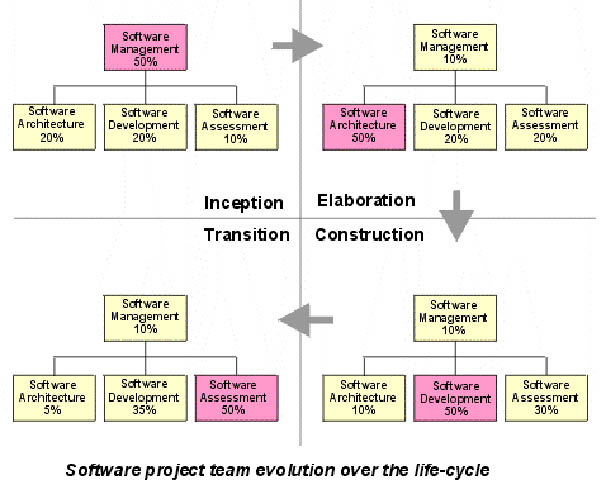
· What do you think are the advantages of having such an evolutionary team structure for software development?
Ans: The mentioned team structure will work relatively well. At the inception stage, most of the manpower is spent on planning of the software, which includes the understanding and documenting the objectives and scope of the project. This is important for the starting phase of a project which also covers the scoping criteria for the planning stage.
In other words, time management is an asset here, as with the progress of the project, majority of the manpower has been focused on the more important part of the project. Another example is at the transition stage, the last stage of the project. As it is the last stage, this is the time where the clients is given the demonstration of the software. Hence majority of the manpower is placed on the software assessment.
Also, the various tasks and work have been broken down into sub-categories which will reduce excessive time and effort required for a project.
· What are the inherent problems in such a structure?
Ans: There are some disadvantages to this structure, namely risk management (not reflected in the mentioned structure). Things may go wrong and in this structure, there is nothing to avoid it.
Moreover, in terms of scheduling, there are no defined responsibilities, milestones as well as compartmentalization indicated as no tasks or types of manpower indicated.
Also, with reference to the inception stage, there would of course be no software assessment since it is the beginning stage of the software development, hence it seems illogical to place 10% of the manpower to software assessment.
· Modify the diagram and show how you would improve the team structure?
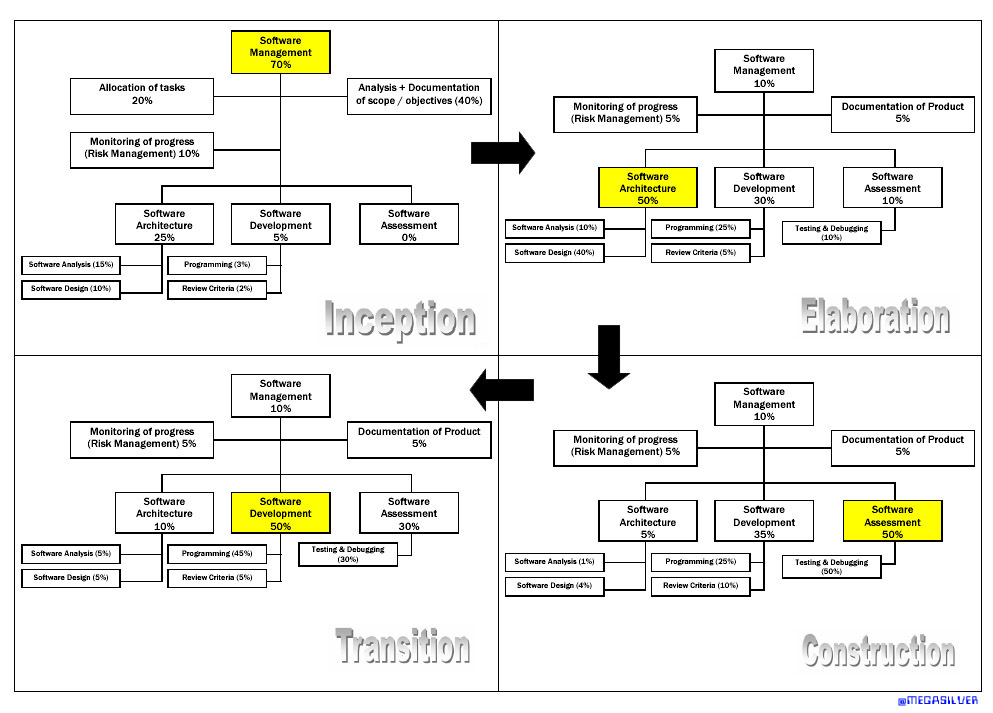
Ans: The following diagram shows the modified diagram. (Click on pic to get pdf version)
Software Management has been broken to a more specific level to make things clearer.
|
|
Click here to return to homepage |
