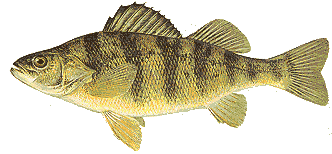
Perca flavescens Mitchill
Other names -- American perch, bandit fish, calico bass, convict, coon perch, coontail, Eisenhower, jack perch, lake perch, raccoon perch, red perch, redfin, redfin trout, ring-tail perch, ringed perch, river perch, sand perch, striped perch.
The yellow perch is essentially a lake inhabitant in Iowa and reaches its greatest abundance in the natural lakes. It is rarely found in large numbers in flowing water with the exception of the Mississippi River, where it is common in some localities. They are also found in a number of man-made recreational lakes and river impoundments in southern Iowa but seldom approach the abundance that occurs in natural lakes.
The yellow perch is a beautiful as well as a hardy fish and quickly adapts itself to changes in environments. The sides of the yellow perch are bright yellow to brassy green, with seven dark, vertical bars. The belly is lighter, and the back is a dark olive-green. There are no canine teeth on the jaws or roof of the mouth. The dorsal fin has 12 to 13 soft rays and 7 or 8 rays in the anal fin. Scales in the lateral line range in number from 57 to 62. The cheeks are covered with 8 to 10 rows of extended scales. The somewhat humpbacked appearance of the fish is due to the head being slightly concave above the eyes.
Spawning takes place near shore in early springtime at water temperatures between 45 and 55 degrees F. Large schools may spawn in the shallows of small embayments. They are not nest builders; instead the long, flat, ribbon-like masses of eggs are deposited over sand bars, submerged vegetation or brush, and other extraneous material on the bottom. Each gravid female may be followed by 15 to 25 males fertilizing the eggs as they are released. Females, depending on their body size, may produce from 10,000 to 40,000 eggs. The eggs swell considerably after fertilization, the ribbon-like masses becoming up to 8 feet long. There is no parental care, and many egg masses are eaten by other fishes, washed up on shore or stranded by low water. Depending on water temperature, 12 to 21 days are usually required for incubation.
Young perch school in or near weedy areas where food, such as cladocerns or insect larvae, is abundant. They are rather slow swimmers when young and must depend upon the aquatic plants for cover protection. Heavy predation from most fish-eating fishes and birds is common. They are a valuable forage fish for walleye, northern pike and muskellunge in many Iowa lakes and to a more limited degree largemouth bass in some man-made lakes.
Although the yellow perch is found in ponds, slow moving streams and rivers, especially in holes around the bends, it is primarily a lake fish, preferring clear, cool water. The large fish usually prefer the deeper regions of lakes, leaving the shorelines to smaller individuals.
Natural foods of the yellow perch consist of small fishes, aquatic insects, small crayfish and snails. They feed throughout the daylight hours in deep water but often move into the shallows during evening to feed on schools of minnows. Midgefly larvae and both the immature and adult stages of mayflies often comprise a large part of their diet.
Growth rates and maximum sizes of the yellow perch vary from year-to-year and lake-to-lake, depending primarily on food availability. Average length in Iowa natural lakes for perch from age I through age VII is 2.7, 5.6, 7.7, 8.9, 9.8, 10.5 and 10.6 inches.
The world record yellow perch has proved to be a difficult record to top. It was taken in 1865 from Cross Wicks Creek, New Jersey, and weighed an incredible 4 pounds, 3 ounces. The existing Iowa record stands at 1 pound, 15 ounces, and was taken in Spirit Lake.
This information obtained from the Iowa Department of Natural Resources - Fisheries Department.