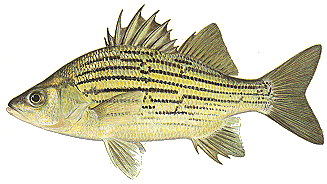
Morone mississippiensis Jordon and Eigenmann
Other names -- brassy fish, bar fish, striper, gold bass, striped bass, streaker, sand bass, rock fish, striped jack.
Morone mississippiensis Jordon and Eigenmann
Other names -- brassy fish, bar fish, striper, gold bass, striped bass, streaker, sand bass, rock fish, striped jack.
The yellow bass is a fish of natural lakes, reservoirs and the backwaters of large rivers. It prefers clear to slightly turbid water and a firm bottom substrate of sand, gravel, rock rubble and mud. It is uncommon in abundance but widespread in the Mississippi River. Presently, it enjoys an abundant status ranking in Hartwick Lake, an impoundment of the Maquoketa River. At one time it was one of the most numerous game fish in North Twin and Clear lakes and may exist in other natural lakes. Yellow bass are found in Lake Manawa. This fish has been historically distributed in the numerous man-made lakes and water-supply impoundments in southern Iowa. Their origin in these waters is unknown but probably resulted from fish transported from the Mississippi.
A laterally compressed, slab-sided spiny-rayed fish, the yellow bass has a yellow-olive to silvery-yellow coloration along back and sides that shades to yellowish white along the belly and pelvic fins. Six to seven prominent, dark horizontal stripes are displayed along the sides that are broken and offset above the front of the anal fin. The dorsal fin is comprised of two slightly connected lobes. Nine spines make up the first lobe and one spine and 12 soft rays are found in the second. The anal fin usually has 9 soft rays and 3 spines that are unevenly graduated. The first spine is considerably shorter than the other two, which are nearly equal in length. The mouth is scarcely oblique and the lower jaw projects slightly beyond the upper jaw.
The yellow bass is similar in appearance but differs in many physical attributes from white bass. In yellow bass, the dorsal fin lobes are not completely separated, the first stripe below the lateral line is distinct and complete to the tail, and the base of tongue is devoid of a tooth patch.
Yellow bass reproduction in Iowa usually takes place during May when the water temperature approaches 60 degrees F. Like white bass, the yellow bass moves into tributary streams for spawning but otherwise spawns over rock reefs and gravel bars in lakes. Spawning occurs in 2 to 3 feet of water and begins when a male and female pair off, swimming slowly about, releasing eggs and milt. Yellow bass eggs are small, averaging about .031 inch in diameter, and they are semi-buoyant. Fertilized eggs sink slowly to the bottom where they hatch in 4 to 6 days at a water temperature of 70 degrees F. No care is given the eggs or sac-fry.
In Iowa, yellow bass grow rapidly, reaching an average of 4 inches in the first year, 7 inches the second, 9 inches the third and 10 inches at the end of the fourth year of life. Both sexes mature at age III and few adults live beyond 4 or 5 years. Being the smallest sized fish in the temperate bass family in the state, yellow bass rarely exceed three-fourths pound in weight. The largest specimen taken by angling weighed 1 pound, 5 ounces, and was caught from Clear Lake, and a specimen of equal weight was caught in a gravel pit in Blackhawk County.
Food of the yellow bass consists of insects, crustaceans and fish. Adults are known to consume significant numbers of their own larval fry. Yellow bass, like the white bass, feed in mid-water or near the surface during evening and early morning hours when natural light is at low intensity.
This information obtained from the Iowa Department of Natural Resources - Fisheries Department.