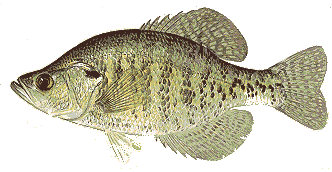
Pomoxis annularis Rafinesque
Other names -- silver crappie, bachelor, white perch, sac-a-lait, newlight, strawberry bass, goggle eye, papermouth, tin mouth, bachelor perch, slab.
Pomoxis annularis Rafinesque
Other names -- silver crappie, bachelor, white perch, sac-a-lait, newlight, strawberry bass, goggle eye, papermouth, tin mouth, bachelor perch, slab.
This sunfish species is common to abundant in most Iowa natural lakes, oxbows, man-made lakes, river impoundments and large rivers. White crappie tolerate turbid waters far better than black crappie and are more abundant in waters that carry heavy silt loads. It is abundant in all reaches of the Mississippi River. Some of the large interior streams have dense populations of white crappie. Many farm ponds have been stocked with white crappie, but their well-being in these small water bodies is seldom satisfactory.
The white crappie is a silvery, deep-bodied, slab-sided
fish with a mouth that is proportional to body size. The upper jaw reaches well
past the middle of the eye when the mouth is closed. The silvery body color
shades to green or brown on the back. There are several, usually 7 to 9,
vertical dark bars on the sides, and the belly is bright silver or white. The
spiny dorsal and soft dorsal fins are broadly connected without a notch between.
The anal fin is usually as long and as large as the dorsal fin and contains 6
spines. The dorsal fin has 6 spines and the length of its base is much less than
the distance from the eye to the front of the dorsal fin. Breeding males become
much darker and vividly marked during spawning; females retain their usual
coloration and markings. The white crappie has a ski-slope shaped nasal
structure, and the forward part of the back is strongly concave.
White crappie young feed mostly on copepods, cladocerans and other zooplankton during the first year of life. During late summer of their first year, young crappie commence feeding on aquatic insects, which remains an important food item for the rest of their life. Crappie start eating small fish in the second year, which become the staple food in adulthood.
White crappie spawning activity occurs in late April or early May when the water temperature reaches 56 degrees F. The male crappie fans out a depression in the bottom, usually in a cove or small embayment that is protected from wave action. Many nests may be located in a cove at depths ranging from l to 20 feet but usually 3 to 10 feet. Female white crappie enter the spawning area and deposit their eggs in one or more of the nests, which are immediately fertilized by the male fish. The number of eggs in a crappie nest is variable, but a nest can hold up to 20,000.
The eggs hatch in about 3 days and the sac-fry remain attached to the substrate for several more days. After the yolk sac is absorbed, the young fish free themselves from the bottom by swimming vigorously. The fry leave the nest only at night and do not congregate into schools.
Growth of white crappie in Iowa averages about 2 to 3 inches in the first year, reaching 10 to 12 inches by the fourth year. Crappie seldom exceed 2 pounds in Iowa, but the record fish caught from our waters is 4 pounds, 9 ounces set in 1981. The exact species of this fish, black or white, was never verified.
This information obtained from the Iowa Department of Natural Resources - Fisheries Department.
Click here for an article on how to fish for Crappie.