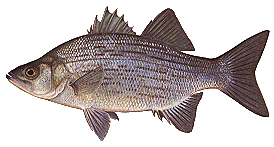
Morone chrysops Rafinesque
Other names -- white bass, striped bass, sand bass, bar fish, rock fish, gray bass, silver bass, streaker.
Morone chrysops Rafinesque
Other names -- white bass, striped bass, sand bass, bar fish, rock fish, gray bass, silver bass, streaker.
The white bass is common to abundant throughout the Mississippi River and in the lower reaches of its main tributary streams. Sizable populations presently inhabit the flood control reservoirs that impound the interior rivers, Red Rock, Rathbun and Coralville, which has led to a dramatic increase in white bass abundance and distribution during the past several decades. Its range also includes the Missouri River and tributaries. This species is common in many natural lakes including: Storm, North Twin, Blackhawk, East and West Okoboji, Spirit, Minnewhasta, Upper and Lower Gar and Clear lakes.
Typical white bass habitat is the deep, quiet pools of medium to large rivers and the mid-water environment of lakes and reservoirs. They are most frequently found utilizing locations with sand and gravel bottoms in clear to slightly turbid water.
The white bass is a slab-sided, blue-gray to silvery, spiny-rayed fish with slate gray dorsal, caudal and anal fins, white belly and pectoral fins. It has 5 to 7 longitudinal dark colored body stripes. Stripes on the body are usually interrupted but not as sharply broken or offset above the anal fin as other fishes in this family. The dorsal fin is separated into two complete lobes; the first contains 9 spines and the second has a single spine with 13 to 15 soft rays. The anal fin is comprised of 3 spines graduating in length followed by 11 to 13 soft rays. The mouth is slightly oblique with the lower jaw projecting slightly beyond the upper jaw.
Spawning is a spring ritual that occurs in Iowa from April through mid-June at water temperatures ranging from 58 to 70 degrees F. Sexually mature fish form schools, often unisexual groups, that move onto shoals or estuaries prior to spawning. Actual spawning commences when several males surround a female and the group swims about scattering eggs and milt near the surface. The eggs are small, averaging about .031 inch in diameter. Fecundity varies from about 241,000 to 933,00 per mature adult female, with the number of eggs produced proportional to body size. Once released, the eggs are fertilized and gradually sink to the bottom where they adhere to rocks and bottom debris and hatch in several days. No parental care is given eggs or newly hatched fry.
Growth of white bass is rapid, averaging 4 to 6 inches in the first year, 9 to 10 inches in the second year, and 12 to 14 inches by the end of the third year. Most males mature at age II, while females mature at age III. White bass seldom live beyond 4 years and few attain a size larger than 2 or 3 pounds. The largest recorded by a fisherman in Iowa was 3 pounds, 14 ounces from West Lake Okoboji.
White bass habitually forage in early morning and late afternoon, while adults are sometimes observed feeding during darkness. Their food consists of insects, crustaceans and fish, with the latter making up the bulk of the adults diet. This species is highly mobile, moving about in large schools, voraciously feeding on other schooling fish, such as gizzard shad. In Iowa, the presence of gizzard shad is a requisite for establishment of white bass in reservoirs and large rivers. White bass utilize other forage fish, particularly minnows and shiners, in the natural lakes for food.
This information obtained from the Iowa Department of Natural Resources - Fisheries Department.