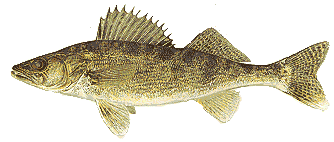
Stizostedion vitreum Mitchell
Other names -- blue pike, dore, dory, glass-eye, gray pike, green pike, jack, jackfish, jack salmon, marble-eye, pickerel, pike, pike-perch, sauger, Susquchanna salmon, walleyed perch, walleyed pickerel, walleyed pike, white eye, yellow pickerel, yellow pike perch.
The walleye ranges from occasional to common in Iowa natural lakes and our major interior river drainages, such as the Des Moines, Iowa, Cedar and Wapsipinicon. Stocking programs have greatly increased the original range of this species to the larger man-made lakes and impoundments. Walleye are widespread and abundant in the Great Border Rivers.
The walleye is the largest member of the perch family, attaining weights of over 20 pounds. Its size, sporting qualities and delicious flesh make it one of the most important game species in North America.
This fish has large, whitish glossy eyes and strong canine teeth. The color of the walleye is a brassy olive-buff, sometimes shadowing to yellowish sides and white beneath. The caudal fin has a silver or milk-white tip on the lower lobe. There are no distinct dark bars or mottlings on the sides of the body, but instead an overall mottling of brown or black. Spots on the anterior dorsal fin are lacking, but one large dark spot or blotch is present near the base on the last 2 to 3 spines of the posterior dorsal fin. There are 19 to 22 soft rays in the dorsal fin and 12 to 14 in the anal fin. The lateral line has 80 to 89 scales. The cheeks are sparsely scaled.
Walleye reproduce in both streams and lakes in Iowa, but
they are also hatchery-propagated in large numbers at the Spirit Lake and
Rathbun Fish Hatcheries. Shortly after the ice melts from the lakes and rivers
and the water temperature reaches 45 to 50 degrees F, walleye move into the
shallows to spawn. Actual spawning takes place at night. The adult female moves
to a spawning area where her arrival is awaited by males. The spawning area may
be a smaller tributary stream, a shallow area in a river or a shoal in a lake.
It is usually an area with clear water, 1 to 5 feet deep, and the bottom is
covered with rubble or gravel. The area is likely to have current, the result of
either flowing water or wave action. If such conditions do not exist, the adult
fish occupy other spawning areas, but egg and young survival will suffer.
Spawning activity takes place over a period of about 3 weeks with the peak
lasting from 7 to 10 days.
Generally, a large female is accompanied by several males of smaller size across the spawning ground in erratic and thrashing movements, with eggs and milt being emitted simultaneously. Approximately 95 percent of the eggs will be fertilized as they sink to the bottom. Individual eggs lodge in rubble or gravel crevices where they will be protected and where water can circulate, keeping them silt free and oxygenated. No protection is provided by the parents. Once spawning is completed, adults return to deep water.
The number of eggs produced by individual females varies according to body size and physical condition, but normal fecundity ranges from 23,000 to 50,000 per pound of fish weight. Incubation lasts 12 to 18 days, depending upon water temperature. Under the best of conditions 5 to 20 percent of the eggs will hatch. Cold weather, which delays hatching, extremely heavy wind action or currents which might wash the eggs ashore, and muddy water which coats the eggs with silt are prime factors which decrease hatching odds.
Upon hatching, the newborn fry is about 1/2 inch long and paper thin. For several days it will drift about, absorbing the yolk sac and gaining strength. Immediately after the yolk sac is absorbed, the fry begins to feed. At first only the tiniest planktonic organisms can be utilized, but as the fish increase in size, cladocerans and immature aquatic insects are consumed. Small fry are sometimes observed in schools on the spawning grounds but soon disperse. After the fish reach approximately 2 inches in length, they begin to add small fishes, minnows, yellow perch, suckers, and bluegill to their diet. Adult walleye consume large quantities of fish, sometimes feeding upon them almost entirely. Yellow perch make up a substantial part of the walleye diet in the natural lakes. Gizzard shad are the most important forage source in the flood control reservoirs and the Great Border Rivers. Crayfish, frogs, snails, and insect larvae are also utilized at times.
The walleye is relatively easy to propagate and rear in hatcheries. Nearly l25 million walleye fry are produced each year in Iowa for stocking larger lakes and reservoirs throughout the state. A smaller number are also raised to fingerling size in shallow nursery lakes and in concrete raceways prior to planting. Walleye typically reach 5.5 inches in length the first year and about 9.3, 12.4, 15.2, 17.4, 19.2, 20.6, 21.7, 22.1 and 23.2 inches in the succeeding 8 years. Females grow more rapidly and attain a larger maximum size than males.
The current Iowa record walleye was caught in Spirit Lake during l968. The fish was 3l l/2 inches in length and weighed l4 pounds, 2 ounces. Several larger individuals have been reported in netting operations for brood fish.
This information obtained from the Iowa Department of Natural Resources - Fisheries Department.
Click here for more information on fishing for Walleye.