Smallmouth Bass
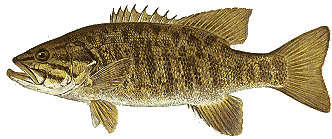
Micropterus dolomieui Lacepede
Other names -- brown bass, browny, bronzeback, green trout, river bass, jumper, Oswego bass, redeye bass.
Smallmouth Bass
Micropterus dolomieui Lacepede
Other names -- brown bass, browny, bronzeback, green trout, river bass, jumper, Oswego bass, redeye bass.
The smallmouth bass is primarily an inhabitant of swift flowing, less turbid waters in rivers and smaller streams. Smallmouth bass are most abundant and widely distributed in the rivers of central and eastern Iowa, but they are occasionally found in impoundments and natural lakes that contain suitable habitat. They are common to abundant in smaller tributary streams during spawning in late spring and are taken occasionally in the Mississippi. Since impoundment of this stream for navigation, smallmouth numbers have decreased.
The smallmouth bass is a slender, streamlined-shaped fish with a moderately large mouth, where the upper jaw reaches about to the rear margin of the eye in adults. Spiny and soft parts of the dorsal fin are broadly connected with only a shallow notch between the lobes. Body color is golden green on the sides and back with faint wavy olive blotches evenly spaced along the sides. There are five olive green bars radiating backward from the eye, and one forward to the end of the snout. The tail fin in young smallmouth is distinctly tri-colored with a black vertical bar separating the yellowish fin base. Pyloric caeca are not forked in contrast to forked pyloric caeca in the closely related largemouth bass.
Smallmouth bass are omnivorous in the food items that they consume. In the larger cool, clear interior streams of northeast Iowa smallmouth bass is the dominant predator, feeding mostly on fish, crustaceans and larger aquatic and terrestrial insects. Food habit studies have revealed that forage fish were present in 40 percent of the stomach samples, crayfish in 30 percent and insects in 20 percent. Where crayfish are abundant, they frequently comprise over two-thirds of the food. Newly hatched smallmouth consume copepods and cladocerans but begin to forage on insects when about one-half inch long. By the time fingerling smallmouth bass are 1 1/2 inches in length, insects and small fish comprise the bulk of the diet.
Smallmouth bass spawn in Iowa during the early part of May as water temperatures exceed 60' F. Preparatory to the spawning ritual, parent spawners move up larger streams, eventually reaching small tributaries where the actual spawning occurs. Male fish construct a saucer-shaped nest on the gravel, coarse sand or rock bottom by sweeping its tail over the substrate. The 14 to 25 inch diameter nest is located in quiet water near the shoreline downstream from a boulder or other natural structure that deflects and slows the current force.
The ripe male bass selects a gravid female after nest construction and nudges her toward the nest in a series of aggressive body contacts and bites. If the female refuses the nest, the male becomes more aggressive until the female is finally physically driven over the depression. Both fish lie side by side, facing the same direction during egg emission as the female vibrates her body by muscle action. The male releases milt for fertilization as the eggs are deposited. The female leaves the nest territory after spawning but may return later to the same nest or another if she has latent egg development. Male fish usually ripen again after a short period of time. Male fish protect the nest from predation and fan the eggs free of silt until the sac fry emerge in 3 to 5 days, depending on water temperature. Re-nesting is quite common for smallmouth, particularly when early nests are destroyed by natural events such as a flood.
The number of eggs laid by a female smallmouth bass varies greatly depending on body size. Average fecundity is 7,000 to 8,000 eggs per pound of body weight. Newly hatched sac fry swim over the nest in a school for about 6 to 15 days, moving sluggishly until all the nourishment in the yolk sac is consumed. The young fry are about one-half inch long when the yolk sac is absorbed, and they leave the nest to feed on small crustaceans and copepods.
Smallmouth bass growth varies with the amount of food eaten and water temperature. Most smallmouth bass in Iowa reach 3 to 5 inches by the first autumn, 6 to 7 inches in the second year, and 9 to 10 inches the third year. Smallmouth sexually mature in the second or third year of life, but where food is scarce or water is relatively cool in all seasons, maturation may not occur until the third or fourth year. Maximum weights of 6 or 7 pounds have been reported in Iowa, but fish over 3 to 4 pounds are trophy sized. The smallmouth bass record is 6 pounds, 8 ounces from Spirit Lake.
This information obtained from the Iowa Department of Natural Resources - Fisheries Department.