Lepomis gibbosus Linnaeus
Other names -- sunperch, sunny, common perch, robin, tobacco box, sand perch, yellow belly, grass perch, round sunfish, common sunfish.
Lepomis gibbosus Linnaeus
Other names -- sunperch, sunny, common perch, robin, tobacco box, sand perch, yellow belly, grass perch, round sunfish, common sunfish.
The pumpkinseed is generally a species of the northern United States and is found in the upper Mississippi River basin. It is not abundant in any part of Iowa, but it is occasionally collected in the natural lakes. It is rarely found in the man-made lakes, mostly in the northern part of the state. Interior rivers very rarely have this little colorful fish, but in the Mississippi River lakes and pools, it is reported as rare to occasional in inventory surveys.
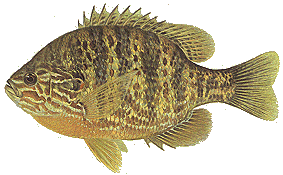
The pumpkinseed is a deep-bodied, slab-sided sunfish with a very small mouth, and the upper jaw does not reach the front margin of the eye when the mouth is closed. The spiny dorsal fin has 10 or 11 spines and is broadly connected to the soft dorsal fin. The pectoral fins are elongated and pointed, reaching entirely across the eye when the fins are bent into a forward position. This fish is pale olive in color with purplish horizontal bars on the sides. The gill cover is quite small with a light-colored margin and generally has a bright red semi-circular spot with 6 or more wavy emerald bars interspersed with gold or copper on the cheeks. The pumpkinseed is one of the most colorful sunfishes and often hybridize with bluegill and green sunfish, making specific identification difficult and sometimes inaccurate.
Pumpkinseed, like all sunfishes, forages on zooplankton when tiny but graduates to a diet of insects, snails, and other small mollusks, along with small fish as they reach adulthood.
The breeding season of the pumpkinseed occurs at about the same time as bluegill in Iowa. Initial preparation begins during May at water temperatures of 60 to 68 degrees F with the peak activity taking place in early June. Spawning usually continues through July.
Several thousand eggs are deposited in each nest by one or more females, after which the male guards the nest until hatching. Pumpkinseeds usually nest nearer to shore and in shallower water than bluegills, and if nesting space permits, they are colonial nesters. Shady nesting sites are preferred over thin silt substrates on sand or fine gravel. Young pumpkinseed sunfish grow to about 1 1/2 inches in length the first year, attaining 4 inches and 5 1/2 inches during the following two years. Adults grow to about 8 to 10 inches.
This information obtained from the Iowa Department of Natural Resources - Fisheries Department.