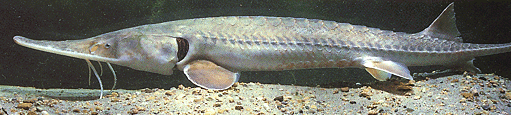
Scaphirhynchus albus Forbes and Richardson
Other names -- white sturgeon, hackleback.
Scaphirhynchus albus Forbes and Richardson
Other names -- white sturgeon, hackleback.
Inclusion of the pallid sturgeon in the Mississippi River, as shown on the distribution map, is based on a single immature specimen captured in 1930 near Keokuk. The Missouri Department of Conservation lists the pallid sturgeon as exceedingly rare and confined to the Missouri and Mississippi rivers penetrating only a few miles into the Mississippi upstream from the mouth of the Missouri. The species is somewhat more abundant in the Missouri River upstream of Iowa; but nowhere in its range is it common.
The pallid sturgeon is similar in appearance to the shovelnose sturgeon but is much lighter in color, has smaller eyes, and a longer and sharper snout. The inner barbels on the lower surface of the snout are only about half as long - instead of about four-fifths as long -- as the outer barbels. The belly is naked in contrast to the shovelnose sturgeon. Maximum size reported for pallid sturgeon is 68 pounds.
The pallid sturgeon was not recognized as a distinct species until 1905. Prior to that time it was included with the shovelnose.
Habitat preference is similar to shovelnose. The fish spawn in the late spring or summer. Males mature at 3 to 4 years of age and females somewhat older. Early growth is similar to that of shovelnose with specimens reaching 23.2 inches FL at age V in South Dakota.
Food habits are similar to lake and shovelnose, except that fish have considerable importance in the pallid sturgeon diet.
This information obtained from the Iowa Department of Natural Resources - Fisheries Department.