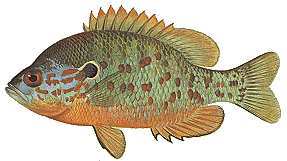
Lepomis humilus Girard
Other names -- redspotted sunfish, dwarf sunfish, pigmy sunfish, sunperch.
Lepomis humilus Girard
Other names -- redspotted sunfish, dwarf sunfish, pigmy sunfish, sunperch.
This colorful, small sunfish is widely distributed throughout Iowa. It is most commonly found in the man-made lakes, natural lakes and interior streams. It is occasionally observed in the Mississippi and rare in the Missouri River.
The orangespot is a moderately deep-bodied, slab-sided sunfish with a large mouth that extends to the front of the eye when the mouth is closed. The spiny dorsal fin has 10 spines and is directly connected to the soft part of the fin. Pectoral fins are short and rounded, usually not reaching past the eye when extended in a forward position. The opercular flap is long and black with a whitish margin. The most striking features of the orangespotted sunfish are the vivid red or orange spots on the sides of males and the more subdued brownish-orange spots on females. The sides are olive colored with profuse sprinkling of fine golden and emerald dots. Pelvic and anal fins are fringed in black.
Like most sunfish family members, the orangespot is an omnivorous feeder, taking a wide variety of crustaceans and aquatic insects, both adult and larval forms, and on occasion foraging on small fish.
The orangespotted sunfish spawns by nesting in colonies with the male fish constructing a nest by excavating a small depression in the sand or gravel in typical sunfish fashion. Since this is the smallest sunfish member, it also builds the smallest nests. Spawning lasts from May through August at which time the males are so brightly colored they appear to be painted artificials. The male stays with the nest for about 5 days or until the eggs hatch.
Orangespots reach about an inch in length by the end of their first year of life and grow to about 2 inches in the second year. Growth continues at about one inch each year for the first 4 years. Adults mature at about 2 inches in length and fish longer than 4 inches are very rare in Iowa.
This information obtained from the Iowa Department of Natural Resources - Fisheries Department.