Lepisosteus osseus Linnaeus
Other names -- gar, gar-pike, billygar, billfish, needle-nosed gar.
Lepisosteus osseus Linnaeus
Other names -- gar, gar-pike, billygar, billfish, needle-nosed gar.
The distribution of the longnose gar is quite similar to that of the shortnose, and if anything, it is more widely distributed. With the exception of the boundary waters it is rare in numbers; a single specimen often making up an interior stream collection.
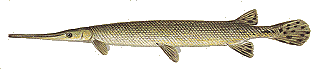
Color of the longnose gar is olive to dark green above and white or silvery below. There are large round black spots on the dorsal, anal, and caudal or tail fins. The entire body is covered with thick rhombic scales, and the snout is extended into a long, slender beak. Length of this beak is from 15 to 20 times its least width. There are usually 8 rays in the dorsal fin, and 8 or 9 in the anal fin. There are 60 to 63 diamond-shaped scales in the lateral line.
The longnose gar spawns in May and June when the water temperature approaches 70 degrees F. Spawning takes place in shallow water of lakes or streams over weed beds or gravel. A large female (40 inches) may produce more than 36,000 large eggs up to 2.6-3.6 mm in diameter. The eggs hatch in 6 days at 68 degrees F. Growth is very rapid with young-of-the-year reaching an average of 18.1 inches. Females grow more rapidly than the males. Male longnose mature at 3-4 years of age and females 2 years later. The fish will live to be 30 years of age and reach a maximum length of 56 inches.
The chief food item in the diet of the gar is fish. A small part of their diet is made up of crayfish and insects. They are wholly carnivorous in their feeding habits.
This information obtained from the Iowa Department of Natural Resources - Fisheries Department.