Lepomis megalotis Rafinesque
Other names -- sunperch, pumpkinseed, creek perch.
Lepomis megalotis Rafinesque
Other names -- sunperch, pumpkinseed, creek perch.
The North American range of the longear sunfish is from southern Minnesota to Ontario and western New York, southward through the Mississippi basin into the Gulf states. It is considered extirpated in Iowa since no specimens have been collected since 1932. The last reported collections were made in the Cedar River near Otranto where it was considered extremely rare. This species appears to be intolerant of silt, and because its native range is south and east of Iowa, it was rarely found in this state.
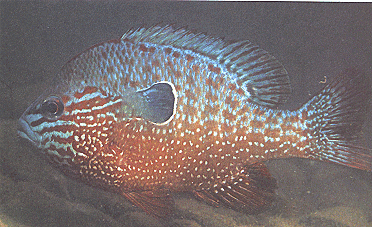
This sunfish is a deep, slab-sided fish with a moderate-sized mouth. The upper jaw nearly reaches the front of the eye when the mouth is closed. The spiny dorsal fin has 10 spines and is connected to the soft dorsal in a single continuous fin. The pectoral fins are short and rounded. The black colored operculum flap is greatly elongated in adults, especially males. Coloration of the sides and back is blue-green, and the belly is orange or yellow. The sides are speckled with yellow, and the olive or light orange head has emerald-blue vermiculations. The ear flap has a thin white margin, and the fins are usually without dark spots.
Food of the longear sunfish young are aquatic insects and entomostracans (copepods and cladocerans), but after the fish reach 2 inches or longer, they consume insects, fish eggs, snails and small crayfish.
Since this species is probably absent from Iowa, precise data are not available, and life history information was gleaned from other locations. This species is a nest builder like all sunfishes and commences at water temperatures from 75 to 85 degrees F. In Kansas spawning usually lasts from May through August. Males construct nests on gravel beds at water depths of 1 to 3 feet. The nests usually contain from 600 to 2,700 eggs with several females depositing eggs in a single nest. Most eggs hatch within one week after which the male leaves the nest. Longear sunfish in Missouri attain about 1 1/2 inches in the first year of life and up to 3 1/2 inches by their third year. They reach maturity in the third year. Maximum length rarely exceeds 6 inches.
This information obtained from the Iowa Department of Natural Resources - Fisheries Department.