Largemouth Bass
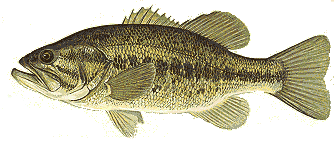
Micropterus salmoides Lacepede
Other names -- bigmouth bass, bucketmouth bass, openmouth bass, hog, hawg, lineside, bigmouth trout, green trout, green bass, Oswego bass, Welshman, slough bass, lake bass.
Micropterus salmoides Lacepede
Other names -- bigmouth bass, bucketmouth bass, openmouth bass, hog, hawg, lineside, bigmouth trout, green trout, green bass, Oswego bass, Welshman, slough bass, lake bass.
The largemouth is a fish of lakes, ponds and quiet river waters where its abundance varies from common to abundant. Distribution of the largemouth bass in Iowa is statewide, mainly from the fact that this species has been stocked by the Conservation Commission into nearly every lake, pond and reservoir. It is uncommonly found in the interior rivers, preferring the quiet waters of overflow oxbows and backwaters along these streams. Occurrence is common in the impounded waters of the Mississippi River, especially the sloughs and backwaters. Early records indicate this species was found only in Missouri River sloughs and adjoining oxbow lakes, but recent sampling showed that they were present in the main channel, closely associated with rock-armored revetments and channel stabilization structures. It is stocked into farm ponds in combination with bluegill and channel catfish.
A rather slender, streamlined sunfish, the largemouth has a very large mouth, hence its name, with the upper jaw extending far past the rear margin of the eye when the mouth is closed (except in small young). The spiny and soft portions of the dorsal fin are almost completely separated by a deep notch. The middle of the green shaded body has a broad continuous dark stripe, but this sometimes becomes indistinct in large adults and fish taken from turbid water. The belly is greenish white or yellowish, and the eye is usually gold. The pyloric caeca, which are finger-like extensions at the junction of the stomach and intestine, are forked, and the tail fin in young largemouth bass is distinctly bicolored -- not tricolored as in spotted bass and smallmouth bass -- and the rear part at the fin is much darker than the basal part.
Largemouth bass is the primary predator in many of our lakes, ponds, and quiet rivers, foraging on fish, crayfish, frogs, aquatic and terrestrial insects, and any small living animal or bird which falls in the water. The small sac fry of bass feed upon microscopic crustaceans. First-food items are supplemented with insects and insect larvae as the fish grows. Largemouth bass usually start foraging on fish when they are 1 to 2 inches in length.
Reproduction characteristics of largemouth bass are quite
similar to the other sunfishes. Spawning commences in early May and lasts into
June when the water temperature is 63 to 68 degrees F. They deposit their eggs
on the roots of submerged plants or grass over rocky or mud bottoms. Male
largemouth bass usually construct a nest prior to spawning, but sometimes they
will spawn with very little nest preparation. Water depth over nests ranges from
1 to 15 feet, but the normal depth is 1 1/2 to 3 feet.
The eggs, which may vary from 2,000 to 26,000 in each nest, hatch in 3 to 6 days depending upon water temperature. Largemouth bass in Iowa average 4 to 6 inches in length during the first year, but lengths of 10 to 12 inches are not unusual in newly stocked lakes and ponds. Total lengths of 8 to 12 inches are expected in the latter part of the second year of life, and fish up to 16 inches are common in the third year. Both sexes usually reach sexual maturity in their third year of life, but faster growing bass can mature in the second year. Largemouth bass have been known to reach 22 pounds in the southern states, but in Iowa they are smaller. The record Iowa bass weighed 10 pounds, 12 ounces and was caught in 1984 from Fisher Lake near Bloomfield.
This information obtained from the Iowa Department of Natural Resources - Fisheries Department.