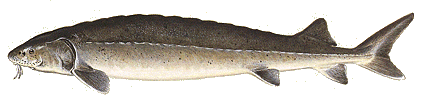
Acipenser fulvescens Rafinesque
Other names -- rock sturgeon, rock fish, rubber-nose, black sturgeon.
Acipenser fulvescens Rafinesque
Other names -- rock sturgeon, rock fish, rubber-nose, black sturgeon.
Distribution of the lake sturgeon in Iowa is confined to the Mississippi River, where it is reported very rarely in commercial fishing operations and by anglers.
Young lake sturgeon are tan, or buff-colored, sometimes contrastingly blotched with dark, becoming more uniformly dark as they grow older. Adults are slate-gray to black above and light beneath. The body is partially covered with five longitudinal rows of heavy, bony plates or scales. The head is roundly conical in shape, and not flattened. Spiracles, or openings from the throat cavity to the outside above and behind the eyes, are present. The mouth is inferior and almost sucker-like, capable of being protracted for ease in sucking foods off the bottom. The fish feeds entirely by taste and has four fleshy barbels on the underside of the snout, which act as sense organs to gauge the distance from the mouth to the bottom.
Lake sturgeon spawn in late spring or early summer, usually in streams, but they have been observed in the shallow areas of lakes in locations where it is native to lentic waters. This fish is not native to Iowa lakes, and little is known of its spawning habits in our rivers. In Wisconsin, female lake sturgeon mature at 24-26 years of age, when approximately 55 inches in length. The females spawn once every 4-6 years, the males mature at a smaller size and spawn every year or two. Each female produces as many as 700,000 eggs. The eggs hatch in 8 days at 55 degrees F. The male and female grow at the same rate; the females are longer lived, with 97% of the fish over 30 years of age being female. It reaches a weight of several hundred pounds in some waters, but the largest reported from this state is about 100 pounds.
Lake sturgeon feed primarily from the bottom. Their food consists largely of insect larvae, snails, bits of aquatic plants and other litter from the floor of a lake or stream. Young fish less than 8 inches in length are known to feed on minute crustaceans.
This information obtained from the Iowa Department of Natural Resources - Fisheries Department.