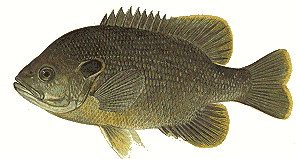
Lepomis cyanellus Rafinesque
Other names -- shade perch, black perch, slicks, ricefield slick, mud bass, rubber-tail, bluespotted sunfish, pond perch, green perch, sand bass, sunfish.
The green sunfish is the most wide-ranging sunfish in Iowa. It is common in natural lakes, man-made lakes, and farm ponds. It is also found in large and small streams but only occasionally. The Great Border Rivers contain green sunfish populations, and the riprap armoring placed along the banks of the Missouri River offers prime habitat for this little fish, which normally prefers quiet or pooled water.
The green sunfish is a thick-bodied sunfish with a mouth that is large for sunfishes; the upper jaw extends to about the middle of the eye when the mouth is closed. The spiny dorsal fin has 10 spines and is broadly connected to the soft dorsal fin. The pectoral fins are short and rounded, and the ear flap is never elongated. The back and sides are bluish-green with emerald and yellow reflections, while the belly is white or light yellow. Sometimes there are several black vertical bars on the sides. The sides of the head are mottled with emerald and yellow streaks, and the black ear flap has a whitish or yellowish margin. Green sunfish typically have whitish or yellow-orange leading edges on their dorsal, anal and caudal fins.
Zooplankton comprise a large part of the diet of small fingerling green sunfish, but later in the first year they switch to aquatic insects. As adults they continue to rely on aquatic insects but also consume small fish, minnows and small crayfish. Since this species has a large mouth, it utilized larger food items than most sunfishes.
Green sunfish share similar reproductive habits with
bluegill, nesting in colonies in shallow water near the shoreline -- often times
in the same location. Nest preparation begins when the water temperature reaches
70 degrees F, usually in mid-May and June but more often in June. The nests are
located in about a foot or less water over gravel or sand, but if these sites
are unavailable the male will fan nests in water-soaked tree leaves or twigs and
muck. Small territories are established and vigorously protected by the male,
but if nesting sites are limited, as many as 25 nests may be built in 50 square
feet. Once the eggs are deposited, the fighting among males ceases except when
one individual invades another`s territory. Males remain with the eggs for 6 or
7 days, at which time the fry become free-swimming. There is considerable cross
mating of green sunfish and bluegill.
Green sunfish attain lengths of up to 7 inches by the fourth year. Most individuals become sexually mature at 2 years. Green sunfish rarely exceed 6 or 7 inches in length.
This information obtained from the Iowa Department of Natural Resources - Fisheries Department.