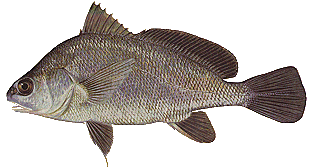
Aplodinotus grunniens Rafinesque
Other names-- sheepshead, croaker, grunt, white perch, rock perch, grinder, silver bass
The freshwater drum is a common fish species in the Mississippi and Missouri Rivers and a large interior streams over most of the state. It is also found in the large flood control impoundments and in some of the larger and deeper natural lakes. Drum are very tolerant of turbidity and prefer quiet waters without swift currents.
This fish is best described as a deep bodied, silvery fish
whose head and body slope steeply up from the snout to the dorsal fin, resulting
in a hump-backed appearance. It has a long dorsal fin that is divided into two
lobes. The first has 8 to 9 spines, and the second has a single spine with 24 to
32 soft rays. The anal fin has 2 spines with the second spine larger than the
first. The pelvic fin has one spine with 5 rays. Ctenoid scales cover the body
and upper head. The lateral line is complete and extends through the caudal fin.
The back is gray, with the sides silvery and belly and lower region of the head
white. Adults commonly weigh up to 5 pounds, but the current Iowa record was a
46-pound fish caught in Spirit Lake in 1962.
The drum spends most of its time on or near the bottom feeding mainly on fish, crayfish, and immature insects. Moving slowly along the bottom, it moves small rocks and other bottom materials with its snout, capturing displaced aquatic life. In the Mississippi River, drum spawn during May and June when the water temperatures range from 66 to 72 degrees F. Unique to the freshwater fish species in North America and characteristic of many saltwater fish, the eggs and larvae are buoyant and float on the water surface during development.
Growth studies in the Mississippi River report that freshwater drum average 5 inches in total length by the end of the first year of life and 8.0, 12.0, 13.5, 15.0, 17.0, 18.5, and 19.5 inches in succeeding years. Fast-growing drums in the Mississippi River reach 7 to 8 years of age, seldom more than 10 years, but there is a record of a 17 year old specimen.
The drumming sound made when the fish is handled is produced by a special apparatus that is located in the body cavity, which is connected with the swim bladder. Two elongated muscles move a tendon over the swim bladder and produce the sound. Only sexually mature males possess this structure. Another unique feature of the drum is the large-sized otolith located in the sacculus. It has white, enameled surfaces and alternating light and dark bands that can be used to age the fish. Otoliths are often kept by fishermen for lucky pieces and sometimes made into jewelry.
The freshwater drum is an important commercial and sport fish along the Mississippi and Missouri Rivers. Commercial harvest in the Mississippi has been over 300,000 pounds each year in the past decade. The sport fish catch of freshwater drum in the river usually ranks in the top three species. In other streams, lakes, and reservoirs of the state, it is less important. Young drum have also been found to be significant forage for musky and northern pike in some of the natural lakes.
This information obtained from the Iowa Department of Natural Resources - Fisheries Department.