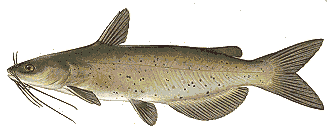
Ictalurus punctatus Rafinesque
Other names -- spotted cat, fiddler, channel cat, blue channel, river cat, white cat, willow cat, speckled cat, forked tail cat, silver cat.
Ictalurus punctatus Rafinesque
Other names -- spotted cat, fiddler, channel cat, blue channel, river cat, white cat, willow cat, speckled cat, forked tail cat, silver cat.
One of the most widely distributed fishes in the state, channel catfish is common to abundant in most rivers and moderate sized streams. Stocking programs to satisfy the public demand for this fish has widened its distribution and increased its abundance in nearly all man-made lakes, natural lakes, water-supply reservoirs, surface mine lakes and farm ponds. During spring flooding catfish have been known to ascend even the smallest streams to inhabit the larger pools in these creeks.
Body color of channel catfish varies widely from silvery-gray on the top side to light on the underside, depending mostly on the clarity of the water. The body is profusely marked with dark pigmented spots, which are usually more or less obscure in large adults. Young individuals, under 2 or 3 inches in length, also frequently lack these spots. There are from 24 to 29 soft rays in the anal fin, and this fin is about two-sevenths the standard length. The posterior margin of the adipose fin is free. The tail is deeply forked, which is unlike all the other catfishes except the blue cat. The eyes are large, but the head is small, slender and subconic. The air bladder has two lobes which are laterally paired so as to appear as one at first glance. The upper jaw is slightly longer than the lower jaw.
The channel catfish is quite selective in its breeding
habits. It prefers obscure places to deposit the eggs. Overhanging rock ledges,
deeply undercut banks, underwater aquatic mammal runs, hollow logs and even
large tin cans, tile, and other similar objects in the stream serve admirably
for spawning purposes. Spawning activity takes place from May through July when
the water temperature reaches 75 degrees F. Male and female channel catfish
exhibit active and prolonged courtship behavior before mating. During the actual
spawning act, the male swims beside the female but facing the opposite
direction. Each fish then wraps its tail around the other's head, whereupon the
male body quivers, which stimulates the simultaneous release of eggs and milt.
Eggs are deposited in a golden colored gelatinous mass. The length of incubation
depends upon the water temperature, but it is usually completed in 6 to 10 days.
Although the number of eggs deposited by a female may run as high as 20,000 or
more, catfish weighing from 1 to 4 pounds produce about 4,000 eggs per pound of
body weight.
After spawning takes place, the male drives the female from the nest and takes over family duties until the young hatch. In artificial culture and perhaps in the wild as well, females and even the parent males will often devour the eggs from their nests, especially when disturbed.
Young catfish travel in schools for several days, or even weeks, after birth. Eventually the schools disperse and the young feed singly in the shallow waters over sand bars, around drift piles, and in rocky areas of quiet waters.
Female catfish reach sexual maturity at 13 to 16 inches and males somewhat earlier. Average body length at each year of life for channel catfish in the Des Moines River is 1 - 3.5 inches, 2 - 6.5 inches, 3 - 8.7 inches, 4 - 11.2 inches, 5 - 13.9 inches, 6 - 15.0 inches, 7 - 17.4 inches, 8 - 19.1 inches, 9 -20.4 inches and 10 - 21.3 inches.
The channel catfish is omnivorous and opportunistic in its feeding, gorging on all manner of living and dead material. Because of its highly developed sensory system, it feeds by touch, taste and sight. For this reason it is frequently caught by anglers in turbid waters which are unproductive for fishes that feed principally by sight. In extremely muddy waters, however, they are prone to feed much less.
A large part of the natural diet of the channel catfish is aquatic insects and their larvae. Crayfish, snails, small clams, worms and fish, both live and dead, are taken as part of the diet. The catfish is not a selective feeder and takes advantage of the food at hand. In the spring of the year its stomach may be packed with elm seeds and cotton from cottonwood trees. Other natural foods include such items as wild grapes, weed seeds, wild fruits, and other vegetable materials dropped into the stream from overhanging branches. Large channel catfish feed almost exclusively on fish.
This information obtained from the Iowa Department of Natural Resources - Fisheries Department.
Click here for an article on how to fish for Catfish.