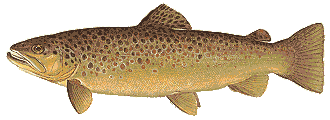
Salmo trutta Linnaeus
Other names -- German brown, loch leven brown, von Behr trout.
Salmo trutta Linnaeus
Other names -- German brown, loch leven brown, von Behr trout.
The original stock of brown trout was introduced into Iowa from Europe in the late 1800`s. Some natural brown trout reproduction occurs, but it is generally very limited by poor water quality caused mainly by extensive soil erosion, winter flooding and stream bank erosion from cattle grazing. Presently most "put and grow" streams are stocked once each year with fingerling brown trout. A few trout streams are stocked only with browns, and most trout streams receive at least some brown trout.
As its name implies, the color of this trout is generally brown, shading into a background of green and yellow. Spots on the sides of brown trout are generally larger and more prominent than on other trout, and they are often bordered with a light-colored "halo." Few, if any, dark spots are found on the tail fin. The leading edge of all belly fins on brown trout is yellow or about the same color as the body. Lower portions of young brown trout are yellow, fading to gray or white underneath. Males, during the breeding season, often exhibit vivid yellow to reddish-yellow colors along the belly region and a sharply hooked lower mandible. The vomer, a bony structure in the roof of the mouth, has sharp teeth in an alternating or "zig-zag" row. There are 115 to 150 scales in the lateral line.
Brown trout spawn during October and November, depositing their eggs in saucer-shaped nests called redds, which are dug by the female in the clean gravel lining the bottom of spring-fed streams. The redd is created by the fish while lying on its side and rapidly beating its tail in an up-and-down motion, allowing the current to move the gravel slightly downstream. Up to two males then move alongside the female and the eggs and sperm are deposited simultaneously into the redd. The female then moves to the upstream edge of the redd, again beating its tail on the stream bottom, burying the eggs in gravel. After spawning is completed, the eggs are abandoned. The eggs incubate through the winter, hatch during late winter, and the tiny fry emerge from the gravel during the first warm days of spring. This whole process is, of course, temperature dependent. With a constant water temperature of 50 degrees F hatching occurs in 41 days. The number of eggs produced depends on fish size. An 8-inch mature brown trout may spawn 200 eggs, while a 10-pound female might spawn over 8,000 eggs.
Fingerling brown trout released at a length of 2 l/2 inches in May will average about 7 l/2 inches one year later and begin entering the catch during that summer. Browns grow nearly one inch per month during mid-summer, with much slower growth in spring and fall, and like most fish, usually no growth occurs during winter. Growth of hatchery-reared fish is constant when water temperature and feeding levels are uniform, averaging slightly over one-half inch per month. A l0-inch brown trout stocked from an Iowa hatchery is probably about 18 months old. Trophy-sized fish over 3 pounds have probably survived in our streams for at least 3 years.
Brown trout strongly orient to hiding cover at the first sign of bank movement, be it fishermen or a fish-eating bird. They seem capable of survival in a variety of coldwater streams as long as there is ample protective cover and water temperature does not continuously exceed 70 degrees F. Brown trout feed largely on terrestrial and aquatic insects, worms and small crayfish. Fish become important in the diet of larger browns. Daily feeding patterns change seasonally with varying water temperature and light intensity. Peak insect drifts will often occur after dark, and browns are well-known for their nocturnal feeding. Brown trout are very capable of switching from life in a hatchery to that in a stream environment and adapt readily to a diet of natural food items.
Brown trout will remain our most important fish for fingerling stocking and for our special regulation trout streams due primarily to their ability to survive well under different stream conditions. They are probably the most tedious species of trout for the average angler to catch, but as a result they provide the greatest challenge to dedicated trout fishermen.
This information obtained from the Iowa Department of Natural Resources - Fisheries Department.
Click here for an article on fishing for Trout.