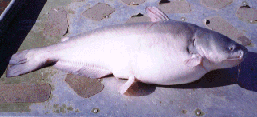
Ictalurus furcatus LeSueur
Other names -- chucklehead cat, forktail cat, great blue cat, blue channel, madtom, humpback blue, highfin blue, Mississippi cat, Fulton cat.
Ictalurus furcatus LeSueur
Other names -- chucklehead cat, forktail cat, great blue cat, blue channel, madtom, humpback blue, highfin blue, Mississippi cat, Fulton cat.
 Blue catfish, not to
be confused with the "blue" color phase of the male channel catfish,
is indigenous to the southern United States and is rarely found in the lower
reaches of the Mississippi River in Iowa. Primarily a "big river" fish
species, no specimens have been collected from any of the interior streams,
although this fish might very well inhabit the lower Des Moines River. It has
been reported in the lower reaches of the Missouri River in Mills and Fremont
counties and has been collected in Lake Manawa. Blue catfish were stocked in Big
Creek Lake in Polk County in l972, but no returns were reported. No collections
of blue catfish have been documented in Iowa waters for more than 10 years.
Blue catfish, not to
be confused with the "blue" color phase of the male channel catfish,
is indigenous to the southern United States and is rarely found in the lower
reaches of the Mississippi River in Iowa. Primarily a "big river" fish
species, no specimens have been collected from any of the interior streams,
although this fish might very well inhabit the lower Des Moines River. It has
been reported in the lower reaches of the Missouri River in Mills and Fremont
counties and has been collected in Lake Manawa. Blue catfish were stocked in Big
Creek Lake in Polk County in l972, but no returns were reported. No collections
of blue catfish have been documented in Iowa waters for more than 10 years.
Color of blue catfish, as its name implies, is blue or
slate-gray above and light below. The body has no dark spots that are
characteristic of channel catfish. The upper jaw protrudes slightly beyond the
lower, and the head is prominently convex. The anal fin is very long, and its
basal length is about one-third the standard length of the fish. Blue catfish
are easily distinguished from the channel catfish by the number of rays in the
anal fin, channel catfish having 24 to 29 rays -blue catfish from 30 to 35. The
tail is deeply forked and the eyes are small. The air bladder has three lobes or
parts, an anterior pair joined side by side and the smaller third lobe is placed
behind.
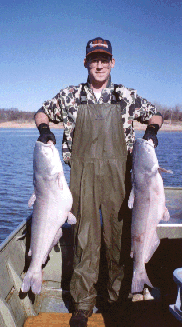
Blue catfish spawn in June and early July when the water temperatures are 70 to 75 degrees F. They construct nests similar to those of channel catfish. The young attain a length of from 2 1/2 to 4 inches at the end of the first growing season. Adults are among our largest freshwater fishes and specimens weighing nearly 100 pounds have been taken from the lower reaches of the Missouri River. While fish of this size are rare, adults weighing up to 20 or 25 pounds are quite common.
The range of natural foods consumed by blue catfish is indeed very wide. They live principally upon aquatic insects and their larvae, crayfish, worms, frogs, small fresh-water mussels, fish, and a host of other living and dead material. Like channel catfish, they are omnivorous in their feeding and take everything that is available and palatable.
This information obtained from the Iowa Department of Natural Resources - Fisheries Department.