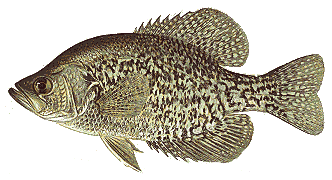
Pomoxis nigromaculatis LeSueur
Other names -- bream, Mason perch, freckle, slab, grass bass, speckled perch, specks, calico bass, sac-a-lait, speckled crappie.
Pomoxis nigromaculatis LeSueur
Other names -- bream, Mason perch, freckle, slab, grass bass, speckled perch, specks, calico bass, sac-a-lait, speckled crappie.
Black crappie are intolerant of turbid waters and are nearly always found in the clearer lakes and streams in Iowa. It ranks common to abundant in the natural lakes and the backwater sloughs of the upper Mississippi River. It is a common resident in certain eastern Iowa rivers but rare in western streams. Most man-made recreational lakes contain black crappie, but their abundance depends greatly upon water clarity. Few lakes in Iowa contain only one crappie species.
The black crappie is a silverly-speckled, deep-bodied, slab-sided sunfish and has a large mouth. The upper jaw reaches well past the middle of the eye when the mouth is closed. It usually has a dark back with numerous green or blackish spots irregularly spaced over the sides. There are no distinct vertical bars as in white crappie. The body is somewhat deeper in proportion to its length, and the dorsal, tail, and anal fins are strongly reticulated with black giving the appearance of a dark-colored fin with many whitish spots. The spiny dorsal and soft dorsal fins are broadly connected without being notched. The anal fin is nearly as long and as large as the dorsal fin and has 6 spines. The dorsal fin has 7 or 8 dorsal spines, and the length of dorsal fin base is equal to the distance from the eye to the front of the dorsal fin.
Food habits of the black crappie are quite similar to those of the closely related white crappie. Initial food is zooplankton, which is supplemented with insects toward the end of their first year. Insects remain an important food item throughout life, but black crappie feed on small fish and minnows from their second year through adulthood.
Spawning requirements for black crappie are nearly the same as those of white crappie, but the nest size is slightly more shallow. The nest is usually constructed in 3 to 8 feet of water. Black crappie spawn at water temperatures of 58 to 64 degrees F. Fecundity of female black crappie may range up to 150,000 eggs, but 20,000 to 60,000 eggs are more the rule. Nests of both crappie species usually contain similar-sized egg masses.
Black crappie growth is somewhat less than that of white crappie, but they are heavier at the same length. The young attain body lengths of 2 to 3 inches in the first year of life and mature during the second or third year. Most of the black crappie caught by fishermen are 8 to 12 inches long, but occasionally very large, up to four pounds, specimens are caught.
This information obtained from the Iowa Department of Natural Resources - Fisheries Department.
Click here for an article on how to fish for Crappie.