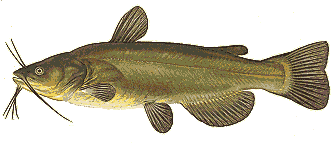
Ameiurus melas Rafinesque
Other names -- bullhead, common bullhead, yellow-belly bullhead, small bullhead, horned pout, brown catfish, catfish, stinger, river snapper.
Ameiurus melas Rafinesque
Other names -- bullhead, common bullhead, yellow-belly bullhead, small bullhead, horned pout, brown catfish, catfish, stinger, river snapper.
This fish species is by far the most common and widely distributed of the three bullhead species found in Iowa. It is abundant in most of the natural lakes and in some man-made lakes. It is a common inhabitant of many farm ponds and is taken less frequently in some of the oxbow lakes that overflow from the major interior rivers. Black bullheads are occasional to common in the river impoundments, although they are usually rare in flowing waters. It is quite common in the backwaters and some sloughs of the Mississippi River, but its apparent aversion to flowing water limits its abundance in the Missouri River.
Black bullhead are usually dark olive to black on the body, although in some waters it becomes light brown. Usually the belly is white, but here again the color is variable, and in certain lakes and larger rivers the belly is bright yellow, especially in the early spring and during the breeding season. The chin barbels are dusky or black. This fish can be distinguished from the other bullheads by the light colored band at the base of the tail fin and the 17 to 20 rays in the anal fin. The tail fin is slightly notched, and the outer two-thirds of the fleshy membrane of the anal fin is uniformly black or dark-pigmented. The backside of the pectoral spine is weakly barbed. This fish is rarely mottled in color.
The black bullhead spawns in May or early June, usually in weedy or muddy shallow areas. Saucer-shaped nests are constructed in the mud or sand in about 2 to 4 feet of water. These nests range from about 6 to 14 inches in diameter and up to l0 inches deep. The number of eggs deposited depends on the age and size of the female, but the average is about 2,000 to 6,000, or more. Incubation is completed in a week or less under normal conditions. The young fry stay in tight black, ball-like schools until they reach nearly 2 inches in length, at which time they leave their parents to shift for themselves. The black bullhead is usually the smallest-sized bullhead, but in larger lakes of northern Iowa some reach a weight of two pounds or more. The record fish in Iowa came from a farm pond in Harrison County and weighed 4 pounds, l2 ounces. In streams or lakes where food is scarce and the population density is quite high, they are much smaller and seldom exceed 7 to 9 inches.
The black bullhead is strictly omnivorous, feeding upon nearly every conceivable thing in the water. Midge and mayfly larvae make up a considerable part of the diet, but it also feeds extensively on other insects and their larvae, small crayfish, worms, small mollusks, crustaceans, and a host of other animals and plants. Bullheads have been known to eat the eggs of other fishes, as well as feeding quite extensively on minnows. Fathead minnow, an abundant form in most Iowa lakes and streams, is of particular importance in their diet.
This information obtained from the Iowa Department of Natural Resources - Fisheries Department.