 |
| Lesson Five What Should I Buy? |
|
| One of the things that confused me most when I first started creating stamped scenes was - what stamps do I need to do this? Take a look at the first scene I ever created, in September of 2000: |
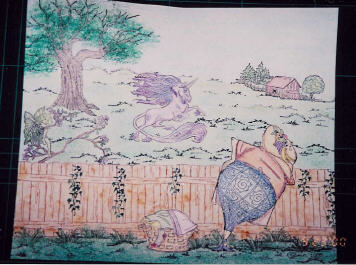 |
| This is a photograph of my first scene. I used stamps that I already had on hand, not purchased specifically for scenic stamping. The large tree, fence, ivy, laundry basket and Fannie are by Art Impressions. I guess I already showed an inclination toward scene stamping, before I really knew what it was! The long grass is by DOTS (now CTMH) and the small grass is by Darcie's. The unicorn is a partial image from the Stamp Pad, the fairy on the branch a partial image of a bookplate by Rubber Stampede. The small barn and trees were a gift from the owner of Lady and the Stamp. Don't forget to look at your stamps to see what partial images may be hiding within. In any event, I simply used what I had on hand, and put together a scene. But if you want to get serious about making scenes, you'll want to consider a few things. |
| 1) What sort of scenes do you want to make? A study of my stamp inventory showed me that I have almost no stamps for indoor scenes. I do have a healthy supply of trees, rocks, mountains, grass and so on. What kind of scenes do you enjoy looking at? That may well be what you'd like to stamp, as well. |
| Taking a Break |
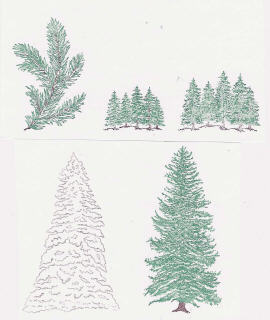 |
| Here, for example, are a few of the stamps I have of pine trees. Notice they run the gamut from a close up of a pine bough (Personal Stamp Exchange) to two sizes of a group of trees (Art Impressions) to a snow covered pine (Joan Wear) and a plain pine tree (PSX again). Why so many of the same thing? you may ask. The larger trees can be used at the bottom of the cardstock, while the smaller trees seem far away and should be placed closer to the top of the cardstock. The pine bough can be stamped around the edges of the cardstock to make it appear as though we are peering through the branches |
| to see. This draws the viewer into the scene, and makes her feel as if she is actually inside the scene. |
| 2) What kind of images do you like? Maybe you'd rather do scenes that are on the "cute" side, as opposed to "realistic." Maybe you prefer surreal scenes! If you prefer one style to another, that simplifies things. If you're like me and love almost everything, you need to decide where you want to begin. Sometimes scene stampers don't stop to think whether the images they have really work together. Take a look at what I mean: |
 |
| A |
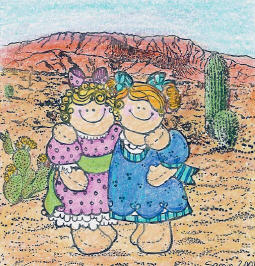
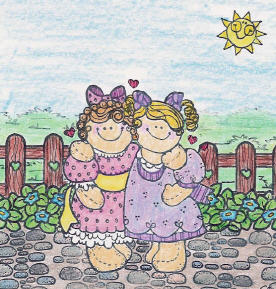
| Say you want to do a scene using these two cuties (a retired stamp by DOTS, now CTMH). First (A) I stuck them in the middle of the desert (all stamps by Beeswax). They look happy enough, but is it really the proper environment for such sweet young things? In the second scene (B), I used stamps (sun by A Country Welcome, all others by Darcie's Country Folk) that have that same cutesy feeling that the stamp of the girls has. I think they look more at home here. Of course, you might want to create a scene that uses the contrast between the cutsey girls and the realistic desert to make a statement. That's fabulous! Just be aware of the way different styles of images work (or don't work) together. |
| B |
| 3) Buy a variety of images. When I first started, I bought alot of larger background images. After awhile I finally noticed that I had a foreground image (usually a person or several people), and a great background image. In between... not much. You will need images of varying sizes to fill the entire scene. Not just alot of different sizes of one thing, though (like trees - oops). You'll also want various sizes of whatever elements you choose to include in your scenes, whether they be people, natural elements, or animals). I still tend to forget to include animals and birds in my scenes, which is a shame. They can add alot of vitality to a scene. If you like to create indoor scenes, you'll want various sizes and styles of furniture, appliances, windows... whatever you want to put into your scene. Don't forget the fairly large sized elements, to go in the foreground. The two best ways I know of to find stamps for your scenes are to surf the on-line catalogs (see the Links page), and to study any scenes you find in the stamping magazines. Make a note of the companies that make the images you like, then look for them at your local stamp store, or on the Internet. One of the best magazines I know of for scenic stampers is Rubberstampmadness. There are many different kinds of images available for creating scenes; from cute/country to fantasy, from indoors to outer space, from forest and jungle to lighthouses and under the sea, from native American to medieval. There are probably alot more styles that I haven't mentioned. You're sure to find something that suits your style. Most of all, have fun shopping and stamping! |
 |