


| Home | News/Activities | Position Papers/Articles | Statements of Support | Photos | Links | Contact us |
Mt. Kanlaon, Its Myths and Wildlife, Painting by Masaste
Is Negros Occidental Facing a Power Crisis?
Based on position papers by Elinore T. Cabanilla
President, VICTORIAS POWER CONSUMERS FOR REFORMS, INC.
( V I P C O R )
For many, EDC's geothermal development in Mt. Kanlaon Natural Park is a price that we must pay to ensure a stable and adequate supply of electricity in the province. But what if there is no looming energy crisis? What if there is already enough power being produced in the region and the problem is not production but transmission? What if there are feasible alternative energy sources? The Save Mt. Kanlaon Coalition's stand is that even with an energy crisis, Mt. Kanlaon is non-negotiable and no part of its area may be compromised. The more pragmatic need to have their doubts addressed, so this article.
I. Pushing the Panic Button via Brown-outs.
While PNOC-EDC's entry into the buffer zone was still pending approval by the Sangguniang Panlalawigan (Provincial Board) of Negros Occidental, for a month the province was beset with daily brown-outs that lasted almost the whole day, or that happened four or five times a day. The brown-outs caused more than mere inconvenience. Equipment and appliances, including one of the new airport's X-ray machines, were damaged or destroyed by the brown-outs and power fluctuations. During the meeting at which the Sanggunian deliberated on the PNOC-EDC issue, the provincial capitol was hit by three brown-outs. After the Provincial Board approved PNOC-EDC's application, the next day and thereafter, the brown-outs have been once a week or not at all. An investigation of the cause for the daily brown-outs revealed that insufficiency of power supply was not the cause for the brown-outs.
The Main Cause of Brown-outs : Preventive Maintenance Shutdowns (PMS) due to:
1) Laying of submarine cables/energization of the CNIUP (Cebu-Negros-Iloilo Uprating Project)
2) Energization of additional 50 MVA transformer at Bay 27 in Amlan; shutdown of the old 30 MVA; transfer of the 50 MVA to the location of the old 30 MVA; installation of gantry at Bus I and II of the 138-kv line; and installation of new beams of Bay 74.
3) Repair of Palinpinon 1 and 2
4) Repair of Dingle diesel plants
These preventive maintenance shutdowns were done at the same time, although they could have been scheduled on different dates. If there was lack of foresight on the part of our power moguls, this lack of foresight is alarming. If those in control of energy production and distribution in Western Visayas deliberately scheduled all of these tasks together, then we must ask if this wasn't done to arm-twist people in Negros into accepting PNOC-EDC's entry into Mt. Kanlaon Natural Park.
II. How reliable are Dept. Of Energy power demand projections?
 But
the geothermal development in Mount Kanlaon is for future needs, you might say.
We might have enough power now but how about in 2010? And we can't think only of
ourselves. What about Panay, part of our region VI.
But
the geothermal development in Mount Kanlaon is for future needs, you might say.
We might have enough power now but how about in 2010? And we can't think only of
ourselves. What about Panay, part of our region VI.
From newspaper accounts and research studies, we can glean some interesting facts:
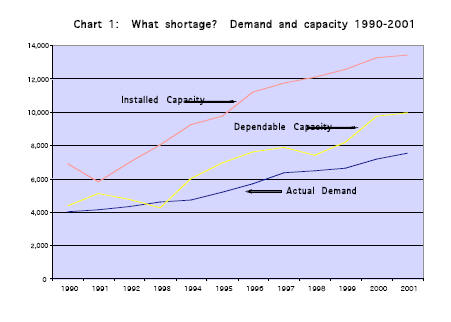
“DOE’s Power Development Plan (PDP) 2005 shows that the Visayas Grid has an installed capacity of 1,721 MW, a dependable capacity of 1,520 MW and a peak demand of 1,063 MW. the grid therefore has an excess dependable capacity of 477 MW or about 43% excess of peak demand. . . .”
According to Melvin Purzuelo of Responsible Ilonggos for Sustainable Energy (RISE), ”the Department of Energy's PDP 2005 lists only indicative capacity additions of 100 MW in 2008 for the Visayas grid. The planned capacity additions for baseload in Cebu Island alone already surpass 100 MW.” (Taken from News Today, August 7-8, 2006)
“The whole Cebu-Negros-Panay (C-N-P) grid has a dependable capacity of up to 931 MW. Peak hour last Monday (July 23) only reached a total of 840 MW, which means there was a power reserve of 91 MW.” (Taken from Cebu Daily News, July 7, 2007)
In a Media Release, dated 02 February 2007, from the Office of then DOE Secretary Raphael Lotilla: “As of 2006, Negros Island has a peak demand of 205 MW with dependable capacity of 180 MW. Its interconnection with Cebu allows Negros Island to satisfy its net deficit of 25 MW.” (It is interesting to note that in its PDP 2005-2014, DOE's forecast of Negros peak demand was 233 MW in 2006.)
Maitet Diokno-Pascual, in her 2005 research paper entitled “Philippine Electricity Demand Projections,” wrote that “according to experts, the country is experiencing a power supply glut due to faulty power demand projections. . . . The current reported capacity is 15,124 MW with an 88.8% dependable capacity of 13,404 MW. The peak demand, however is 8,378 MW, representing only 55.4% of the installed capacity and 62.5% of the dependable capacity.”
The fact that this oversupply of power continues to exist is reflected in the statements of Dr. Benjamin Austria, chairman of the Philippine Chamber of Commerce and Industry (PCCI) energy committee and executive director of the Energy Council of the Philippines. Citing the 2004-2013 PDP, he said, “there is only a dependable capacity of 9,000 MW out of a total installed capacity of 13,000 MW. This means there is a difference of 4,000 MW that are not efficiently utilized.” To reduce power cost, he suggested the need for the country to efficiently utilize the 4,000 MW in installed capacity to increase its available power supply. (Taken from Sun Star – Manila, August 14, 2007.)
III. A Most Viable and Immediate Solution
There are three (3) major grids in the country, Luzon, Visayas and Mindanao. “Grid” refers to the high-voltage backbone system of interconnected transmission lines, substations and related facilities. The ideal set-up, of course, is grid unification so that there will only be a single power grid for the entire country. Once the three grids are interconnected, there will not be much need to construct more power plants as electricity may be transferred from an area of surplus to an area of inadequate supply.
The Cebu-Negros-Panay grid
Eighty percent (80%) of the power in the C-N-P grid (Cebu - Negros - Panay grid) comes from the Tongonan Geothermal Fields in Leyte. With its 722.68 MWe output, the geothermal fields in Leyte rank as the biggest "wet steam producing field" in the world. Beginning 1997, 200 MW of electricity was ferried from Leyte to Cebu, 100 MW going to Negros which then sent about 60 MW to Panay via the Negros-Panay interconnection. In 2005, the Leyte Cebu Interconnection Uprating Project (LCIUP) increased the load of the submarine cable from 200 to 400 MW. This year, 2008, the Cebu-Negros uprating project is scheduled to increase from 100 MW to 200 MW, the power that may be sourced from Leyte via Cebu.
Also scheduled in 2008 is the optimization of Palinpinon 2 with an additional 20 MW. This can mean additional power for CENECO (Central Negros Electric Cooperative). CENECO may also be able source from the 192.5 MW of Palinpinon 1 & 2 (hopefully after the auction on the first quarter of this year) as well as from Nasulo and Dauin (20 MW and 40 MW, respectively) in Negros Oriental, both plants set to be online by 2011 and 2012.
With the increased capacity of the Cebu-Negros interconnection from 100 MW to 200 MW, 200 MW from Leyte can be sent to Negros, which then will share 100 MW with Panay via the Negros-Panay interconnection. Cebu will still be left with the full 200 MW it has been enjoying since 2005 at the time that Negros and Panay were sharing only 100 MW from Leyte.
Leyte-Samar-Luzon Interconnection
Since 1998, the geothermal-rich fields of Tongonan, Leyte have also been connected to the Luzon grid via Samar. Napocor's 12-billion Leyte-Luzon interconnection project is designed to ferry 900 MW of electricity to Luzon but the actual supply stands at only 440 MW.
Leyte-Mindanao Interconnection.
In 1999, Napocor secured a $600 million loan from the Asian Development Bank (ADB) to finance transmission and interconnection projects. $390 million was allotted for the Leyte-Mindanao interconnection project, the last leg of the planned grid unification, in order to reach the ultimate goal of improving overall system reliability. This much-desired project was scheduled to have started operations in 2004. Whatever happened to this dream? Only God and Napocor know! As the project hasn't materialized, what happened to the $390 million obtained to fund the project? Again, only God and Napocor know!
The Problem is Transmission, not Generation
“Average capacity utilization of Transco’s transmission lines, according to an ADB report, is only at 12%.”
IV. Other renewable energy sources.
I cannot think of any other logical, immediate and viable option than the golden opportunity that Transco offers now as a very special blessing. But while we vigorously pursue this endeavor, let us continue to support other renewable energy projects to be tapped for future power needs. For example: wind, solar, hydro may serve as peaking plants. PNOC, with its newest subsidiary, the PNOC-Renewables Corporation can intensify its exploration and development not only of geothermal resources but also of other strategic energy sources, such as hydro, wind, bagasse, ethanol, solar, jathropa and other emerging and indigeneous sources of energy.
I fervently hope that the Honorable Members of our Sangguniang Panlalawigan, with the dynamic leadership of its Energy Committee, will look closely into the beautiful possibilities brought about by the latest Transco uprating of the Cebu-Negros interconnection in order to ensure affordable, secure, reliable and clean supply of energy for Negros Occidental.
In line with this challenging urgent call to Action for the sake of our province, I would also like to suggest that our esteemed Sanggunian sponsors a Resolution appealing to Congress for the immediate passage of the Renewable Energy Bill, which has been pending for several years in both Houses.