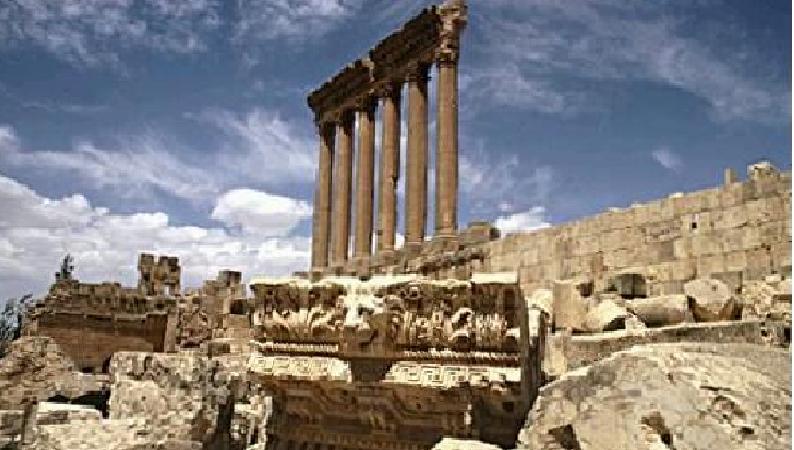
Baalbeck, Lebanon's greatest Roman treasure can be counted among the wonders of the
ancient world.The largest and most
noble Roman temples ever built, they are also among the best preserved.
Towering high above the Beqaa plain, their monumental proportions proclaimed
the power and wealth of Imperial Rome. The gods worshipped here, the Triad of
Jupiter, Venus and Mercury, were grafted onto the indigenous deities of Hadad,
Atargatis and a young male god of fertility. Local influences are also seen in
the planning and layout of the temples, which vary from the classic Roman
design.
Baalbek (ancient Heliopolis), town, eastern Lebanon,
between the L�þ�n� and Asi rivers.
The name, which means "City of Baal,"
is derived from the early association of the town with the worship of Baal,
a local sun deity whom the ancient Greeks identified with their sun god,Helios;
the Greeks and Romans called the town Heliopolis,"CITY OF THE SUN".
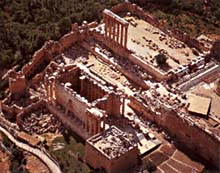
Once a splendid city, it is famous now for the imposing ruins of ancient temples.
The great Temple of the Sun was about 49 by 88 m (about 160 by 290 ft)
and contained 58 Corinthian columns, each 22.9 m (75 ft) high and 2.2 m (7.25 ft)
in diameter. The entablature was 4.3 m (14 ft) in height.
The temple appears to have been built on an artificial mound of earth,
with great stones, or megaliths, employed to sustain this mass.
Of these megaliths, three are in position at the western end,
one of them measuring 19.5 m (64 ft) long by 4.3 m (14 ft) square.
The Temple of Jupiter, also of the Corinthian order,
measured 69.2 m (227 ft) by 35.7 m (117 ft) and was surrounded by a peristyle
of 42 plain columns, with 10 fluted columns in the vestibule.
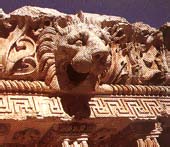
The entablature was very profusely and richly ornamented.
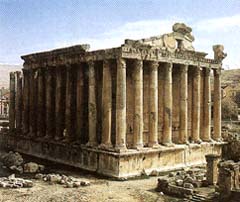
The Temple of Bacchus, in front of the Temple of Jupiter, is better preserved.
A smaller temple, the Temple of Venus, supported by six granite columns,
adjoined the Temple of Jupiter. Traces also remain of a later Christian basilica.
Although the early history of Baalbek is almost entirely unknown,
abundant evidence indicates that the city is ancient,
portions of the masonry being attributed to Phoenician origin.
The Roman emperor Augustus made the city a Roman colony;
the Roman emperor Trajan consulted a celebrated oracle there.
The city was sacked by the Arabs in AD748,
and pillaged by the Turkic chieftain Tamerlane in 1400.
A severe earthquake in 1759 devastated what monuments still remained in the city.
Present-day Baalbek, connected by rail with Beirut and with Damascus and
alab (Aleppo) in Syria, is the chief town in eastern Lebanon.
Population (1981 estimate) 50,000.
"Baalbek," Microsoft� Encarta� Encyclopedia 2000.
� 1993-1999 Microsoft Corporation. All rights reserved.