The following material is an adaptation of mecha from MACROSS M3, an
Dreamcast game sequel to the original Japanese MACROSS TV series (which
became Robotech in the U.S.) Please feel free to use, copy, and distribute it as
you see fit. All I ask is that you give proper credit to the author and do not
claim that it is your own work. Comments and suggestions are welcome.
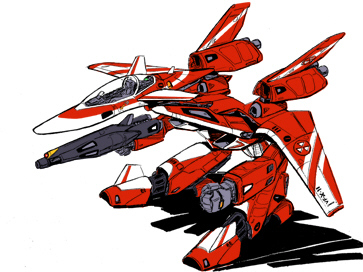
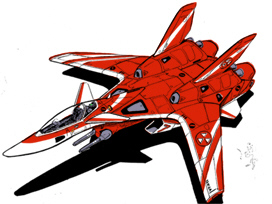
VF-9 CUTLASS
LIGHT VARIABLE FIGHTER
- RPG Stats by PIERRE COURTEMANCHE
- Based upon RPG Stats by DANIEL HENWOOD
- Background info provided by the
SKETCHLEY'S
STATISTICS
BACKGROUND
The VF-9 Cutlass was General Galaxy's first assignment for the UN Armed
Forces. Under their chief project advisor Algus Selzaa, development on the VF-9
Cutlass began in 2018. After three years of development the first flight of the
VF-9 took place in 2021, with mass production beginning in 2023, and ending in
2029. The original concept for the VF-9 was as an inexpensive light variable
fighter, for use on colony worlds with low budgets. However Captain Milia
Jenius of the Dancing Skulls Squadron, and a test pilot¸ was so impressed with
its high manouverability and speed that she recommended it as a Special Forces
Fighter.
The VF-9 was a fighter to be built on the VF-4 Airframe as a
replacement to an aging VF-4 fleet. Project Nova was funded by the UN Spacy in a
search for a high performance carrier based variable fighter. The VF-X-10
incorporated some of the latest technology for it's day. The project was a
complete success and 1,200 were ordered by the Spacy after being redesignated
VF-9. By 2030 only 675 VF-9s had been delivered to 5 Spacy squadrons, and more
were planned to come until all armed services agreed to buy the VF-11
Thunderbolt. The 4 service investment in Thunderbolts had dropped their price to
half that of the VF-9s. The Spacy cancelled plans to buy 525 more fighters, and
instead ordered the VF-11 Thunderbolt.
Lockheed/Martin and Rockwell/Bell (Boeing?), trying to recoup their loss
decided to release a Civilian Variant of the VF-9. The factories were quickly
changed over from VF-9s to VC-9s and 325 limited edition fighters were produced.
These VFs found homes among Airshow Flyers, News Agencies, VF Enthusiasts, Civil
Air Patrol, and Spiritia Warfare Units. The civilian models are unarmed, but
cameras and research equipment can be fitted in the forearms and fuselage if
needed.
The VF-9 Cutlass was only replaced as the UN Armed Forces choice of Special
Forces fighter in the late 2030's by the VF-17 Nightmare. However many VF-9's
can be found in Colony World defence forces, and with private VF collectors. The
VF-9 was a huge success for General Galaxy and has made them a lot of money
which they have wisely plowed into more variable fighter designs, such as the
YF-21/VF-22 Sturmvogel.
RPG STATS
Vehicle Type: VF-9 Cutlass
Class: Light Variable Fighter
Manufacturer: General Galaxy
Crew: One pilot wearing Tactical Life Support System
Variants:
- VF-X-10 Nova: Prototype version produced in 2021. 75 had been
delivered to 5 Navy squadrons. (No shoulder lasers or beam canons)
- VF-9A: First manufactured version from 2023.
- VF-9B: Manifacture upgrade in 2028 to stay competitive with the
upcoming new VF; enhanced navigational electronic equipment and increased
engine thrust.
- VF-9C: Fleet wide upgrade in 2035; Engines redesigned giving
comparable thrust at a reduced fuel consumption rate and introduction of the
internal pallet.
- VF-9D: Two-seater version (mostly used for training and recon
operations.) Based on B and C variants.
- VF-9 Kai: Custom version equiped with modified engines, enhanced
navigational electronic and sensors, AVF-level beam weapon, VF-5000's internal
missiles lunchers, Micronized space fold drive, Pinpoint Barrier and Prototype
micronized active stealth generator. Based on VF-9C variant specifications.
- VF-9F: (Also known at VC-9) Version produced for civilian use
(No shoulder lasers or beam canons)
MDC BY LOCATION:
(1) Head                                    75
    Hands (2)                               50 each
    Arms/Beam Cannons (2)                  100 each
(2) Shoulders/Engine Nacelles (2)          150 each
(2) Legs/Main Thrusters (2)                200 each
(3) Main Body                              275
    Canard Forward Wings (2)                25 each
    Main Wings (2)                         100 each
    Tails (4)                               50 each
    Reinforced Pilot's Cockpit             150
    GU-12 Gun Pod                          100
NOTES:
- Destroying the head of the VF will knock out the mecha's major sensor
systems, including all of the optics systems (infrared, nightvision, thermal).
Radar and communications will be unaffected.
- Destroying the shoulders/engine nacelles or the legs/thrusters will
severely damage the VF-9's engines. Destruction of either shoulder will reduce
maximum speeds by 20%, and destruction of either leg will reduce speeds by
30%. If three of the four engines are destroyed the Lightning will have
insufficient thrust to remain airborne and must land. If all four engines are
destroyed the variable fighter will lose power and crash.
- Destruction of the main body will completely destroy the mecha.
SPEEDS:
- FLYING IN AN ATMOSPHERE:
- Mach 4 (2680 mph/4288 kmph) max speed at 10,000-30,000 meters above sea
level. Mach 19+ max speed at 30,000+ meters above sea level. The Cutlass is
capable of achieving orbit over an Earth-class planet without additional
rocket assistance.
- MAX ENGINE THRUST:
- 45,000 kg x 2
STATISTICAL DATA:
- HEIGHT:
- 49 ft in soldier mode.
- LENGTH:
- 45 ft in fighter mode.
- PHYSICAL STRENGTH:
- Equal to a P.S. of 50
- CARGO:
- Small compartment behind pilot's seat for personal belongings.
- POWER PLANT:
- Two Shinnakasu-Daimler FF-2650 engines. P&W-Daimler HMM-5D
high-manueverability vernier thrusters at key locations along the VF-9's hull
for added mobility.
WEAPON SYSTEMS:
- LARGE-CALIBER HIGH POWERED BEAM CANNONS (2): The VF-9 Cutlass'
main weapons are a pair of high-power beam cannons mounted in the engine
nacelles of the fighter. The cannons can be fired together or individually.
The cannons are fixed forward, In battloid mode the beam cannons are mounted
on the VF's back and are capable of firing forward, although this is not the
best position for them.
- PRIMARY PURPOSE: Assault
- SECONDARY PURPOSE: Anti-Aircraft
- RANGE: 4000 feet (1200 m)
- DAMAGE: 1D8x10+5 M.D. per blast
- RATE OF FIRE: Equal to the pilot's combined number of attacks.
Cannons may be fired separately or linked together (one attack do double
damage).
- PAYLOAD: Effectively Unlimited.
- ANTI-AIRCRAFT LASERS (2): Similar to the earlier VF-1J,the VF-9
sports twin anti-aircraft lasers for close in defence. In battloid mode
however the lasers re stored on the right shoulder like the VF-3000 Crusader.
The lasers power is weak compared to its other weapons and they are normally
used as a last choice weapon or for anti-missile work.
- PRIMARY PURPOSE: Anti-aircraft
- SECONDARY PURPOSE: Anti-missile/defensive
- RANGE: 4000 feet (1200 m)
- DAMAGE: 1D6 M.D. per laser.
- RATE OF FIRE: The laser can be fired as a continuous beam, or in
rapid pulses up to 4 blasts per round. A rapid fire blast counts as a burst
of up to 4 shots.
- PAYLOAD: Effectively Unlimited.
- MAUSER PBC-13F PARTICLE BEAM GUNPOD : For additional close-range
combat capability, the VF-9C carries a new type of hand helded weapon; Unlike
the old GU-11 Gunpod, the PBC-13F fire particule beam instead of bullets. The
weapon is able to fire 15 MJ bursts up to 30 times per minute at a range of 5
kilometers utilises clips of ammunition rather than pre-loaded ammo. The
VF-9A where originally assigned the GU-12, a gunpod based on the GU-11 but
instead utilises clips of ammunition rather than pre-loaded ammo. This gives
it a lower ammo count that the older GU-11 but as the Cutlass is capable of
carrying spare clips, the VF-9's GU-12 Gunpod essentially gives more
ammunition. One spare GU-12 clip is stored in each leg of the VF-9. Since the
new PBC-13F don't use ammo clip, this space have been used to add internal
pallet.
- PRIMARY PURPOSE: Assault
- SECONDARY PURPOSE: Anti-Mecha
- RANGE: 5,000 m
- DAMAGE: 1D6x10 MD for each shot
- RATE OF FIRE: 7 times per melee
- PAYLOAD: Unlimited
- BODY/WING HARD POINTS: The VF-9 is equipped with eight fixed hard
points for missile loads and other ordinance. Two hard points are mounted on
each wing of the aircraft and four are mounted under the main body.
These hardpoints can be used to hold a variety of different
ordinance types, including long or medium range missiles,
bombs or UUM-7 micro-missiles pods. One long range, 3 medium range or 1 UUM-7 missiles
pods can be mounted per hardpoint. Usually long
range missiles are used.
NOTE:
Due to the location of the hard points, ALL missiles must be fired or ejected
before the VF-9 may convert into soldier mode. For this reason the hard point
missiles are usually fired within the first few passes of an attack. Note
that the ventral hard points of VF-9 must also be free before to convert
into Gerwalk mode.
- LONG RANGE MISSILES
- Primary Purpose: Heavy Assault
- Secondary Purpose: Anti-Spacecraft
- Missile Types:
Any type of standard UN Spacy
Long Range Missile can be used.
- Range:
Varies with missile type.
- Damage:
Varies with missile type.
- Rate of Fire:
One or two.
- Payload:
One per hardpoint; 8 maximum.
- MEDIUM RANGE MISSILES
- Primary Purpose: Assault
- Secondary Purpose: Anti-Mecha
- Missile Types:
Any type of standard UN Spacy
Medium Range Missile can be used.
- Range:
Varies with missile type.
- Damage:
Varies with missile type.
- Rate of Fire:
1-3 missiles per hardpoint.
- Payload:
Three per hardpoint; up to 24 maximum.
- UUM-7 MICRO-MISSILES PODS
- Primary Purpose: Assault
- Secondary Purpose: Anti-Mecha
- Missile Types:
Any type of standard UN Spacy
Micro-Missile
can be used.
- Range:
Varies with missile type.
- Damage:
Varies with missile type.
- Rate of Fire:
1-5 missiles per pod.
- Payload:
One pod per hardpoint, up to four pods, 15 missiles
per pod; up to 60 missiles
maximum.
- STANDARD INTERNAL CUSTOMIZABLE PALLETS (2): Each engine nacelle (leg)
of the VF-9 Cutlass contains an concealed and enclosed Standard Internal
Pallet, which can be customized for different mission objectives and carry a
variety of different loads. When activated the internal pallets open and
slightly extends from the engine nacelle (leg,) allowing all of the pallet's
payload (usually missiles) to be activated at once, if necessary. The leg
pallets can be used in all modes. The standard UN Armed Forces load for the
internal pallets is the
B-7 STANDARD INTERNAL PALLET, with its load of micro-missiles. However, if
the mission calls for it, any of the various types available in the
Modular VF Pallet System can be used, such as ECM and PPB generating
equipment. .
The internal pallets were introduced to the VF-9 Cutlass with the C upgrade
starting in 2035. Currently the internal pallets are standard to only C and D
models.
- PRIMARY PURPOSE: Assault
- SECONDARY PURPOSE: Defence / ECM warfare
- NUMBER OF PALLETS: one (1) per engine nacelle (leg,) for a
maximum of two (2.)
- LOADOUT: any of the pallet types from the
MODULAR VF PALLET SYSTEM can be loaded. Usually B-7 Standart internal
pallet.
- MISSILE TYPES: Any type of standard UN Spacy
Micro-Missile, Usually BMM-24 High-maneuvrability Micro-missiles.
- RANGE: 1 mile (1.6 km).
- DAMAGE: 1D8x10 M.D.
- RATE OF FIRE: Volleys of 1-9 missiles per launcher, per round.
One volley counts as one attack. If necessary, all 18 missiles can be fired
in a single round by expending two attacks.
- BONUSES: +3 to strike, +1 to dodge.
- PAYLOAD: 9 missiles per launcher; 18 total.
- LIMITATIONS: ECM, PPB and Space Fold generating pallet types are
usually reserved for VFs reserved for Special Forces and/or AWACS duties.
- COUNTERMEASURE DISPENSERS:
Every
VF has combined chaff, flare and squib dispensers mounted on them that are
useable in all modes. When used, it fires a burst of 6 flares, 1 exploding
chaff container or one parachute squib per 1 unit listed in the stats. Chaff,
flares and squibs are each unique in their means of countering attacking
missiles. The following will describe the individual details of each of the
the three types of countermeasures. The short and easy benefit is that they
add a +3 to dodge the missiles.
- PRIMARY PURPOSE: Assault
- SECONDARY PURPOSE:
Distraction (especially true for the ECM squibs.)
- RANGE:
GM's arbitration. Squibs effect a 1 Km³ spherical area.
- BONUSES:
+3 to dodge. Roll to dodge after rolling on the following per missile:
01-40
Missile distracted - explodes harmlessly in the countermeasures.
41-80 Missile distracted -
it loses track of its target. Depending on the missile type and its
remaining fuel, it could reacquire you, or another target in the area
81-00 No effect.
Note: +5% to the above chart per every
additional countermeasure deployed after the first. For example: 3
countermeasures changes the table to 01-50, 51-90, and 91-00.
- RATE OF FIRE:
unlimited. (Author's recommendation: maximum of 4 per attack to better
reflect their fallibility.)
- PAYLOAD:
8 bursts of flares, 8 chaff pods and 4 parachute squibs per dispenser.
- HAND TO HAND COMBAT: If necessary, the pilot of the VF-9 can engage
in melee combat rather than use a weapon. The Cutlass is incredibly agile and
can execute most typical hand to hand combat moves, such as punches, jump
kicks, leap attacks, rolling with impacts, etc.
DAMAGE:
- Restrained Punch: 1D4 M.D.
- Full Strength Punch: 3D6 M.D.
- "Booster" Punch: 1D4x10 M.D. (counts as two attacks)
- Tear or Pry with Hands: 1D6 M.D.
- Kick: 3D6 M.D.
- Leap Kick: 2D6x10 M.D.
- Body Flip/Throw: 2D6 M.D.
- Body Block/Tackle: 2D6 M.D.
- Stomp: 1D6x10 M.D. (only effective against small objects)

STANDARD EQUIPMENT FOR THE VF-9:
- AUTO-PILOT: The VF-9 is equipped with a computerized auto-pilot,
allowing the pilot to relax or even sleep during long voyages. The auto- pilot
can be programmed with a single destination or a complex flight plan involving
multiple speeds, directions, and destinations. The onboard computer will alert
the pilot when the fighter is near its destination, and can also be set to
automatically signal when sensors detect objects near the mecha. The
auto-pilot was designed with long intra-system space journeys in mind.
- COMBAT COMPUTER W/HUD DISPLAYS: The VF-9 is equipped with a combat
computer that can store and analyze data during combat with hostile forces.
Data readouts and stats can be displayed either on the cockpit's HUD display
or on the dashboard monitors of the aircraft. The combat computer tracks and
identifies specific enemy targets, and has a database of over 10,000 images
stored in memory. The computer can identify and track up to 150 targets
simultaneously.
- EXTERNAL AUDIO PICKUP: Range: 300 ft (91.5 m). A sound
amplification system that can pick up normal conversation up to 300 feet away.
- HEAT AND RADIATION SHIELDS: Special shielding prevents the
penetration of life threatening heat and radiation. A radiation detection and
alarm system are linked with the shields and will sound an alarm if there is a
rupture in the shields and what the levels of radiation are.
- HOMING SIGNAL: The VF-9 is equipped with a homing device that
enables rescue teams to locate a disabled craft or ejected life pod. The range
of the signal is 300 miles (480 km). Most UN Spacy ships and variable fighters
can locate and track homing signals, and the onboard computers will
automatically notify their pilots if such a signal is detected.
- ESCAPE POD: The entire reinforced cockpit of the VF-9 is a
detachable escape pod that can be jettisoned when the mecha is destroyed. The
ejected cockpit does not contain thrusters, but does contain a powerful
locator beacon and an integrated life support system that can support the
pilot for up to 24 hours after ejection. The pod is also equipped with
parachutes in case of ejection in an atmosphere. The combat computer is
programmed to automatically eject the escape pod if the mecha is destroyed
(main body MDC reduced to 0), but this can be overridden if the pilot is
feeling suicidal for some reason.
- LASER TARGETING SYSTEM: Range: 100 miles (160 km). Used for
increased accuracy in the striking of enemy targets and is partly responsible
for the mecha's strike bonus.
- LOUDSPEAKER: A loudspeaker system is built into the craft, which
can be used to amplify the pilot's voice up to 90 decibels.
- OPTICS: INFRARED: Range: 2000 feet (610 m). This optical system
projects a beam of infrared light that is invisible to the normal eye, but
detectable by the mecha's sensors. The system allows the pilot to detect
hidden/concealed objects by their IR reflectiveness. The beam will be visible
to anyone with IR sensitive optics, however.
- OPTICS: NIGHTVISION: Range: 2000 feet (610 m). A passive light
image intensifier that emits no light of its own, but relies on ambient light
which is electronically amplified to produce a visible picture.
- OPTICS: THERMAL IMAGER: Range: 2000 feet (610 m). A passive optical
heat sensor that detects infrared radiation projected by warm objects and
converts that data into a false-color visible image. The system enables the
pilot to see in the dark, in shadows, and through smoke, and also adds a +10%
bonus to pilots using a tracking skill.
- RADAR: 200 mile (321 km) range.
- RADIO/VIDEO COMMUNICATION: Long range, directional communications
system with satellite relay capabilities. Range: 600 miles (960 km) or can be
boosted indefinitely via satellite relay.
- SELF-DESTRUCT: To prevent capture of a variable fighter by the
enemy, the pilot can activate the VF-9's self-destruct system, which will
cause the fighter to explode after a delay of up to 60 minutes (time is set by
the pilot). The explosive damage is contained within a 20 foot (6 m) area and
inflicts 1D6x10 M.D. to everything within the radius of the explosion. All
internal systems are obliterated.
- STANDARD SURVIVAL KIT: All UN Spacy VFs come equipped with a
portable survival kit. Inside the small reinforced box is a medium-sized
flashlight, two hand flares, one rocket flare, a compass, infrared distancing
binoculars, a small mirror, a pocket knife, dehydrated and concentrated food (can
be stretched into a five day supply for one person) and basic first aid items
(aspirin, bandages, disinfectants, etc.)
- TACTICAL LIFE SUPPORT SYSTEM: The VF-9's cockpit is pressurized,
and also provides additional air feeds to the pilot's flight suit that
provides him with pressurized breathing. The UN Spacy flight suit also
contains an upper and lower g-suit that promotes blood circulation even during
high-g turns, thus decreasing the possibility of pilot blacking out in combat.
COMBAT BONUSES FOR VF-9 CUTLASS VARIABLE FIGHTER TRAINING:
BASIC VARIABLE FIGHTER COMBAT TRAINING
- Basic training for non-pilot military personnel.
- 1 attack per melee (plus those of the pilot).
- Add one additional action/attack at levels three, nine, and fifteen.
- +1 to strike.
- +1 to parry
- +1 to dodge in soldier mode, +3 in gerwalk, +5 in jet mode.
- +1 to roll with a punch or move with an impact, reducing damage by half.
- Tilt Dodge Modifier (applied to the regular dodge bonus for the mode the
VF is in): -5
- No leap dodge.
- No leap kick.
- Critical strike same as pilot's hand-to-hand.
- Body block/tackle/ram - 2D4 M.D. plus a 50% chance of knocking an opponent
down, causing him to loose initiative and one attack that melee round.
ADVANCED CUTLASS COMBAT TRAINING
- Advanced training for military pilots and mecha specialists.
- 4 attacks per melee (plus those of the pilot).
- Add one additional action/attack at levels three, six, eleven, and fifteen.
- +1 on initiative.
- +3 to strike.
- +3 to parry
- +3 to dodge in solder mode, +5 in gerwalk, +7 in jet mode.
- +3 to roll with a punch or move with an impact, reducing damage by half.
- Critical strike same as pilot's hand-to-hand.
- Body block/tackle/ram - 2D4 M.D. plus a 50% chance of knocking an opponent
down, causing him to loose initiative and one attack that melee round.
REFERENCES USED IN THIS DESIGN